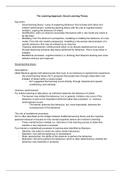
The Learning Approach: Social Learning Theory
Key terms
- Social learning theory: a way of explaining behaviour that includes both direct and
indirect reinforcement, combining learning theory with the role of cognitive factors
- Imitation: copying the behaviour of others
- Identification: when an observer associates themselves with a role model and wants to
be like them
- Modelling: from the observer’s perspective, modelling is imitating the behaviour of a role
model. From the role model’s perspective, modelling is the precise demonstration of a
specific behaviour that may be imitated by an observer
- Vicarious reinforcement: reinforcement which is not directly experienced but occurs
through observing someone else being reinforced for behaviour. This is a key factor in
imitation
- Mediational processes: cognitive factors (i.e. thinking) that influence learning and come
between stimulus and response
Social learning theory
Assumptions
Albert Bandura agreed with behaviourists that much of our behaviour is learned from experience
- His social learning theory (SLT) proposed that people learn through observation and
imitation of others within a social context
- SLT suggested that learning occurs directly, through classical and operant
conditioning, and indirectly
Vicarious reinforcement
For indirect learning to take place, an individual observes the behaviour of others
- The learner may imitate the behaviour, but, in general, imitation only occurs if the
behaviour is seen to be rewarded (reinforced rather than punished, i.e. vicarious
reinforcement occurs
- The learner observes the behaviour, but, more importantly, observes the
consequences of the behaviour
The role of mediational processes
SLT is often described as the ‘bridge’ between traditional learning theory and the cognitive
approach because it focuses on how mental (cognitive) factors are involved in learning
- These mental factors mediate (i.e. intervene) in the learning process to determine
whether a new response is acquired
Four mental or mediational processes in learning were identified by Bandura:
- Attention: the extent to which we notice certain behaviours
- Retention: how well the behaviour is remembered
- Motor reproduction: the ability of the observer to perform the behaviour
- Motivation: the will to perform the behaviour, which is often determined by whether the
behaviour was rewarded or punished
Key terms
- Social learning theory: a way of explaining behaviour that includes both direct and
indirect reinforcement, combining learning theory with the role of cognitive factors
- Imitation: copying the behaviour of others
- Identification: when an observer associates themselves with a role model and wants to
be like them
- Modelling: from the observer’s perspective, modelling is imitating the behaviour of a role
model. From the role model’s perspective, modelling is the precise demonstration of a
specific behaviour that may be imitated by an observer
- Vicarious reinforcement: reinforcement which is not directly experienced but occurs
through observing someone else being reinforced for behaviour. This is a key factor in
imitation
- Mediational processes: cognitive factors (i.e. thinking) that influence learning and come
between stimulus and response
Social learning theory
Assumptions
Albert Bandura agreed with behaviourists that much of our behaviour is learned from experience
- His social learning theory (SLT) proposed that people learn through observation and
imitation of others within a social context
- SLT suggested that learning occurs directly, through classical and operant
conditioning, and indirectly
Vicarious reinforcement
For indirect learning to take place, an individual observes the behaviour of others
- The learner may imitate the behaviour, but, in general, imitation only occurs if the
behaviour is seen to be rewarded (reinforced rather than punished, i.e. vicarious
reinforcement occurs
- The learner observes the behaviour, but, more importantly, observes the
consequences of the behaviour
The role of mediational processes
SLT is often described as the ‘bridge’ between traditional learning theory and the cognitive
approach because it focuses on how mental (cognitive) factors are involved in learning
- These mental factors mediate (i.e. intervene) in the learning process to determine
whether a new response is acquired
Four mental or mediational processes in learning were identified by Bandura:
- Attention: the extent to which we notice certain behaviours
- Retention: how well the behaviour is remembered
- Motor reproduction: the ability of the observer to perform the behaviour
- Motivation: the will to perform the behaviour, which is often determined by whether the
behaviour was rewarded or punished