AP Computer Science Principles EXAM Questions & Answers
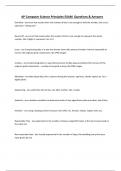
AP Computer Science Principles EXAM Questions & Answers Overflow - ans-error that results when the number of bits is not enough to hold the number, like a car's odometer "rolling over" Round-off - ans-error that results when the number of bits is not enough to represent the actual number, like 3 digits to represent π as 3.14 Lossy - ans-Compressing data in a way that throws some data away and makes it almost impossible to recover the original, great compression, like JPEG images Lossless - ans-Compressing data in a way that preserves all data away and allows full recovery of the original, good compression -- usually not as good as lossy, like PNG images Metadata - ans-data about data, like a camera storing the location, aperture, shutter speed, etc. for a digital photo Sequencing - ans-code flows line by line, one after another, like a recipe Selection - ans-a boolean condition to determine which of two algorithmic paths are taken, aka if-then Iteration - ans-using a looping control structure, like while, for, foreach, repeat, repeat-until, etc. Reasonable Time - ans-polynomial in the number of steps an algorithm takes in the worst case based on the input size Not reasonable time - ans-Usually exponential in the number of steps, like doubling every time your input grows by one Heuristic - ans-using a "rule" to guide an algorithm, like always walking toward the north star if you were stuck in a forest Undecidable - ans-A problem that is so difficult, we can't ever create an algorithm that would be able to answer yes or no for all inputs, like determining if a user's program run on some input would always stop and not run forever Linear Search - ans-Going one by one vs starting in the middle and going left/right like looking for a word in the dictionary Binary Search - ans-requires the list to be sorted in order and then cutting the list in half APIs - ans-Application Programming Interface Citizen Science - ans-Lots of people to help with a scientific project, like asking everyone around the world to count the butterflies they see one day Cloud Computing - ans-Using distributed calculations and/or storage for big data or a web application Crowdsourcing - ans-Asking lots of users online to help with something, like funding a project, or running SETI@Home to help look for extraterrestrial signals Creative Commons - ans-An alternative to copyright that allows people to declare how they want their artistic creations to be shared, remixed, used in noncommercial contexts, and how the policy should propagate with remixed versions Open Access - ans-A policy that allows people to have read access to things, e.g., libraries or online data Moore's Law - ans-The # of transistors on a chip doubles every two years Peer-to-peer Networks - ans-A system where one user's computer connects through the Internet to another user's computer without going through an intermediary "centralized" computer to manage the connection Digital Divide - ans-The idea that some communities / populations have less access to computing than others ISP - ans-Internet Service Provider How does internet communication arrive at its destination? - ans-Speech on the Internet goes from the source to an ISP, into the cloud, out of the cloud to another ISP, and to its destination How can the government control speech on the Internet? - ans-1) It can try to control the speaker or the speaker's ISP, by criminalizing certain kinds of speech. But that won't work if the speaker isn't in the same country as the listener. 2)It can try to control the listener, by prohibiting possession of certain kinds of materials. In the U.S., possession of copyrighted software without an appropriate license is illegal, as is possession of other copyrighted material with the intent to profit from redistributing it. 3) The government can try to control the intermediaries. How can Internet posters evaded being convicted for defamation/slander on the Web? - ans-The posters could evade responsibility as long as they remained anonymous, as they easily could on the Internet. What has Congress given ISPs relating to an Internet Defamation case? - ans-Congress had given the ISPs a complete waiver of responsibility for the consequences of false and damag- ing statements, even when the ISP knew they were false. Internet Protocol Hourglass - ans-Each protocol interfaces only to those in the layers immediately above and below it, and all data is turned into IP bit packets in order to pass from an application to one of the physical media that make up the network. -Email, Web, Phone -SMTP, HTTP -TCP, UDP -IP -Wire, Fiber, Radio TCP - ans-Transmission Control Protocol Guarantees reliable transmission by breaking messages into packets, keeping track of which packets have been received successfully, resending any that have been lost, and specifying the order for reassembling the data on the other end. UDP - ans-User Datagram Protocol provides timely but unreliable message delivery HTTP - ans-HyperText Transport Protocol which is used for sending and receiving web pages SMTP - ans-Simple Mail Transport Protocol used for sending email. What does "End to End" mean in regards to the Internet? - ans-"End to End," in the Internet, means that the switches making up the core of the network should be dumb—optimized to carry out their single limited function of passing packets. RFC - ans-Request for Comment Standards adopted through a remarkable process of consensus- building, nonhierarchical in the extreme. Someone posts a proposal, and a cycle of comment and revision, of buy-in and objection, eventually converges on something useful, if not universally regarded as perfect. Shortcut for going from binary to hexadecimal - ans-To translate a binary numeral (like ) to hexadecimal, start by splitting it into groups of four bits, from right-to-left (like this: ). Then determine the value of each group and write the corresponding hex digit. Internet - ans-A network of independent but connected devices all over the world. World Wide Web - ans-The collection of interlinked website documents (such as HTML files) that you can view with a web browser by typing addresses like HTML - ans-Hypertext markup language Most web pages are written with ________ URL - ans-Uniform Resource Locator An address for accessing specific web data located on a server Server - ans-A computer hosting data for others to access Protocol - ans-the standard for communication between browsers and servers (usually "http" or "https") Sometimes not visible in browsers like Google Chrome Domain Name - ans-The name of the server that hosts the data () Path - ans-the location of the data in a hierarchy of folders on the server CONTINUES...
Written for
- Institution
- AP Computer Science
- Course
- AP Computer Science
Document information
- Uploaded on
- November 16, 2023
- Number of pages
- 19
- Written in
- 2023/2024
- Type
- Exam (elaborations)
- Contains
- Questions & answers
Subjects
- ap computer science
- questions answers
-
ap computer science principles exam

Also available in package deal