100% satisfaction guarantee Immediately available after payment Both online and in PDF No strings attached 4.2 TrustPilot
logo-home
Exam (elaborations)

Engineering Circuit Analysis 9th Edition

Rating
-
Sold
-
Pages
68
Grade
A+
Uploaded on
14-11-2023
Written in
2023/2024

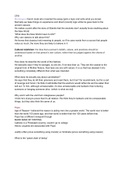
1. Convert the following to engineering notation: (a) 0.045 W  45103 W = 45 mW (b) 2000 pJ  2000 1012  2 109 J = 2 nJ (c) 0.1 ns  0.1109  100 1012 s = 100 ps (d) 39,212 as = 3.9212×104×10-18 = 39.212×10⁻¹⁵ s = (f) 18,000 m  18 103m= 18 km (g) 2,500,000,000,000 bits  2.51012 bits = 2.5 terabits 1015 atoms  102 cm  3 (h)    1021 atoms/m3 (it’s unclear what a “zeta atom” is)  cm3  1 m  39.212 fs 2. Convert the following to engineering notation: (a) 1230 fs  1.23103 1015  1.231012 s = 1.23 ps (b) 0.0001 decimeter 1104 101 10106 m (c) 1400 mK  1.4 103 103  1.4 K = 10 m (d) 32 nm  32 109 m = (e) 13,560 kHz  1.356 104 103  13.56 106 Hz = (f) 2021 micromoles  2.021103 106  2.021103moles = (g) 13 deciliters  13101  1.3 liters (h) 1 hectometer 100 meters 2.021 millimoles 13.56 MHz 32 nm 3. Express the following in engineering units: (a) 1212 mV = 1.121 V (b) 1011 pA = 1011×10-12= 100 mA (c) 1000 yoctoseconds 1103 1024 11021 seconds = 1 zs (e) 13,100 attoseconds 1.311015 s = 1.31 fs (f) 10−14 zettasecond=10-14×1021=107=10×106 s = 10 Ms (g) 10−5 second 10106 seconds = (h) 10−9 Gs109 109 1 second (d) 33.9997 zeptoseconds 10 s 4. Expand the following distances in simple meters: (a) 1 Zm  11021 m (b) 1 Em  11018 m (c) 1 Pm  11015 m (d) 1 Tm  11012 m (e) 1 Gm  1109 m (f) 1 Mm  1106 m (c) 0 K 5. Convert the following to SI units, taking care to employ proper engineering notation: (a) 212F  212  32 5  273.15  373.15 K 9 (b) 0F  0 32 5  273.15  255.37 K 9 (d) 200 hp  200 745.7 W 1 hp  1.4914 105 W  149.14 103 W = 149.14 kW (e) 1 yard  0.9144 m 914.4 mm (f) 1 mile  1 1760 yards 0.9144 m  1,609.3 m  1.6093 km 1 mile 1 yard (a) 373.15 K (c) 4.2 K 6. Convert the following to SI units, taking care to employ proper engineering notation: (b) 273.15 K (already in SI) (d) 150 hp  150 745.7 W 1 hp  1.11855 105 W  111.855 103 W = 111.855 kW (e) 500 Btu  5001055 J  5.275 105 J  527.5 103 J  527.5 kJ 1 Btu (f) 100 J/s  100 W 7. It takes you approximately 2 hours to finish your homework on thermodynamics. Since it feels like it took forever, how many galactic years does this correspond to? (1 galactic year = 250 million years) 2 hours  1 day 24 hours  1 year 365 days  galactic years 250 106 years  913.24 1015 galactic years (or, 913.24 femto-galactic-years!)   8. A certain krypton fluoride laser generates 15 ns long pulses, each of which contains 550 mJ of energy. (a) Calculate the power using the pulse energy over the 15 ns duration. p  w  t 550 mJ  15 ns 550 103 J 7 15109 s 3.6667 10 W  36.667 MW (b) If up to 100 pulses can be generated per second, calculate the maximum average power output of the laser. In this case, look at the total energy of 100 pulses over the one second duration. p  w  100 pulses 550 mJ  55 W t 1 s 9. Your recommended daily food intake is 2,500 food calories (kcal). If all of this energy is efficiently processed, what would your average power output be? 2500 103 cal  4.187 J  10.4675 106 J cal p  w  t 10.4675 106 J 24 h / day60 min / h60 s / min  121.15 W 10. An electric vehicle is driven by a single motor rated at 40 hp. If the motor is run continuously for 3 h at maximum output, calculate the electrical energy consumed. Express your answer in SI units using engineering notation. w  pt   40 hp 745.7 W  3 h 3600 s  3.2214 108 J  322.14 106 J   1 hp     1 h   = 322.14 MJ 11. Under insolation conditions of 500 W/m2 (direct sunlight), and 10% solar cell efficiency (defined as the ratio of electrical output power to incident solar power), calculate the area required for a photovoltaic (solar cell) array capable of running the vehicle in Exercise 10 at half power. p  20 hp  20 hp  745.7 W 1 hp  14.914 103 W p  14.914 103 W   500 W  area10% efficiency   m 2  area  14.914 103 W 5000.1  298.28 m 2 m 2 12. A certain metal oxide nanowire piezoelectricity generator is capable of producing 100 pW of usable electricity from the type of motion obtained from a person jogging at a moderate pace. (a) 1 W 100 1012 W / nanowire (b) 1010 nanowires 5 nanowires/ m 2  2 109  2 1 m 2 106  m 2 This area would fit in a square that is approximately 4.5 cm x 4.5 cm, so very reasonable!  1010 nanowires  2 103m 2 13. Assuming a global population of 9 billion people, each using approximately 100 W of power continuously throughout the day, calculate the total land area that would have to be set aside for photovoltaic power generation, assuming 800 W/m2 of incident solar power and a conversion efficiency (sunlight to electricity) of 10%. Power needed  Power density from Sun AreaConversion Efficiency 100 W 9109 people Area  800 W / m 2 0.10 About the size of the state of Connecticut.  1.1251010 m 2  11,250 km2 14. The total charge flowing out of one end of a small copper wire and into an unknown device is determined to follow the relationship q(t) = 5e−t/2 C, where t is expressed in seconds. Calculate the current flowing into the device, taking note of the sign. dq d   t   t i    5e 2   2.5e 2 A dt dt   Note that the charge on the device starts positive, and then decreases. This means that current is flowing out of the device. The current flowing into the devices is therefore negative. 15. The current flowing into the collector lead of a certain bipolar junction transistor (BJT) is measured to be 1 nA. If no charge was transferred in or out of the collector lead prior to t = 0, and the current flows for 1 min, calculate the total charge which crosses into the collector. q   idt  109 A60 s  60 109 C  60 nC

Show more Read less
Institution
Course


Whoops! We can’t load your doc right now. Try again or contact support.

Written for

Institution
Study
Unknown
Course
Unknown

Document information

Uploaded on
November 14, 2023
Number of pages
68
Written in
2023/2024
Type
Exam (elaborations)
Contains
Questions & answers

Subjects

Content preview

Engineering Circuit Analysis 9th Edition Hayt
SOLUTION MANUAL

,1. Convert the following to engineering notation:

(a) 0.045 W  45 103 W = 45 mW

(b) 2000 pJ  2000 1012  2 109 J = 2 nJ

(c) 0.1 ns  0.1109  100 1012 s = 100 ps

(d) 39,212 as = 3.9212×104×10-18 = 39.212×10⁻¹⁵ s = 39.212 fs

(e) 3 Ω

(f) 18,000 m  18 103m= 18 km

(g) 2,500,000,000,000 bits  2.5 1012 bits = 2.5 terabits
3
 1015 atoms  102 cm 
(h)     1021 atoms/m3 (it’s unclear what a “zeta atom” is)
 1 m 
3
 cm

,
2. Convert the following to engineering notation:

(a) 1230 fs  1.23103 1015  1.231012 s = 1.23 ps

(b) 0.0001 decimeter  1104 101  10 106 m = 10 m

(c) 1400 mK  1.4 103 103  1.4 K

(d) 32 nm  32 109 m = 32 nm

(e) 13,560 kHz  1.356 104 103  13.56 106 Hz = 13.56 MHz

(f) 2021 micromoles  2.021103 106  2.021103moles = 2.021 millimoles

(g) 13 deciliters  13101  1.3 liters

(h) 1 hectometer  100 meters

, 3. Express the following in engineering units:

(a) 1212 mV = 1.121 V

(b) 1011 pA = 1011×10-12= 100 mA

(c) 1000 yoctoseconds  1103 1024  11021 seconds = 1 zs

(d) 33.9997 zeptoseconds

(e) 13,100 attoseconds 1.311015 s = 1.31 fs

(f) 10−14 zettasecond=10-14×1021=107=10×106 s = 10 Ms

(g) 10−5 second  10 106 seconds = 10 s

(h) 10−9 Gs  109 109  1 second
$8.49
Get access to the full document:

100% satisfaction guarantee
Immediately available after payment
Both online and in PDF
No strings attached

Get to know the seller
Seller avatar
akira11114684

Get to know the seller

Seller avatar
akira11114684 Bournemouth University (London)
Follow You need to be logged in order to follow users or courses
Sold
2
Member since
2 year
Number of followers
0
Documents
79
Last sold
8 months ago

0.0

0 reviews

5
0
4
0
3
0
2
0
1
0

Recently viewed by you

Why students choose Stuvia

Created by fellow students, verified by reviews

Quality you can trust: written by students who passed their tests and reviewed by others who've used these notes.

Didn't get what you expected? Choose another document

No worries! You can instantly pick a different document that better fits what you're looking for.

Pay as you like, start learning right away

No subscription, no commitments. Pay the way you're used to via credit card and download your PDF document instantly.

Student with book image

“Bought, downloaded, and aced it. It really can be that simple.”

Alisha Student

Frequently asked questions