9. Jury Trial Procedure
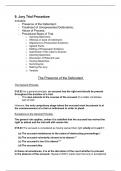
Includes:
- Presence of the Defendant;
- Treatment of Unrepresented Defendants;
- Abuse of Process;
- Procedural Steps of Trial.
o Opening Speeches;
o Witness on back of Indictment;
o Objections to Prosecution Evidence;
o Agreed Facts;
o Editing of Prosecution Evidence
o Submission of No Case to Answer;
o Opening Speeches;
o Discussion of Relevant Law;
o Closing Speeches;
o Summing-Up
o Retiring the Jury;
o Verdicts
The Presence of the Defendant
The General Principle
D15.82 As a general principle, an accused has the right and should be present
throughout the duration of a trial.
- This also extends to the counsel of the accused (if a matter constitutes
part of trial).
However, the only compulsory stage where the accused must be present is at
the commencement of a trial on indictment in order to plead.
Exceptions to the General Principle
The general rule applies, unless it is satisfied that the accused has waived the
right to attend and the trial will still remain fair.
D15.83 The accused is considered as having waived their right wholly or in part if:
(a) The accused misbehaves to the extent of obstructing proceedings;*
(b) The accused voluntarily choose to be absent;**
(c) The accused is too ill to attend;***
(d) The accused dies.
In these circumstances, it is at the discretion of the court whether to proceed
in the absence of the accused. Hayward (2001) made clear that only in exceptional
, cases should it be exercised and the court should make fairness to defence their
primary objective, although fairness to the prosecution is still taken into account.
The judge must also have regard to all circumstances including:
(a) The nature and circumstances of the accused’s behaviour in being
absent or disruptive, and whether this was deliberate;
(b) Whether adjournment might result in the accused being caught or
attending voluntarily;
(c) The likely length of such an adjournment and its impact (such as witness
memory);
(d) Whether the absent accused has a representative who could represent
them and the extent to which this representative could defend in their
absence;
(e) The extent of the disadvantage caused by the accused not being able to
give their account of events and the likelihood this could cause an
improper conclusion;
(f) The general public interest in the case;
(g) That a trial should take place within a reasonable time;
(h) In the case of joint trial, the effect separate trials may have on non-
absconding defendants.
If the judge exercises their discretion, reasonable steps must be taken in
summing up to expose weakness in the prosecution case on behalf of the
accused, as well as warn a jury that absence is not an admission of guilt and
does not aid the prosecution.
*D15.86 Misbehaviour of the accused is to the extent of behaving unruly in the
dock… shouting out, trying to intimidate jurors and witnesses, making it impractical
for the hearing to continue. If this is the case, the judge has the discretion to order
they be removed and the trial proceed.
- In practice, the judge would first warn the accused before barring them
and, if they did bar them, provide an opportunity for them to return at a
later stage.
- The accused may only be handcuffed in the dock if there is a real risk of
violence or escape.
Unruly behaviour may also be deterred by the threat of contempt of court.
The judge may also choose to proceed in the accused’s absence if they refuse to be
brought into court from the cells, if there has been an unequivocal waive.
**D15.87 Voluntary absence refers to the accused escaping from custody or by
failing to surrender after an adjournment, once trial has commenced.
Includes:
- Presence of the Defendant;
- Treatment of Unrepresented Defendants;
- Abuse of Process;
- Procedural Steps of Trial.
o Opening Speeches;
o Witness on back of Indictment;
o Objections to Prosecution Evidence;
o Agreed Facts;
o Editing of Prosecution Evidence
o Submission of No Case to Answer;
o Opening Speeches;
o Discussion of Relevant Law;
o Closing Speeches;
o Summing-Up
o Retiring the Jury;
o Verdicts
The Presence of the Defendant
The General Principle
D15.82 As a general principle, an accused has the right and should be present
throughout the duration of a trial.
- This also extends to the counsel of the accused (if a matter constitutes
part of trial).
However, the only compulsory stage where the accused must be present is at
the commencement of a trial on indictment in order to plead.
Exceptions to the General Principle
The general rule applies, unless it is satisfied that the accused has waived the
right to attend and the trial will still remain fair.
D15.83 The accused is considered as having waived their right wholly or in part if:
(a) The accused misbehaves to the extent of obstructing proceedings;*
(b) The accused voluntarily choose to be absent;**
(c) The accused is too ill to attend;***
(d) The accused dies.
In these circumstances, it is at the discretion of the court whether to proceed
in the absence of the accused. Hayward (2001) made clear that only in exceptional
, cases should it be exercised and the court should make fairness to defence their
primary objective, although fairness to the prosecution is still taken into account.
The judge must also have regard to all circumstances including:
(a) The nature and circumstances of the accused’s behaviour in being
absent or disruptive, and whether this was deliberate;
(b) Whether adjournment might result in the accused being caught or
attending voluntarily;
(c) The likely length of such an adjournment and its impact (such as witness
memory);
(d) Whether the absent accused has a representative who could represent
them and the extent to which this representative could defend in their
absence;
(e) The extent of the disadvantage caused by the accused not being able to
give their account of events and the likelihood this could cause an
improper conclusion;
(f) The general public interest in the case;
(g) That a trial should take place within a reasonable time;
(h) In the case of joint trial, the effect separate trials may have on non-
absconding defendants.
If the judge exercises their discretion, reasonable steps must be taken in
summing up to expose weakness in the prosecution case on behalf of the
accused, as well as warn a jury that absence is not an admission of guilt and
does not aid the prosecution.
*D15.86 Misbehaviour of the accused is to the extent of behaving unruly in the
dock… shouting out, trying to intimidate jurors and witnesses, making it impractical
for the hearing to continue. If this is the case, the judge has the discretion to order
they be removed and the trial proceed.
- In practice, the judge would first warn the accused before barring them
and, if they did bar them, provide an opportunity for them to return at a
later stage.
- The accused may only be handcuffed in the dock if there is a real risk of
violence or escape.
Unruly behaviour may also be deterred by the threat of contempt of court.
The judge may also choose to proceed in the accused’s absence if they refuse to be
brought into court from the cells, if there has been an unequivocal waive.
**D15.87 Voluntary absence refers to the accused escaping from custody or by
failing to surrender after an adjournment, once trial has commenced.