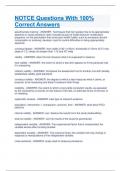
NOTCE Questions With 100% Correct Answers
NOTCE Questions With 100% Correct Answers assertiveness training - ANSWER- Techniques that train people how to be appropriately assertive in social situations; often included as part of health behavior modification programs, on the assumption that some poor health habits, such as excessive alcohol consumption or smoking, develop in part to control difficulties in being appropriately assertive. universal design - ANSWER- door width of 36'' or 92cm, thresholds of 13mm (0.5'') max slope of 1:2, ramps no steeper than 1:12 and 43'' wide validity - ANSWER- does the test measure what it is supposed to measure face validity - ANSWER- the extent to which a test item appears to fit the particular trait it is measuring criterion validity - ANSWER- Compares the assessment tool to another one with already established validity (gold standard) construct validity - ANSWER- the degree to which a test measures what it claims, or purports, to be measuring and doesn't measure other things reliability - ANSWER- the extent to which a test yields consistent results, as assessed by the consistency of scores on two halves of the test, on alternate forms of the test, or on retesting systematic reviews - ANSWER- best type of research evidence population, intervention 1, comparison, outcome, time - ANSWER- what does PICO stand for internal validity - ANSWER- can i believe the results from the study (believability) external validity - ANSWER- can the results of the study be generalized independent variable - ANSWER- The experimental factor that is manipulated; the variable whose effect is being studied. dependent variable - ANSWER- The outcome factor; the variable that may change in response to manipulations of the independent variable. cross-sectional - ANSWER- study used to measure prevalance cross section study - ANSWER- one time measurement, observational (don't change exposure), looks for association, ex. how many people in Halifax have ADHD case-control - ANSWER- study used to measure risk factors or cause case-control study - ANSWER- always retrospective, start with people with outcome and without then trace back to investigate exposure, uses odds ratio cohort - ANSWER- study design for measuring incidence, cause or prognosis cohort study - ANSWER- can be prospective or retrospective, population-based, uses risk-ratio static group - ANSWER- a preexperimental design in which there are two groups: the experimental group (EG), which is exposed to the treatment, and the control group (CG). Measurements on both groups are made only after the treatment, and test units are not assigned at random. one shot case study - ANSWER- a single group of subjects is measured on a dependent variable following an experimental stimulus randomized controlled trial - ANSWER- study design for measuring effectiveness of an intervention p value - ANSWER- The probability of results of the experiment being attributed to chance. (tells you if the results are statistically significant) type 1 error - ANSWER- Rejecting null hypothesis when it is true, no difference between the groups but you find one type 2 error - ANSWER- false negative, difference between the groups is there but you don't find it systematic review - ANSWER- has clear research question, does critical appraisal, used to determine best practice or relationships, identify research gaps, summarize results of something meta-analysis - ANSWER- a procedure for statistically combining the results of many different research studies convergent design - ANSWER- a mixed methods research design that collects and analyzes the quantitative and qualitative data simultaneously, then integrates the results together exploratory sequential design - ANSWER- In mixed-methods research, a design in which the qualitative method is implemented first and the quantitative method next. explanatory sequential design - ANSWER- In mixed-methods research, a design in which the quantitative method is implemented first and the qualitative method next. interactive - ANSWER- what is the best way to complete knowledge translation regression - ANSWER- type of analysis used to predict levels of another variable (used to identify risk factors of a condition) t-test - ANSWER- Compares mean values of a continuous variable between 2 categories/groups. Mann-Whitney U test - ANSWER- Determines whether two uncorrelated means differ significantly when data are nonparametric anova - ANSWER- Compares mean values of a contributes variable for multiple categories/groups (3 or more) Kruskal-Wallis test - ANSWER- The non-parametric equivalent to the one-way ANOVA. Chi-square test - ANSWER- A statistical method of testing for an association between two categorical variables. Specifically, it tests for the equality of two frequencies or proportions. inductive reasoning - ANSWER- specific to general deductive reasoning - ANSWER- general to specific crutches or wheelchair - ANSWER- if you are non weight bearing what mobility device should you use walker or crutches - ANSWER- if you are touch down weight bearing or partial weight bearing cane - ANSWER- if you are 50% weight bearing what mobility device should you use broca aphasia (expressive) - ANSWER- consists of poor articulation and sparse vocabulary (type of aphasia) Wernicke's aphasia - ANSWER- inability to comprehend speech (type of aphasia) (lots of talking, doesn't make sense) left sided stroke - ANSWER- LANGUAGE aphasia agnosia (unfamiliar objects) agraphia alexia (reading issues) right hemiplegia/hemiparesis hemianopsia (visual field) SLOW CAUTIOUS behavior ANGER/DEPRESSION right sided stroke - ANSWER- affects left side, unilateral neglect, safety impulses, uninhibited & have perceptual deficits conditional reasoning - ANSWER- understanding of the client's disabilities in specific life contexts interactive reasoning - ANSWER- emphasizes OTs understanding of client's feelings about themselves and their interventions procedural reasoning - ANSWER- consideration and use of intervention routines for identified conditions (maximizing function is the goal) Sublimation - ANSWER- channeling unacceptable sexual or aggressive drives into socially acceptable and culturally enhancing activities
Written for
- Institution
- NOTCE Quest
- Course
- NOTCE Quest
Document information
- Uploaded on
- November 14, 2023
- Number of pages
- 12
- Written in
- 2023/2024
- Type
- Exam (elaborations)
- Contains
- Questions & answers
Subjects
-
notce questions with 100 correct answ
-
notce questions with 100 correct answers

Also available in package deal