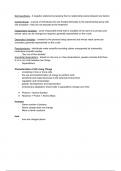
- Job definitions and descriptions
- Production efficiency and effectiveness measures
Information Organization: Arises from the interaction of people working in the organization
- Personal friendships
- Grapevines
- Group norms and sentiments
- Informal leaders
- Prestige and power structures
- Emotional feelings, needs and desires
- Effective relationships between managers and subordinates
- Personal and group goals and perceptions
Conflicts:
- Organized conflicts: strike action and occupations
- Overt individual conflict: grievances
- Latent conflict: manifested through absence, turnover, underperformance, and fractious
interpersonal relationships.
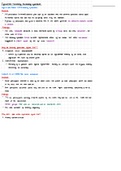
Lecure 4: Learning and development
4.1 Learning can be defined as the acquisition of knowledge that leads to a relatively permanent
change in behavior.
It can be:
● deliberate, as the result of a formal process;
● Or unintentional as the result of experiences.
● It can result in new behaviors or understanding.
● Individuals differ in their learning capabilities and styles
● Generic or social
20
, ● Lifelong learning will be essential for people to cope with the changing work
environment.
How do people learn?
- Behaviorism: belief in specific actions. Based on the assumption that our behavior and
actions and reactions to stimuli in our environment are a result of the learning process.
- Cognitive theories: belief in our mental abilities and representations. Learning is based
on our feelings and what takes place in our minds rather than our behavior.
- Learning style
Knowledge management
4.2 Two schools of how people learn:
1. Behaviorist school: maximized control, reliability, validity
- Law of exercise and association
- Classical conditioning
- Law of effect
- Operant conditioning
Law of exercise and association
This refers to the process that occurs when two responses are connected and repeatedly
exercised. (fixed habits and routines)
Classical conditioning:
● Modifying behavior so that conditioned stimulus is paired with an unconditioned
stimulus and elicits an unconditioned response.
● The job description you receive is a form of classical conditioning where you are
expected to perform the duties assigned.
● Instinctive reflexes could be ‘conditioned’ to respond to a new situation and a new
stimulus
● Reactions may be conditioned because of previous association of pain, guilt or fear.
Smell and sounds may release reactions.
● Classical conditioning is a type of unconscious or automatic learning that creates a
conditioned response through associations between an unconditioned stimulus and a
neutral stimulus. It was discovered by Russian physiologist Ivan Pavlov and has had a
tremendous influence over the school of thought in psychology known as behaviorism.
Behaviorism assumes that all learning occurs through interactions with the environment
and that environment shapes behavior.
● Classical conditioning involves placing a neutral stimulus before a naturally occurring
reflex. One of the best-known examples of classical conditioning is Pavlov’s classic
experiments with dogs. In these experiments, the neutral signal was the sound of a tone,
and the naturally occurring reflex was salivating in response to food. By associating the
neutral stimulus (sound) with the unconditioned stimulus (food), the sound of the tone
alone could produce a salivation response..
21
- Production efficiency and effectiveness measures
Information Organization: Arises from the interaction of people working in the organization
- Personal friendships
- Grapevines
- Group norms and sentiments
- Informal leaders
- Prestige and power structures
- Emotional feelings, needs and desires
- Effective relationships between managers and subordinates
- Personal and group goals and perceptions
Conflicts:
- Organized conflicts: strike action and occupations
- Overt individual conflict: grievances
- Latent conflict: manifested through absence, turnover, underperformance, and fractious
interpersonal relationships.
Lecure 4: Learning and development
4.1 Learning can be defined as the acquisition of knowledge that leads to a relatively permanent
change in behavior.
It can be:
● deliberate, as the result of a formal process;
● Or unintentional as the result of experiences.
● It can result in new behaviors or understanding.
● Individuals differ in their learning capabilities and styles
● Generic or social
20
, ● Lifelong learning will be essential for people to cope with the changing work
environment.
How do people learn?
- Behaviorism: belief in specific actions. Based on the assumption that our behavior and
actions and reactions to stimuli in our environment are a result of the learning process.
- Cognitive theories: belief in our mental abilities and representations. Learning is based
on our feelings and what takes place in our minds rather than our behavior.
- Learning style
Knowledge management
4.2 Two schools of how people learn:
1. Behaviorist school: maximized control, reliability, validity
- Law of exercise and association
- Classical conditioning
- Law of effect
- Operant conditioning
Law of exercise and association
This refers to the process that occurs when two responses are connected and repeatedly
exercised. (fixed habits and routines)
Classical conditioning:
● Modifying behavior so that conditioned stimulus is paired with an unconditioned
stimulus and elicits an unconditioned response.
● The job description you receive is a form of classical conditioning where you are
expected to perform the duties assigned.
● Instinctive reflexes could be ‘conditioned’ to respond to a new situation and a new
stimulus
● Reactions may be conditioned because of previous association of pain, guilt or fear.
Smell and sounds may release reactions.
● Classical conditioning is a type of unconscious or automatic learning that creates a
conditioned response through associations between an unconditioned stimulus and a
neutral stimulus. It was discovered by Russian physiologist Ivan Pavlov and has had a
tremendous influence over the school of thought in psychology known as behaviorism.
Behaviorism assumes that all learning occurs through interactions with the environment
and that environment shapes behavior.
● Classical conditioning involves placing a neutral stimulus before a naturally occurring
reflex. One of the best-known examples of classical conditioning is Pavlov’s classic
experiments with dogs. In these experiments, the neutral signal was the sound of a tone,
and the naturally occurring reflex was salivating in response to food. By associating the
neutral stimulus (sound) with the unconditioned stimulus (food), the sound of the tone
alone could produce a salivation response..
21