MLT ASCP Practice Questions 3.7.16 And Answers 100% Correct!!
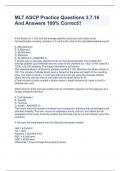
MLT ASCP Practice Questions 3.7.16 And If the dilution is 1:100, and the average platelet count from both sides of the hemacytometer counting chamber in 2 mm2 is 68, what is the calculated platelet count? A. 680,000/mm3 B. 6,800/mm3 C. 68,000/mm3 D. 680/mm3 E. 34,000/mm3 - ANSWER-C; A simple way to calculate platelet counts on the hemacytometer is to multiply the average platelet count between the two sides of the chamber by 1,000. In this case 68 x 1,000 = 68,000 platelets. The longer derivation is as follows: The standard dilution of blood for platelet counts is 1:100; therefore the dilution factor is 100. The volume of diluted blood used is based on the area and depth of the counting area. The area counted is 1 mm2 per side (since we are using the average platelet count, we only use the area of one side) and the depth factor is 10. ((Total number of cells counted x dilution factor x depth factor(mm)) / area in mm2) = platelets per mm3 Which branch of the immune system has an immediate response on first exposure to a foreign antigenic stimulus? A. Cell Mediated B. Specific C. Humoral D. Innate - ANSWER-D; The innate immunity system is inherent and nonspecific; meaning that all pathogens are attacked similarly. The skin, mucus in respiratory tracts, acid pH, and others are all examples of the innate immunity system that the body has to prevent infection upon first exposure. A two-year old male patient has the following hemogram results: Hgb = 6.7gms/dl Hct = 20% Platelets = 355,000/ mm3 RBC = 3.0mil/cmm WBC Answers 100% Correct!!
Written for
- Institution
- MLT ASCP
- Course
- MLT ASCP
Document information
- Uploaded on
- November 12, 2023
- Number of pages
- 31
- Written in
- 2023/2024
- Type
- Exam (elaborations)
- Contains
- Questions & answers
Subjects
- mlt ascp practice
-
mlt ascp practice questions 3716 and answers 100
-
if the dilution is 1100 and the average platele
-
e 34000mm3 answer c a simple way to calculat

Also available in package deal