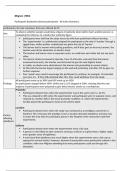
Milgram (1963)
Participants Randomly selected participants - 40 male volunteers.
participants 40 male volunteers that were offered $4.50
To observe whether people would obey a figure of authority when told to harm another person i.e.
Aim
evaluating the influence of a destructive authority figure.
participants were told that the study was to do with how punishment affects learning.
The ‘experimenter’ (a confederate) assigned the participant to the role of ‘teacher’ through a
rigged draw, whilst another confederate was given the role of ‘learner’.
The learner had to answer word-pairing questions, and if they gave an incorrect answer, the
teacher was told to administer an electric shock
The teacher and learner were in separate rooms, so could hear each other but not see each
other.
Procedure
The electric shocks increased in intensity, from 15-450 volts, and each time the learner
answered incorrectly, the teacher was instructed to give the next highest shock.
In reality, no shocks were administered, the learner only pretending to receive shocks.
At 300 volts the learner began banging on the wall and protesting, and after 315 he gave no
further response.
Four ‘prods’ were used to encourage the participant to continue, for example, ‘its essential
you carry on’ - if they still protested after this, they could withdraw from the study.
All participants went up to 300V and 65% went up to 450V.
Findings No participants stopped below 300V, whilst only 12.5% stopped at 300V, showing that the vast
majority of participants were prepared to give lethal electric shocks to a confederate.
Proximity
Participants obeyed more when the experimenter was in the same room i.e. 62.5%.
This was reduced to 40% when the experimenter and participant were in separate rooms, and
reduced to a further 30% in the touch proximity condition i.e. where the experimenter
forcibly placed the participant’s hand on the electric plate.
Location
Participants obeyed more when the study was conducted at a prestigious university i.e.
Stanford. This is because the prestige of such a location demands obedience and also may
Factors
increase the trust that the participant places in the integrity of the researchers and their
affecting
experiments.
obedience
Uniform
Participants obeyed more when the experimenter wore a lab coat.
A person is more likely to obey someone wearing a uniform as it gives them a higher status
and a greater sense of legitimacy.
It was found that obedience was much higher when the experimenter wore a lab coat as
opposed to normal clothes. However, demand characteristics were particularly evident in this
condition, with even Milgram admitting that many participants could see through this
deception.
Participants Randomly selected participants - 40 male volunteers.
participants 40 male volunteers that were offered $4.50
To observe whether people would obey a figure of authority when told to harm another person i.e.
Aim
evaluating the influence of a destructive authority figure.
participants were told that the study was to do with how punishment affects learning.
The ‘experimenter’ (a confederate) assigned the participant to the role of ‘teacher’ through a
rigged draw, whilst another confederate was given the role of ‘learner’.
The learner had to answer word-pairing questions, and if they gave an incorrect answer, the
teacher was told to administer an electric shock
The teacher and learner were in separate rooms, so could hear each other but not see each
other.
Procedure
The electric shocks increased in intensity, from 15-450 volts, and each time the learner
answered incorrectly, the teacher was instructed to give the next highest shock.
In reality, no shocks were administered, the learner only pretending to receive shocks.
At 300 volts the learner began banging on the wall and protesting, and after 315 he gave no
further response.
Four ‘prods’ were used to encourage the participant to continue, for example, ‘its essential
you carry on’ - if they still protested after this, they could withdraw from the study.
All participants went up to 300V and 65% went up to 450V.
Findings No participants stopped below 300V, whilst only 12.5% stopped at 300V, showing that the vast
majority of participants were prepared to give lethal electric shocks to a confederate.
Proximity
Participants obeyed more when the experimenter was in the same room i.e. 62.5%.
This was reduced to 40% when the experimenter and participant were in separate rooms, and
reduced to a further 30% in the touch proximity condition i.e. where the experimenter
forcibly placed the participant’s hand on the electric plate.
Location
Participants obeyed more when the study was conducted at a prestigious university i.e.
Stanford. This is because the prestige of such a location demands obedience and also may
Factors
increase the trust that the participant places in the integrity of the researchers and their
affecting
experiments.
obedience
Uniform
Participants obeyed more when the experimenter wore a lab coat.
A person is more likely to obey someone wearing a uniform as it gives them a higher status
and a greater sense of legitimacy.
It was found that obedience was much higher when the experimenter wore a lab coat as
opposed to normal clothes. However, demand characteristics were particularly evident in this
condition, with even Milgram admitting that many participants could see through this
deception.