Describe research into conformity to social roles
A01
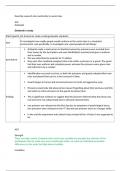
Zimbardo
Zimbardo’s study
Participants 24 American male undergraduate students
To investigate how readily people would conform to the social roles in a simulated
Aim
environment, and specifically, to investigate why ‘good people do bad things’.
Zimbardo made a mock prison in Stamford university, prisoners were arrested from
their homes by the local police and were blindfolded, searched and given a uniform
and a number
this was advertised to students for 15 dollars
procedure
they were then randomly assigned roles to be either a prisoner or a guard. The guard
had their own uniform and complete power, whereas the prisoners were given rules
and referred to by a number
Identification occurred very fast, as both the prisoners and guards adopted their new
roles and played their part in a short amount of time.
Guards began to harass and torment prisoners in harsh and aggressive ways
Prisoners would only talk about prison issues (forgetting about their previous real life),
and snitch on other prisoners to the guards to please them.
findings This is significant evidence to suggest that the prisoners believed that the prison was
real and were not acting simply due to demand characteristics.
one prisoner was released on the first day due to symptoms of psychological stress,
two prisoners were released on the 4th day and one prisoner went on a hunger strike.
In the end the experiment only lasted 6 days instead of the 14 days it was supposed to
be.
A03
Strength
There was high control, Zimbardo had control over variables for example the selection of the
participants who he made sure were emotionally stable, he ruled out individual personality
differences so the study had high internal validity.
Limitation
A01
Zimbardo
Zimbardo’s study
Participants 24 American male undergraduate students
To investigate how readily people would conform to the social roles in a simulated
Aim
environment, and specifically, to investigate why ‘good people do bad things’.
Zimbardo made a mock prison in Stamford university, prisoners were arrested from
their homes by the local police and were blindfolded, searched and given a uniform
and a number
this was advertised to students for 15 dollars
procedure
they were then randomly assigned roles to be either a prisoner or a guard. The guard
had their own uniform and complete power, whereas the prisoners were given rules
and referred to by a number
Identification occurred very fast, as both the prisoners and guards adopted their new
roles and played their part in a short amount of time.
Guards began to harass and torment prisoners in harsh and aggressive ways
Prisoners would only talk about prison issues (forgetting about their previous real life),
and snitch on other prisoners to the guards to please them.
findings This is significant evidence to suggest that the prisoners believed that the prison was
real and were not acting simply due to demand characteristics.
one prisoner was released on the first day due to symptoms of psychological stress,
two prisoners were released on the 4th day and one prisoner went on a hunger strike.
In the end the experiment only lasted 6 days instead of the 14 days it was supposed to
be.
A03
Strength
There was high control, Zimbardo had control over variables for example the selection of the
participants who he made sure were emotionally stable, he ruled out individual personality
differences so the study had high internal validity.
Limitation