1.
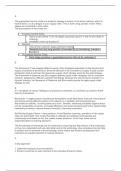
The guaranteed service model is a model to manage inventory in the whole network, which is
multi-echelon, so at at stages in your supply chain. This is done using periodic review These
stages are connected to each other.
The assumptions of the model are:
Inventory Control Policy
1. Same review period (T) for all stages (assumed equal to 1 and no time delay in
ordering)
2. Installation order-up-to policy-S
Demand
1. Only at final customer stages (demand nodes)
2. Demand over any long periods is bounded by an increasing, concave
function
Guaranteed-Service Times
1. Each stage promises a guaranteed-service time to its customers
2.
The framework of Lee suggest different supply chain strategies dependant on the demand and
supply uncertainty of the product. Since the demand is still uncertain but supply is quite certain
(prodcution back to normal), the responsive supply chain strategy would be the right strategy.
The framework of Gattorna and Ellis suggest aligning supply chain strategies with on customer
behavior, adressed by different customer archetypes. Because the semiconductor industry is a
dynamic industry, the framework of Gatoorna and Ellis would propose the agile supply chain
strategy as well.
3.
AI = simulation of human intelligence processes by machines, so machines can perform these
tasks by themselves.
Blockchain = a digital system recording all transactions (of all three flows: financial, informational
and fysical) among different parties in the network in a verifiable and tamperproof way.
Also better for visibility, ‘no blind parties any more’. Benefits: enhancing tracebility (against fraud
and for sustainibilty concenrs), increased efficiency and speed (lowering lead times, opportunities
centralizing inventory, improve demand forecast), improving transaction.
Self-Driving Supply Chains = using sensors, AI and Machine Learning, operations in the supply
chain are automated. This means that data is collected and alalysed automatically and
continuously and based on this, the system makes decisions. In this way, there can be
responded faster to chaning decisions.
The full potential of technology can be achieved by improving the data literacy of the employees,
so they can understand and use date better and so the technology. Also crowdsourcing can help
to achieve the full potential of the technology, which means that humans (employees) and
machines are equally important in making decisions.
4.
3 step approach:
1. Determine transport chain boundaries
2. Extract round-trips for each element of the individual transport chains
The guaranteed service model is a model to manage inventory in the whole network, which is
multi-echelon, so at at stages in your supply chain. This is done using periodic review These
stages are connected to each other.
The assumptions of the model are:
Inventory Control Policy
1. Same review period (T) for all stages (assumed equal to 1 and no time delay in
ordering)
2. Installation order-up-to policy-S
Demand
1. Only at final customer stages (demand nodes)
2. Demand over any long periods is bounded by an increasing, concave
function
Guaranteed-Service Times
1. Each stage promises a guaranteed-service time to its customers
2.
The framework of Lee suggest different supply chain strategies dependant on the demand and
supply uncertainty of the product. Since the demand is still uncertain but supply is quite certain
(prodcution back to normal), the responsive supply chain strategy would be the right strategy.
The framework of Gattorna and Ellis suggest aligning supply chain strategies with on customer
behavior, adressed by different customer archetypes. Because the semiconductor industry is a
dynamic industry, the framework of Gatoorna and Ellis would propose the agile supply chain
strategy as well.
3.
AI = simulation of human intelligence processes by machines, so machines can perform these
tasks by themselves.
Blockchain = a digital system recording all transactions (of all three flows: financial, informational
and fysical) among different parties in the network in a verifiable and tamperproof way.
Also better for visibility, ‘no blind parties any more’. Benefits: enhancing tracebility (against fraud
and for sustainibilty concenrs), increased efficiency and speed (lowering lead times, opportunities
centralizing inventory, improve demand forecast), improving transaction.
Self-Driving Supply Chains = using sensors, AI and Machine Learning, operations in the supply
chain are automated. This means that data is collected and alalysed automatically and
continuously and based on this, the system makes decisions. In this way, there can be
responded faster to chaning decisions.
The full potential of technology can be achieved by improving the data literacy of the employees,
so they can understand and use date better and so the technology. Also crowdsourcing can help
to achieve the full potential of the technology, which means that humans (employees) and
machines are equally important in making decisions.
4.
3 step approach:
1. Determine transport chain boundaries
2. Extract round-trips for each element of the individual transport chains