1
i. Question
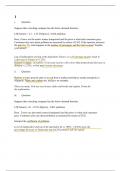
Suppose that a trucking company has the below demand function:
LN[Tonnes] = 2.1 - 1.25 LN[price] - 0.024 pollution
Here, Tonnes are the metric tonnes transported and the price is what each consumer pays.
Customers also care about pollution as measured by tonnes of CO2. If the operator increases
the price by 1%, what happens to the number of passengers and the total revenue? Explain
your answer.
Log of independent and log of the dependent Tonnes, so a 1% increase in price leads to
a decrease in Tonnes of -1.25%.
Demand is elastic, so a given 1% increase in price will a more than proportional decrease in
demand (-1.25%), so that total revenue decreases.
ii. Question
Barriers to entry prevent entry to or exit from a market and help to sustain monopoly or
oligopoly. Name and explain one, and give an example.
There are many. Pick one (see lecture slides and book) and explain. Points for
the explanation.
iii. Question
Suppose that a trucking company has the below demand function:
LN[Tonnes] =4.1 - 0.52 LN[price] - 0.021 pollution
Here, Tonnes are the metric tonnes transported and the pricre is what each consumer
pays. Customers also care about pollution as measured by tonnes of CO2.
Interpret the coefficient of pollution.
Level of independent and log of the dependent Q, so 100% · (-0.021) gives the
percentage decrease in Tonnes per ton of CO2 polluted. (all else equal)
, 2 (There are 3 versions of this calculation question, you would only see one)
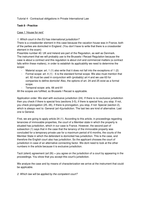
i. 1st version of the congestion calculation question
Suppose there is only a congestion externality. Consider the outcomes in the below
table of a case without any intervention (i.e. with a zero toll) and the socially optimal outcome
(i.e. with a socially optimal first-best toll).
• What value will the socially optimal toll take and why?
• What is the difference in welfare between the two cases and why? (Hint: you can
either use the rule-of-a-half for the consumer surplus change and the toll revenue, or
you can use the deadweight loss triangle.)
No intervention Social optimum
(i.e. no toll) (i.e. first-best toll)
Travel cost: c €11 €8
Marginal External Cost €9 €6
Price: p=toll+c €11 €14
Number of users (Q) 4500 3000
Toll revenue - €18 000
ANSWER
Socially optimal toll: 6 euros. Toll equals marginal external (congestion) cost.
Welfare change:
There is no producer (surplus), so W = CS + GS (GS= Government surplus =Toll revenue)
So to compare FB vs NT: ∆W = ∆CS + ∆GS
Rule of a half: ∆CS ≈ ½ ×(4500+3000) ×(11-14)= - 11 250
Toll revs: ∆GS =18000
Note that output decreases and price increases, so CS decreases
toll: €6
CS change ΔCS - 11 250
toll revenue 18000
Welfare change, ΔW: 6750
Alternatively, calculate the change in welfare using the deadweight loss triangle (of
unpriced congestion);
ΔW=MECNT * ΔQ /2 =9 *(4500-3000)/2=9*1500 /2 =6750
Which indeed gives the same number.
i. Question
Suppose that a trucking company has the below demand function:
LN[Tonnes] = 2.1 - 1.25 LN[price] - 0.024 pollution
Here, Tonnes are the metric tonnes transported and the price is what each consumer pays.
Customers also care about pollution as measured by tonnes of CO2. If the operator increases
the price by 1%, what happens to the number of passengers and the total revenue? Explain
your answer.
Log of independent and log of the dependent Tonnes, so a 1% increase in price leads to
a decrease in Tonnes of -1.25%.
Demand is elastic, so a given 1% increase in price will a more than proportional decrease in
demand (-1.25%), so that total revenue decreases.
ii. Question
Barriers to entry prevent entry to or exit from a market and help to sustain monopoly or
oligopoly. Name and explain one, and give an example.
There are many. Pick one (see lecture slides and book) and explain. Points for
the explanation.
iii. Question
Suppose that a trucking company has the below demand function:
LN[Tonnes] =4.1 - 0.52 LN[price] - 0.021 pollution
Here, Tonnes are the metric tonnes transported and the pricre is what each consumer
pays. Customers also care about pollution as measured by tonnes of CO2.
Interpret the coefficient of pollution.
Level of independent and log of the dependent Q, so 100% · (-0.021) gives the
percentage decrease in Tonnes per ton of CO2 polluted. (all else equal)
, 2 (There are 3 versions of this calculation question, you would only see one)
i. 1st version of the congestion calculation question
Suppose there is only a congestion externality. Consider the outcomes in the below
table of a case without any intervention (i.e. with a zero toll) and the socially optimal outcome
(i.e. with a socially optimal first-best toll).
• What value will the socially optimal toll take and why?
• What is the difference in welfare between the two cases and why? (Hint: you can
either use the rule-of-a-half for the consumer surplus change and the toll revenue, or
you can use the deadweight loss triangle.)
No intervention Social optimum
(i.e. no toll) (i.e. first-best toll)
Travel cost: c €11 €8
Marginal External Cost €9 €6
Price: p=toll+c €11 €14
Number of users (Q) 4500 3000
Toll revenue - €18 000
ANSWER
Socially optimal toll: 6 euros. Toll equals marginal external (congestion) cost.
Welfare change:
There is no producer (surplus), so W = CS + GS (GS= Government surplus =Toll revenue)
So to compare FB vs NT: ∆W = ∆CS + ∆GS
Rule of a half: ∆CS ≈ ½ ×(4500+3000) ×(11-14)= - 11 250
Toll revs: ∆GS =18000
Note that output decreases and price increases, so CS decreases
toll: €6
CS change ΔCS - 11 250
toll revenue 18000
Welfare change, ΔW: 6750
Alternatively, calculate the change in welfare using the deadweight loss triangle (of
unpriced congestion);
ΔW=MECNT * ΔQ /2 =9 *(4500-3000)/2=9*1500 /2 =6750
Which indeed gives the same number.