Tutorial 1
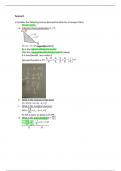
1 Consider the following inverse demand function for a transport firm:
D=d 0−d 1 Q
a) Interpret these parameters d 0 ∧d 1
D=d 0−d 1∗Q (eigenlijk is D P!)
d 0 is the highest willingness to pay
d 1 is the marginal benefit changes with Q (slope)
B is total benefit, area under D
( )
d 0 −D d0 P d 0 1
Demand function is Q= = − = − ∗P
d1 d1 d 1 d 1 d 1
b. What is the revenue of the firm?
R=D∗Q=d 0∗Q−d 1∗Q2
c. What is the marginal revenue?
∂R
MR= =d 0−2∗d 1∗Q
∂Q
So MR is twice as steep as D=MB
d. What is the price elasticity?
∂Q −1
∗P ∗d 0−d 1 Q
∂P d1
ε= =
Q Q
,2
−d 1
100% ∙ d2 gives the percentage increase in demand each year (all else equal)
Log gives changes in percentages.
Elasticity gives changes
d1> 1 (absolute value) = inelastic demand
3
a. What is the cost elasticity ?
∂TC Q MC
ε= = , but you have log-log so elasticity is just 1.1
∂ Q TC AC
b. Are there economies of scale?
No: Diseconomies of scale: output increases by 1%, TC increases 1.1% (MC>AC)
c. Interpret the coefficient for the variable year
100%*-0,1, so TC -10% per year
d. Why do the coeffficients for wage and rent exactly add up to 1?
If both increase 1%, TC rises also with 1%
4
a. What is MC?
MC=10−2Q
b. What is AC?
AC=10−Q
c. What is the cost elasticity?
∂ TC
∗Q
∂Q MC 10−2 Q
ε= = = <1
TC AC 10−Q
d. Are there economies of scale?
So yes there are economies of scale
e. Does the train operator make a profit if it does marginal cost pricing?
R=P∗Q=MC∗Q (as P=MC) and TC= AC∗Q , MC<AC so TC>R and they are making
a loss
, 5
a. Draw these functions
b. For marginal cost pricing and zero fixed costs. Draw the total costs, consumer
surplus, welfare and profit.
c. For average cost pricing and zero fixed costs. Draw the total costs, consumer surplus,
welfare and profit.
D=MC Q=5
b. Consumer surplus, CS
( Pmax −P0 )∗Q ( 10−5 )∗5
CS= = =12.5
2 2
c. Profit
PR=( P∗Q )−TC=25−25=0 as P=MC=AC
d. Welfare, W , since MC=AC & TC=5Q
W =PR+ CS=12.5
Average costs decrease with Q so yes, there are economies of scale
1 Consider the following inverse demand function for a transport firm:
D=d 0−d 1 Q
a) Interpret these parameters d 0 ∧d 1
D=d 0−d 1∗Q (eigenlijk is D P!)
d 0 is the highest willingness to pay
d 1 is the marginal benefit changes with Q (slope)
B is total benefit, area under D
( )
d 0 −D d0 P d 0 1
Demand function is Q= = − = − ∗P
d1 d1 d 1 d 1 d 1
b. What is the revenue of the firm?
R=D∗Q=d 0∗Q−d 1∗Q2
c. What is the marginal revenue?
∂R
MR= =d 0−2∗d 1∗Q
∂Q
So MR is twice as steep as D=MB
d. What is the price elasticity?
∂Q −1
∗P ∗d 0−d 1 Q
∂P d1
ε= =
Q Q
,2
−d 1
100% ∙ d2 gives the percentage increase in demand each year (all else equal)
Log gives changes in percentages.
Elasticity gives changes
d1> 1 (absolute value) = inelastic demand
3
a. What is the cost elasticity ?
∂TC Q MC
ε= = , but you have log-log so elasticity is just 1.1
∂ Q TC AC
b. Are there economies of scale?
No: Diseconomies of scale: output increases by 1%, TC increases 1.1% (MC>AC)
c. Interpret the coefficient for the variable year
100%*-0,1, so TC -10% per year
d. Why do the coeffficients for wage and rent exactly add up to 1?
If both increase 1%, TC rises also with 1%
4
a. What is MC?
MC=10−2Q
b. What is AC?
AC=10−Q
c. What is the cost elasticity?
∂ TC
∗Q
∂Q MC 10−2 Q
ε= = = <1
TC AC 10−Q
d. Are there economies of scale?
So yes there are economies of scale
e. Does the train operator make a profit if it does marginal cost pricing?
R=P∗Q=MC∗Q (as P=MC) and TC= AC∗Q , MC<AC so TC>R and they are making
a loss
, 5
a. Draw these functions
b. For marginal cost pricing and zero fixed costs. Draw the total costs, consumer
surplus, welfare and profit.
c. For average cost pricing and zero fixed costs. Draw the total costs, consumer surplus,
welfare and profit.
D=MC Q=5
b. Consumer surplus, CS
( Pmax −P0 )∗Q ( 10−5 )∗5
CS= = =12.5
2 2
c. Profit
PR=( P∗Q )−TC=25−25=0 as P=MC=AC
d. Welfare, W , since MC=AC & TC=5Q
W =PR+ CS=12.5
Average costs decrease with Q so yes, there are economies of scale