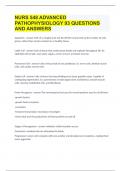
NURS 548 ADVANCED PATHOPHYSIOLOGY |93 QUESTIONS AND ANSWERS.
Apoptosis Cells of a neoplasm do not die off like normal cells so the number of cells grows, rather than remain constant as in healthy tissue. Labile Cell Cells of tissue that continuously divide and replicate throughout life. Ex: epithelial cells of skin, oral cavity, vagina, cervix, GI tract, and bone marrow. Permanent Cell Cells of tissue that do not proliferate. Ex: nerve cells, skeletal muscle cells, and cardiac muscle cells. Stable Cell Cells of tissue that stop dividing once tissue growth ceases. Capable of undergoing regeneration. Ex: parenchyma of solid organs (liver and kidney), smooth muscle cells, vascular endothelial cells, and fibroblasts. Proto-Oncogenes The normal genes that case for normal proteins used in cell division: -growth factors -growth factor receptors -G proteins -Enzymes that produce secondary messengers -Genes that turn the productions of these proteins on and off Stages of Oncogenesis Initiation: initial mutation occurs Promotion: mutated cells are stimulated to divide Progression: tumor cells compete with one another and develop more mutations, making them more aggressive -oma Benign tumors Carcinoma Malignant Epithelial Tissue Sarcoma Malignant Mesenchymal Tissue Epithelial Surface Tumors Papilloma; Squamous cell carcinoma Epithelial Glandular Tumors Adenoma; Adenocarcinoma Connective Fibrous Tumors Fibroma; Fibrosarcoma Connective Adipose Tumors Lipoma; Liposarcoma Connective Cartilage Tumors Chondroma; Chondrosarcoma Connective Bone Tumors Osteoma; Osteosarcoma Connective Blood Vessel Tumors Hemangioma; Hemangiosarcoma Connective Lymph Vessel Tumors Lymphangioma; Lymphangiosarcoma Connective Lymph Tissue Tumors Only Lymphosarcoma Smooth Muscle Tumors Leiomyoma; Leiomyosarcoma Striated Muscle Tumors Rhabdomyoma; Rhabdomyosarcoma Nerve Cell Tumors Neuroma; Neuroblastoma Glial Tissue Tumors Glioma; glioblastoma, astrocytoma, medulloblastoma, oligodendroglioma Nerve Sheath Tumors Neurilemmoma; Neurilemmal sarcoma Meninges Tumors Meningioma, Meningeal sarcoma Granulocytic leukemia Myelocytic leukemia Erythrocytic leukemia Erythrocytic leukemia Plasma cell leukemia Multiple myeloma Lymphocytic leukemia Lymphocytic leukemia, Lymphoma Monocytic leukemia Monocytic leukemia Blood Vessel Tumors Hemangioma; Hemangiosarcoma Lymph Vessel Tumors Lymphangioma; Lymphangiosarcoma Primary function of prostaglandins in acute inflammation Inflammatory mediator, synthesized from arachidonic acid through cyclooxyrgenase pathway. Induce inflammation and potentiate the effects of histamine and the other inflammatory mediators. Primary function of leukotrienes in acute inflammation Inflammatory mediator formed from arachidonic acid through lipoxygenase pathway. Affect the permeability of post capillary venules, adhesion properties of endothelial cells, and the extravasation of chemotaxis of neutrophils, eosinophils, and monocytes. *The slow-reactive substance of anaphylaxis: cause slow and sustained constriction of bronchioles . Serous Exudate Watery fluid, low in protein, resulting from plasma entering the inflammatory site. Hemorrhagic Exudate Occurs with severe tissue injury, where there is damage to blood vessels or there is leakage of red cells from the capillaries. Fibrinous Exudate Contains large amounts of fibrin, forming a thick and sticky meshwork, much like the fibers of a blood clot. Membranous Exudate Develops on mucous membrane surfaces, composed of necrotic cells enmeshed in a fibropurulent exudate. Purulent Exudate Contains pus: degraded white blood cells, proteins, and tissue debris. Pavementing (Margination) In the cellular stage of acute inflammation, leukocytes accumulate along endothelial defect and there to cell wall. Emigration In the cellular stage of acute inflammation, after pavementing, leukocytes squeeze through defect, into vascular space. Chemotaxis In the cellular stage of acute inflammation, after emigration, chemical signals attract the leukocytes to area of damaged tissue. Function of Histamine and Serotonin as inflammatory mediators. Allow for the dilatation of arterioles, and the permeability of venues. Granulomatous Chronic Inflammation -Macrophages mass together around foreign bodies -Connective tissue surrounds and isolates the mass -(associated with foreign bodies, and with microorganisms that cause TB, syphilis, sarcoidosis, deep fungal infections, and brucellosis) Mechanics of Fever 1. Pyrogens 2. Resetting of thermostatic set point 3. Temperature-raising responses: vasoconstriction, shivering, piloerection, increased metabolism 4. Fever: Core body temperature reaches new set point 5. Temperature-reducing responses occur: vasodilation, sweating, increased ventilation Suggestive Stages of Fever 1. Prodromal Period: nonspecific complaints 2. Chill Stage: chills, generalized shaking, core temp is rising 3. Flush Stage: Cutaneous vessel dilation, warm flushed skin 4. Defervescence Stage: Sweating Common Manifestations of Fever -Anorexia, myalgia, arthralgia, and fatigue -Respiration and heart rate increased -Dehydration may occur due to sweating and rapid respiratory rate. Classification of Hypersensitivity Responses: I. Immediate hypersensitivity IgE-mediated - mast cell degranulation: hay fever, asthma, anaphylaxis Classification of Hypersensitivity Responses: II. Antibody-mediated hypersensitivity Formation of antibodies (IgG, IgM) against cell surface antigens. Compliment is usually involved: Autoimmune hemolytic anemia Classification of Hypersensitivity Responses: III. Immune complex-mediated hypersensitivity Formation of antibodies (IgG, IgM, IgA) that interact with exogenous or endogenous antigens to form antigen-antibody complexes that cause vessel or tissue injury: Arthus reaction, autoimmune diseases, such as lupus, RA Classification of Hypersensitivity Responses: IV. Cell-mediated hypersensitivity Sensitized T Lymphocytes release cytokines that cause direct cell-mediated cytotoxicity or delayed-type hypersensitivity disorders: TB, contact dermatitis, transplant rejection. Anaphylaxis Systemic response to the inflammatory mediators released in Type I hypersensitivity. -Histamine, acetylcholine, kinins, leukotrienes, and prostaglandins all cause vasodilation. -Acetylcholine, kinins, leukotrienes, and prostaglandins all can cause bronchoconstriction. Mechanisms of Autoimmune Disease -Gender: occur more frequently in women than men -Genetic Susceptibility -Environmental Factors: breakdown in T-Cell Anergy, release of sequestered antigens, molecular mimicry, super antigens Course of HIV infection 1. Primary infection phase: -signs of systemic infection -seroconversion: immune system response and antibodies against HIV appear (1-6 months) 2. Latent Period -Virus is replicating -T(h) cell count gradually falls (10-11 years or longer) 3. Overt AIDS -T(h) cell count <200 cells/uL or AIDS defining illnesses Lymphocytes - B cells: create antibodies - T cells: control immune response, cell-mediated immunity - Natural Killer Cells: kill antigenic cells Clinical Manifestations of Acute Leukemia Bone Marrow Depression - malaise, easy fatiguability - fever - bleeding: petechiae, gingival bleeding, epistaxis Bone pain and tenderness on palpitation Headache, nausea, vomiting, papilledema, cranial nerve palsies, seizures, coma Abdominal Discomfort Increased vulnerability to infections Hematologic abnormalities - Anemia - Thrombocytopenia Hyperuricemia and other metabolic disorders. Acute Lymphocytic Anemia (ALL) Most common leukemia of childhood, occurs between ages 2 and 4 Acute Myelogenous Leukemia (AML) Chiefly an adult disease, also seen in children and adolescents. Associated with Down's syndrome Chronic Lymphocytic Leukemia (CLL) Mainly a disorder of older people, men affects 2 times as much as woman. Chronic Myelogenous Leukemia (CML) Predominantly occurs between ages 30 and 50, slightly higher rate in men than women, associated with the presence of Philadelphia chromosome. Hodgkin's Lymphoma Malignant B cells invite lymphoid organs: Reed-Sternberg Cells -Enlargement of cervical and mediastinal nodes -Painless enlargement of a single or group of nodes Symptoms: fever, night sweats, chills, weight loss (pain at lymph node with alcohol consumption) Anemia, and increased neutrophil count are common. Non-Hodgkin's Lymphoma Originate from B-cells and T-cells. 3x more prevalent than Hodgkin's Platelets (thrombocytes) -Thrombopoietin: made in liver, smooth muscle, and bone marrow -Megakaryoctes: form in bone marrow, break apart to form many platelets -Platelets: stored in spleen, released into blood stream when needed, live for 8-9 days in circulation Extrinsic Coagulation Pathway -Damaged tissues leak thromboplastin (tissue factor) into blood stream -Prothrombinase forms in seconds -Thrombin is catalyzed from prothrombin and calcium ion -Thrombin converts soluble fibrinogen into insoluble fibrin threads -Factor XIII (fibrin stabilizing factor) activated -Positive feedback mechanism of thrombin: accellerates formation of prothrombinase, activates platelets to release phopholipids. Intrinsic Coagulation Pathway -Takes several minutes -With damage to the endothelium, platelets come in contact with collagen of the blood vessel wall. -Phospholipids released by damaged platelets -Involves calcium ion and clotting factors XII, X, and V
Written for
- Institution
- NUR 375
- Course
- NUR 375
Document information
- Uploaded on
- November 7, 2023
- Number of pages
- 14
- Written in
- 2023/2024
- Type
- Exam (elaborations)
- Contains
- Unknown
Subjects
-
nurs 548 advanced pathophysiology

Also available in package deal