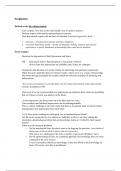
Scepticism
Defined as the life without beliefs:
- Later sceptics view thus as the only feasible way to achieve ataraxia. ¹
- Modern sceptics hold mainly epistemological concerns.
- Note that ancient sceptics did not have or entertain Cartesian hyperbolic doubt. ²
1. Ataraxia – Freedom from anxiety and thus, happiness.
2. Cartesian hyperbolic doubt – doubts all thoughts, beliefs, opinions and sensory
experiences to find a foundation of knowledge that could not be doubted.
Early Sceptics:
- Question the dogmatism of both Epicureans and Stoics
NB: Epicureans believe that perception is necessarily veridical.
Stoics claim that impressions are infallible only if they are cataleptic.
- Scepticism calls the idea of a secure criteria for knowledge into question in particular.
- While the stoics hold that there are internal ‘marks’ which serve as a ‘canon’ of knowledge
(the twins and egg examples) the sceptics add proto-cartesian examples of dreaming and
hallucination.
‘Every true presentation is such that there can be a false presentation of the same quality,’
(Cicero, Academica 2.40)
Thus even if we are convinced that two impressions are identical, there exists the possibility
that we’ll discover their non-identity in the future.
- A true impression can always turn out to be false and vice versa.
Thus veridical and falsidical impressions can be indistinguishable.
- This is a direct challenge to the stoic claim that there is an internal mark of criteria which
distinguishes such impressions from each other.
(1) Is Zeno (stoic) making an ontological, not an epistemological claim?
- Are the stoics saying that no two objects are indistinct in fact, or are they making the
externalist, epistemological claim that our knowledge claims are verified by their causal
history?
- Either way this presents problems
o On the ontological front, the stoics seem to be begging the question: ‘non-identical
things may be discernible in theory but not in practice,’
This serves as a challenge to the indiscernibility of identicals (Teibniz’s Law)
o On the epistemological front, an externalist approach toe knowledge does not seem
contained in the stoic sources.
Even if externalism affords us knowledge, it does not afford us the knowledge we
know. The stoics view this as insufficient.
Defined as the life without beliefs:
- Later sceptics view thus as the only feasible way to achieve ataraxia. ¹
- Modern sceptics hold mainly epistemological concerns.
- Note that ancient sceptics did not have or entertain Cartesian hyperbolic doubt. ²
1. Ataraxia – Freedom from anxiety and thus, happiness.
2. Cartesian hyperbolic doubt – doubts all thoughts, beliefs, opinions and sensory
experiences to find a foundation of knowledge that could not be doubted.
Early Sceptics:
- Question the dogmatism of both Epicureans and Stoics
NB: Epicureans believe that perception is necessarily veridical.
Stoics claim that impressions are infallible only if they are cataleptic.
- Scepticism calls the idea of a secure criteria for knowledge into question in particular.
- While the stoics hold that there are internal ‘marks’ which serve as a ‘canon’ of knowledge
(the twins and egg examples) the sceptics add proto-cartesian examples of dreaming and
hallucination.
‘Every true presentation is such that there can be a false presentation of the same quality,’
(Cicero, Academica 2.40)
Thus even if we are convinced that two impressions are identical, there exists the possibility
that we’ll discover their non-identity in the future.
- A true impression can always turn out to be false and vice versa.
Thus veridical and falsidical impressions can be indistinguishable.
- This is a direct challenge to the stoic claim that there is an internal mark of criteria which
distinguishes such impressions from each other.
(1) Is Zeno (stoic) making an ontological, not an epistemological claim?
- Are the stoics saying that no two objects are indistinct in fact, or are they making the
externalist, epistemological claim that our knowledge claims are verified by their causal
history?
- Either way this presents problems
o On the ontological front, the stoics seem to be begging the question: ‘non-identical
things may be discernible in theory but not in practice,’
This serves as a challenge to the indiscernibility of identicals (Teibniz’s Law)
o On the epistemological front, an externalist approach toe knowledge does not seem
contained in the stoic sources.
Even if externalism affords us knowledge, it does not afford us the knowledge we
know. The stoics view this as insufficient.