Lectures Cognitive Behaviour Interventions
Lecture 1, Exposure and Cognitive Restructuring. Philip Spinhoven
Literature: Exposure therapy: Promoting emotional processing of pathological anxiety. A.K. Zalta &
E.B. Foa (chapter 4), Cognitive restructuring. R.L. Leahy & S.A. Rego (chapter 6)
Exposure therapy
Theoretical background
Classical Conditioning = a type of learning in which a stimulus acquires the capacity to evoke a
reflexive response that was originally evoked by a different stimulus.
Three pathways: (1) direct experience; (2) observational learning; (3) informational learning
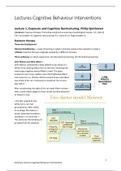
John Watson and little Albert I
John Watson conditioned a baby (Albert) to be afraid of a
white rat by showing Albert the rat and then slamming two
metal pipes together behind Albert's head. The pipes
produced a very loud, sudden noise that frightened Albert
and made him cry. Watson did this several times until Albert
was afraid of the rat. Previously he would pet the rat and
play with it
After conditioning, the sight of the rat made Albert scream –
after a while Albert began to show similar terrified behaviors
to Watson's face.
> the fear evoked by the
white, furry, rat, had
generalized to other white,
furry things, like Watson's
beard. Operenant condition:
avoidance > no more fear >
This enhances the tendency to
go away from the situation.
1
Summary lectures Cognitive Behaviour Interventions
, What is Exposure Therapy?
- Exposure purposefully generates anxiety (unlike systematic desensitization).
- Repeated exposure to the feared object or situation > repeated experience of anxiety > until the
object/situation eventually loses its anxiety provoking effect
- = habituation
3 types of exposure: - Exposure to external feared stimuli (in vivo exposure) > real situation
- Exposure to imaginal stimuli (in vitro/imaginal exposure)
- Exposure to physical (internal) stimuli (interoceptive exposure)
Emotional processing theory (Foa & Kozak, 1986)
- Anxiety-memory is a “fear-structure” in which representations of stimuli, responses, and meanings
are stored.
- In anxiety disorders, stimulus representations are linked to danger and strong responses
PTSD fear structure >
Consequences for therapy
Effective therapy (EF): correct fear-structure
Demands: -fear-structure has to be activated (the patient must experience anxiety during exposure)
- new information, incompatible with old info, must be introduced in fear structure.
Emotional processing theory emphasizes integration of disconfirming
information in the fear structure as the mechanism of change of exposure
therapy.
(i.e. cognitive explanation of exposure in vivo)
2
Summary lectures Cognitive Behaviour Interventions
Lecture 1, Exposure and Cognitive Restructuring. Philip Spinhoven
Literature: Exposure therapy: Promoting emotional processing of pathological anxiety. A.K. Zalta &
E.B. Foa (chapter 4), Cognitive restructuring. R.L. Leahy & S.A. Rego (chapter 6)
Exposure therapy
Theoretical background
Classical Conditioning = a type of learning in which a stimulus acquires the capacity to evoke a
reflexive response that was originally evoked by a different stimulus.
Three pathways: (1) direct experience; (2) observational learning; (3) informational learning
John Watson and little Albert I
John Watson conditioned a baby (Albert) to be afraid of a
white rat by showing Albert the rat and then slamming two
metal pipes together behind Albert's head. The pipes
produced a very loud, sudden noise that frightened Albert
and made him cry. Watson did this several times until Albert
was afraid of the rat. Previously he would pet the rat and
play with it
After conditioning, the sight of the rat made Albert scream –
after a while Albert began to show similar terrified behaviors
to Watson's face.
> the fear evoked by the
white, furry, rat, had
generalized to other white,
furry things, like Watson's
beard. Operenant condition:
avoidance > no more fear >
This enhances the tendency to
go away from the situation.
1
Summary lectures Cognitive Behaviour Interventions
, What is Exposure Therapy?
- Exposure purposefully generates anxiety (unlike systematic desensitization).
- Repeated exposure to the feared object or situation > repeated experience of anxiety > until the
object/situation eventually loses its anxiety provoking effect
- = habituation
3 types of exposure: - Exposure to external feared stimuli (in vivo exposure) > real situation
- Exposure to imaginal stimuli (in vitro/imaginal exposure)
- Exposure to physical (internal) stimuli (interoceptive exposure)
Emotional processing theory (Foa & Kozak, 1986)
- Anxiety-memory is a “fear-structure” in which representations of stimuli, responses, and meanings
are stored.
- In anxiety disorders, stimulus representations are linked to danger and strong responses
PTSD fear structure >
Consequences for therapy
Effective therapy (EF): correct fear-structure
Demands: -fear-structure has to be activated (the patient must experience anxiety during exposure)
- new information, incompatible with old info, must be introduced in fear structure.
Emotional processing theory emphasizes integration of disconfirming
information in the fear structure as the mechanism of change of exposure
therapy.
(i.e. cognitive explanation of exposure in vivo)
2
Summary lectures Cognitive Behaviour Interventions