REGIS NU641 Pharmacology Exam 2 Study Guide 2023 Infectious Disease (35%
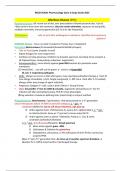
REGIS NU641 Pharmacology Exam 2 Study Guide 2023 Infectious Disease (35%) Resistance factors: d/t recent use of abx, over prescription of broad spectrum abx, <2yo & >65yo tend to have more abx resistance, day care center attendees, exposure to young kids, multiple comorbids, immunosuppression (b/c tx’d w/ abx frequently) refer to local lab’s antibiogram to decide tx- identifies local resistance patterns* Antibiotic Classes – focus on what’s treated in Primary Care / Outpatient Penicillins:Beta-Lactams (IE Amoxicillin/Amoxil & Nafcillin/Unipen) • Take w/ food (some unstable in acid) • Adjust dosages for renal impairment • Combine w/ beta-lactamase inhibitors to broaden spectrum, less likely to be resistant o (IE Piptazo/Zosyn, Unasyn/Amp-sulbactam, Augmentin) • Aminopenecillins: more activity against gram NEG bacteria b/c penetrate outer membrane (IE Amoxicillin) … can still use for gram+ o Used to tx Gram NEG GI, GU, & respiratory pathogens • ADRs: allergic rxn occurs 2-30m after given, may need desensitization therapy o Rash (if true allergy immediate), n/v/d, fungal overgrowth, C. diff risk o Rash after 5-7d unlikely allergy, either way change of agent indicated • Pregnancy Category C= safe, used in birth if Mom + Group B strep • Uses: Amoxicillin 1st line for AOM & sinusitis, Augmentin (Amox/Clauv) 1st line for infection d/t bites (including human), PCN for strep pharyngitis. Drug selection is based on defining tests (rapid strep) vs empiric method Cephalosporins: Beta-lactams, 5 generations. Only being tested on 1-3 rd generation Used if therapeutic failure of AOM or penicillin allergy o 1 st gen : ie Cephalexin/Keflex for skin & soft tissue infections, ppx post-op Active against Gram +POS bacteria (S. aureus & S. epidermidis) o 2 nd gen : ie Cefactor/Ceclor. Same as 1st gen but to lesser extent & PO Active against same as above + Klebsiella, Proteus, E. Coli, & some anaerobes (Cefoxitin/Cefotetan) o 3 rd gen : ie Ceftriaxone/Rocephin. Broad spectrum More active against gram –NEG Ceftriaxone & Cefixime for gonorrhea Cefpodoxime, cefuroxime, or PO ceftriaxone IV then PO for community acquired PNA Give 2nd gen if 1st generation fails. As move up in number, spectrum broadens. o Monitor for C. Diff & renal function if prolonged therapy Antibiogram: o ADRs : rash, arthralgia, abnormal coags, anemia, neutropenia, leukopenia, thrombocytosis, fever, renal/hepatic failure, seizures in pts at high risk Fluoroquinolones: -OXACIN ie Lexofloxacin/Levaquin & Ciprofloxacin/Cipro o Increased resistance to these d/t v broad spectrum & overprescribing. CANNOT use for gonorrhea (GC) & Tb resistant NO pregnancy, NO pedi. NO alcohol use o Use: uncomplicated UTI, pyelonephritis, PNA/chronic bronchitis exacerbation, PCNresistant shit (s. pneumoniae, skin & bone/J infections, infectious diarrhea). o Rare to use >10 days, Pre-tx obtain EKG for pts at risk getting moxifloxacin IV dosage = oral dose; risk for severe hepatotoxicity o Black box warning for tendonitis/tendon rupture; elderly at high risk May have delayed onset of those s/s, up to 120d after administration If tendon pain occurs, stop ASAP & notify provider** o EKG changes- can prolong QT interval** angina & atrial flutter o Can cause dizziness, take to see effect prior to driving o Take on empty stomach for best absorption or w/ full glass of water o Mg + Aluminum containing antacids, iron, & calcium supplements decrease absorption Macrolides/Azalides: -THROMYCIN IE erythromycin, clarithromycin/Biaxin, azithromycin/zithromax o Drug of choice for community acquired PNA, pertussis, H. pylori, chronic bronchitis, & sometimes COPD exacerbations o ADR s: GI (n/v/d & ABD pain) & skin (utucaria/hives, eczema, SJS) HOLD statins if giving, when combined increase risk of myopathy QT prolongation concern o **Monitor for altered resp to drugs metabolized by CYP450 MRSA tx: Lincosamides clindamycin/cleocin 1st line in clinic setting (if no resistance indicated in local area) & Sulfonamides & trimethoprim (Bactrim) 1st in acute care setting If MRSA resistant to clinda & Bactrim, given glycopeptide Vancomycin • Sulfonamides & trimethoprim (Bactrim): 1 st line UTI & some MRSA in acute care settings o Always check angiobiogram for MRSA o Caution with folic deficiency o Monitor CNS & CBC if tx for UTI • Lincosamides- clindamycin/cleocin (some MRSA activity). o NO gram –NEG activity o 1 st line in kids & pregnant ppl, 2nd line therapy overall (narrow aerobic spectrum) o STOP if diarrhea occurs, high risk for colitis o Take w/ full glass of water to avoid esophageal irritation • Oxalodinones aka Linezolid/Zyvox: Active against aerobic gram +POS o Myelosuppression/bone marrow suppression can occur, resolves when d/c drug Watch CBC baseline & weekly if >14d course o INTERXN w/ MAOIs- extreme caution (can cause serotonin syndrome) Food interxns w/ cheese, wine • Tetracyclines : -CYCLINE. 1 st line C. trachomatis/chlamydia & ureaplasma (Lyme d/s) o ie tetracycline, doxycycline, minocycline o Take on EMPTY stomach & 2h before/after Iron, Ca, Mg, Al o Contraindicated in pregnant, lactating, & <8YO • Glycopeptides : ie Vancomycin, daptomycin, telavancin/vebativ, & dalbavancin/dalvance o Used for severe gram +POS infections (ie MRSA resistant to 1st line abx) o PO for C. Diff tx only, otherwise IV (redman syndrome if infuse too fast) o Vanc troughs d/t risk of ototoxicity, adjust dose if kidney failure o New agents great d/t long T1/2 (dose 1x/week) • Systemic azoles & antifungals : -AZOLE. ie Fluconazole. Used to tx superficial infections d/t yeast infections (ie candida) & dermatophytes (tinea infections) o Fluconazole req renal dose adjustment (adr= hepatotoxicity) Fluconazole has least drug to drug interxns o **Need loading dose (slow onset, long T1/2) • Antivirals: Nucleoside Analogues: -CYCLOVIR. o Acyclovir tx for shingles/herpes zoster, herpes simplex, varicella, & gingivomatitis o Acyclovir/valacylovir few ADRs when given PO o Monitor BUN & Cr in high risk pts o Educate s/s renal failure, encephalopathic changes, blood dyscrasias (monitor
Written for
- Institution
- REGIS NU641 Pharmacology
- Course
- REGIS NU641 Pharmacology
Document information
- Uploaded on
- November 5, 2023
- Number of pages
- 17
- Written in
- 2023/2024
- Type
- Exam (elaborations)
- Contains
- Questions & answers
Subjects
-
regis nu641 pharmacology exam 2 study guide 2023
-
regis nu641 pharmacology exam 2 study guide 2023 i

Also available in package deal