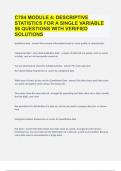
C784 MODULE 4 DESCRIPTIVE STATISTICS FOR A SINGLE VARIABLE |56 QUESTIONS WITH VERIFIED CORRECT ANSWERRS
qualitative data Non-numeric information based on some quality or characteristic. Categorical data, also called qualitative data, consists of data that are groups, such as names or labels, and are not necessarily numerical. You use what type of charts for Categorical Data Pie charts-percents Bar Charts-display frequencies or counts for categorical data What type of charts do you use for Quantitative Data Dot plots-shows each data value as a point, arranged in order along a horizontal axis. Stem plots-show the same data set, arranged by separating each data value into a stem (usually the first digit), and a leaf Box plotsshow the distribution of a data set, and can be used to compare data sets, as shown here. Histograms-display frequencies or counts for quantitative data Dot plots Dot plots-shows each data value as a point, arranged in order along a horizontal axis. You can easily see the distribution of a data set, as well as any outliers. Because every data value is represented by a single point Stem plots Stem plots, also known as stem-and-leaf plots, show the same data set, arranged by separating each data value into a stem (usually the first digit), and a leaf (usually the second digit). For example, the data point 43 has a stem of 4 and a leaf of 3. The advantages of a stem plot are that it shows the distribution or shape of the data, while representing each individual data value. Healthcare statistics such as age, height, weight, blood pressure, and blood cholesterol level are examples a. Quantitative b. Qualitative are examples of numerical (quantitative) data. Healthcare statistics such as gender, ethnicity, marital status, and eye color are examples of a. Quantitative b. Qualitative (Categorical) are examples of categorical (qualitative) data. John is reviewing patient charts and reads that this patient is male and diabetic. a. Quantitative b. Qualitative (Categorical) Categorical data Categorical data is correct. The data is categorical as the patient is either male or female, and diabetic or not. The intake nurse in the ER asked the patient to describe her pain, and rate it on a scale of 1 to 10. The patient stated that her current pain level was an 8, and reported she was experiencing sharp, shooting pain that referred down her legs. a. Quantitative b. Qualitative (Categorical) Categorical data Categorical data is correct. The pain can be placed into specific categories (1, 2, 3, 4, 5, 6, 7, 8, 9, or 10). Although these categories are numbers, they don't hold a numerical meaning. That is, it wouldn't make sense to add them. Sara just came on shift and was reviewing patient charts. She reads the following updates for Mr. Jones: BP 130/61, Pulse 65. Medications: Coumadin 3.5 mg p.o. q.d. a. Quantitative b. Qualitative (Categorical) Quantitative data Quantitative data is correct. Quantitative data deals with data that can be objectively measured. The lab returned the following report on a tissue biopsy sample that was sent down for analysis: Mass 25.1 mg, Mitotic rate 2-3/mm2. a. Quantitative b. Qualitative (Categorical) Quantitative data Quantitative data is correct. Quantitative data deals with data that can be objectively measured. Quantitative Numerical, continuous bar chart A graph that displays data that is distributed over groups or categories. For which type of data would a bar chart be most appropriate? a. Diastolic blood pressure in mm Hg b. Hospital admissions by month c. Heights in centimeters d. Weight in kilograms b. Hospital admissions by month The answer is b. Months are a category. The other examples are examples of data that would be continuous data, and therefore not appropriate for a bar chart. A bar chart is used to show frequencies of what type of data? a. Quantitative (numerical, continuous) b. Qualitative (categorical, discrete) Qualitative. The answer is b. A bar chart measures data that is distributed over discrete groups or categories. quantitative data Data values that are numbers, representing quantities that can be counted or measured. also called numerical data, consists of data values that are numerical, representing quantities that can be counted or measured. Qualitative (categorical, discrete pie chart A graphical display that shows data in categories as percentages of a circle. Each section of a pie chart corresponds to a category of data. True or False? a. True Pie charts are used to show data as parts. Therefore, each part, or section/slice, of a pie chart corresponds to a category of data. When creating a pie chart, the percentages for each category are calculated from the data. True or False? a. True The percentage of the whole that each category represents must be calculated from the data. The sum of all the percents in a pie chart do not always have to add up to 100%. True or False? b. False The sum of all the percents should add up to 100% in a pie chart. The height of each bar in a bar chart is determined by the number of values in the category for that bar. True or false? a. True The height of each bar in a bar chart corresponds to the number of values in that bar's category. When constructing a bar chart, it is not necessary to include all of the data collected. True or false? b. False When constructing a bar chart, the categories included in the chart need to encompass all of the data collected. mode The most frequent value in a dataset. interquartile range The difference, in value, between the bottom and top 25 percent of the sample or population. five-number summary The minimum, first quartile, median, third quartile, and maximum. A box plot represents the five numbers in a five-number summary. stem plot A visual representation of data in which individual data points are plotted to the right of a horizontal line, or chart, and the left shows the interval categories. distribution An arrangement of values that illustrates their frequency or occurrence. statistics The science that deals with the interpretation of numerical facts or data through theories of probability. Also, the numerical facts or data themselves. measure of central tendency A summary measure that is used to describe an entire set of data with one value that represents the middle or center of the data set's distribution. There are three main measures: mean, median, or mode.
Written for
- Institution
- WGU C784:APPLIED HEALTHCARE STATISTICS
- Course
- WGU C784:APPLIED HEALTHCARE STATISTICS
Document information
- Uploaded on
- November 5, 2023
- Number of pages
- 9
- Written in
- 2023/2024
- Type
- Exam (elaborations)
- Contains
- Questions & answers
Subjects
-
c784 module 4 descriptive statistics for a single

Also available in package deal