Week 4 – The Musculoskeletal System
LO:
Understand & describe the phases of muscle twitch.
Explain the different types of muscle contraction.
Muscle mechanics :
Contraction over a wide range of forces and velocities.
- A skeletal muscle can contract with varying force, different velocities, or varying lengths of
time. Muscles can also perform short, brief, explosive contractions e.g., javelin sessions.
- We reach our peak force then returns to 0. Like an action potential.
- Contractions can be string, weak, long, or short.
The Muscle twitch:
The response of a muscle of a single stimulation
- Strong or weak
- Long or short
- This event when a muscle contract and produces a response to generated action potential,
this is known as the muscle twitch.
- The muscle twitch is the SAME if were producing a strong or weak contraction OR long or
short contraction.
- Motor neurons come down to the muscle and branch off to terminal branches & where
they get in contact with the muscle fibre, this is the neuron muscular junction.
- When an action potential is sent down a neuron, all the muscle fibres that are innovated by
that motor neuron is stimulated (when the signal comes down then motor neuron, any
muscle fibres that the motor neuron is embedded in or innovated in, will become
stimulated), example shown below:
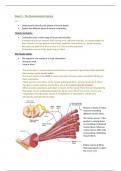
Picture 1: Shows 2 motor
neurons innovating
different muscle fibres.
The motor neuron 1 (the
purple) is coming down
& innovating 2 individual
muscle fibres. Whereas
motor neuron 2(the red)
is innovating 3 individual
muscle fibres.
Motor neuron & fibres
that innervated, is called
the motor unit.
, Examples of motor unit: Motor neurons compromised very small numbers of muscle fibres.
e.g., 1, Fingers (where we want delicate and precise movements, we don’t want string, these are
regarded as having very small motor units because it could be the case that the motor neuron
innervated a hand full of muscle fibres.
e.g., 2, Large weight barring muscle (to produce strong muscle contractions and lots of force), this is
regarded as a large motor unit. Therefore, this motor unit may be stimulating several different
muscle fibres.
Laboratory origins
- Myography
Like an action potential, a muscle twitch is a reproduceable all or nothing response (if we were to
stimulate the muscle fibres repeatedly within a reasonable time, we will get the same, identical
response).
The concept of muscle twitch resonates from laboratory.
LO:
Understand & describe the phases of muscle twitch.
Explain the different types of muscle contraction.
Muscle mechanics :
Contraction over a wide range of forces and velocities.
- A skeletal muscle can contract with varying force, different velocities, or varying lengths of
time. Muscles can also perform short, brief, explosive contractions e.g., javelin sessions.
- We reach our peak force then returns to 0. Like an action potential.
- Contractions can be string, weak, long, or short.
The Muscle twitch:
The response of a muscle of a single stimulation
- Strong or weak
- Long or short
- This event when a muscle contract and produces a response to generated action potential,
this is known as the muscle twitch.
- The muscle twitch is the SAME if were producing a strong or weak contraction OR long or
short contraction.
- Motor neurons come down to the muscle and branch off to terminal branches & where
they get in contact with the muscle fibre, this is the neuron muscular junction.
- When an action potential is sent down a neuron, all the muscle fibres that are innovated by
that motor neuron is stimulated (when the signal comes down then motor neuron, any
muscle fibres that the motor neuron is embedded in or innovated in, will become
stimulated), example shown below:
Picture 1: Shows 2 motor
neurons innovating
different muscle fibres.
The motor neuron 1 (the
purple) is coming down
& innovating 2 individual
muscle fibres. Whereas
motor neuron 2(the red)
is innovating 3 individual
muscle fibres.
Motor neuron & fibres
that innervated, is called
the motor unit.
, Examples of motor unit: Motor neurons compromised very small numbers of muscle fibres.
e.g., 1, Fingers (where we want delicate and precise movements, we don’t want string, these are
regarded as having very small motor units because it could be the case that the motor neuron
innervated a hand full of muscle fibres.
e.g., 2, Large weight barring muscle (to produce strong muscle contractions and lots of force), this is
regarded as a large motor unit. Therefore, this motor unit may be stimulating several different
muscle fibres.
Laboratory origins
- Myography
Like an action potential, a muscle twitch is a reproduceable all or nothing response (if we were to
stimulate the muscle fibres repeatedly within a reasonable time, we will get the same, identical
response).
The concept of muscle twitch resonates from laboratory.