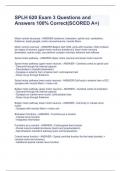
SPLH 620 Exam 3 Questions and Answers 100% Correct(SCORED A+)
Motor control structures - ANSWER-cerebrum, brainstem, spinal cord, cerebellum, thalamus, basal ganglia, motor nerves/neurons, muscle fibers Motor control overview - ANSWER-Begins with CNS, ends with muscles, CNS contains two types of neurons (upper motor neurons [cerebrum], lower motor neruons [brainstem, spinal cord]), can perform complex voluntary behavior and reflexes Spinal motor pathway - ANSWER-Upper motor neurons and lower motor neurons Spinal motor pathway upper motor neurons - ANSWER-- Cerebral cortex to spinal cord - Descend through the internal capsule - Decussates in medulla (brainstem) - Synapse in anterior horn of spinal cord: corticospinal tract - Does not go through thalamus Spinal motor pathway lower motor neurons - ANSWER-Cell body in anterior horn of SC, synapse with muscle fibers = motor unit Bulbar motor pathway upper motor neurons - ANSWER-- Cerebral cortex to brainstem - Descend through the internal capsule - Synapse on cranial nerve nuclei: corticobulbar tract - Does not go through thalamus Bulbar motor pathway lower motor neurons - ANSWER-- Cell body in cranial nerve nuclei - Synapse with muslce fibers = motor unit Brainstem functions - ANSWER-- Functions as a conduit - Cranial nerve function - Integrates information Functions as a conduit - ANSWER-- Corticospinal tract (motor) - Dorsal column-medial lemniscus (touch and proprioception) - Spinothalamic tract/ALS pathway (pain and temperature) Cranial nerve function - ANSWER-- Spinal cord-like function for the head (somatic + visceral motor and sensory) - Additional special cranial nerve function Integrates information - ANSWER-- Reticular formation (complex motor patterns, aspects of respiratory and cardiovascular activity, consciousness) Central pattern generator - ANSWER-function is locomotion, respiration, swallowing, reticular formation - rythmic behavioral patterns Spinal cord - ANSWER-32 segments - 8 cervical - 12 thoracic - 5 lumbar - 5 sacral - 1 coccygeal Cross-sectional structure - ANSWER-Similar cross-sectional structure throughout spinal cord Dorsal rootlets - ANSWER-sensory, dorsal root ganglion Ventral - ANSWER-motor Dorsal and ventral rootlets merge to form - ANSWER-spinal nerve - afferents and efferents travel together
Written for
- Institution
- SPLH 620
- Course
- SPLH 620
Document information
- Uploaded on
- November 3, 2023
- Number of pages
- 2
- Written in
- 2023/2024
- Type
- Exam (elaborations)
- Contains
- Questions & answers
Subjects
- splh 620 exam 3 stuvia
-
splh 620 exam 3 questions and answers 100 correct
-
motor control structures answer cerebrum brains
-
motor control overview answer begins with cns e

Also available in package deal