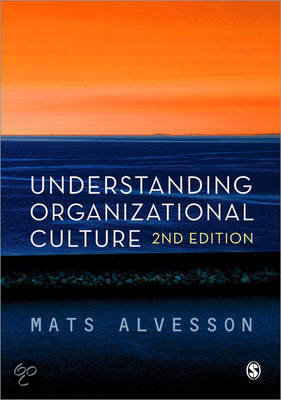
Understanding Organisational Culture (2nd edition) - Mats Alvesson – Summary
Chapter 1 – The concept of Organisational Culture
- Organisational culture is a major issue, the cultural dimension is central in all aspects of
organisational life. How people in a company think, feel, value and act is guided by ideas, meanings
and beliefs of a cultural nature.
- Managing culture: framing how the corporate world should be understood. Culture management
aspires to intervene in and regulate being, so that there is no distance between individuals purposes
and those of the organization for which they work.
- There is often a lack of a deeper understanding of how people and organizations function in terms
of culture. A well-elaborated framework and a vocabulary in which core concepts – culture, meaning,
symbols – are sorted out are necessary for understanding and for qualified organizational practice
- 1980: highlighting of corporate culture, belief that culture is the significant factor behind
performance has been shaken by problems in many companies. More rationalistic business recipes
partly replaces culture and the focus on ‘people’. Interest in culture has moved over to the nearby
and overlapping field of organisational identity.
- Still a strong case can be made for taking an interest in corporate culture in relation to performance.
Knowledge is said to be the crucial factor behind sustainable advantage and success for companies,
and knowledge issues are closely interlinked with organizational culture. Culture is thus highly
significant for how organisations function: from strategic change to everyday leadership and how
managers and employees relate to and interact with customers, as well as to how knowledge is
created, shared, maintained and utilized.
- Major point is not to preach culture as the principal means to corporate effectiveness, growth and
success. For Alvesson, organisational culture is significant as a way of understanding organizational
life in all its richness and variations. The centrality of the culture concept follows form the profound
importance of shared meanings for any coordinated action. A sense of common taken-for-granted
ideas is necessary, beliefs and meanings is necessary for continuing organised activity
The Meaning(s) of Culture
- There is an enormous variation in the definitions given to ‘organizational culture’ and even more in
the term ‘culture’.
- Assumptions about cultural phenomena
1. They are related to history and tradition
2. They have some depth, are difficult to grasp and account for, and must be interpreted
3. They are collective and shared by members of groups
4. They are primarily ideational in character, having to do with meanings, understandings,
beliefs, knowledge and other intangibles
5. They are holistic, intersubjective and emotional rather than strictly rational and analytical
- Alvesson uses the term organizational culture as an umbrella concept for a way of thinking which
takes a serious interest in cultural and symbolic phenomena
- Definition organizational culture: talking about organizational culture seems to mean talking about
the importance for people of symbolism – of rituals, myths, stories and legends – and about the
interpretation of events, ideas, and experiences that are influenced and shaped by the groups within
which they live.
- Culture is to be understood to be a system of common symbols and meanings, ‘the shared rules
governing cognitive and affective aspects of membership in an organization, and the means whereby
they are shaped and expressed’.
- Culture is not homogenous, cohesive and causal; it is emergent, dynamic, adaptive and co-created.
1
, Key Concepts of Culture: Symbols and Meanings
- Symbols and meanings most significant concepts for cultural understanding
- Meaning: how an object or utterance is interpreted, makes an object relevant and meaningful,
appeals to an expectation. Example: a rule differs in how strictly and how uniformly it is interpreted
and taken seriously owning to the cultural context giving the rule its exact meaning. In cultural
context it is always socially shared meanings that are of interest, not individual meanings. Perceptions
and beliefs are becoming more homogenous through culture.
- Symbol: an object – a word or statement, a kind of action or material phenomenon – that stands
ambiguously for something else and/or something more than the object self. A symbol is rich in
meaning, it communicates meaning in an economic way.
- Distinction between culture and social structure: culture is regarded as a more or less cohesive
system of symbols, in terms of which social interaction takes place (creation of meaning). Social
structure is regarded as the behavioural patterns which the social interaction itself gives rise to (the
form which action takes or network of social relations)
What Culture is Not
- Culture and social structure represent different abstractions of the same phenomenon
- Culture and social structure are not necessarily in well-integrated and well harmonized relationship
with each other
The Broad Relevance of a Cultural Perspective
- Cultural research concentrates on meanings anchored and transmitted in a symbolic form. Cultural
meanings guide thinking, feeling and acting. It is difficult to argue that culture is not important, but it
could be seen as something to vague and broad. Cultural analysis is about shared meanings of a
specific phenomenon that is addressed, rather than about culture as a specific object. Culture is a
perspective rather than an objective
Some Comments on the Contemporary Interest in Organizational Culture
- Increased interest in the 1980’s because of the boom experienced by Japanese companies and
difficulties for US and Western countries at the same time. Also because of theoretical concerns, is
incapable of providing deep, rich and realistic understandings; organizational culture addresses the
lived experiences of people.
- Changes in production technology and/or work organization may also have been important in
bringing the cultural dimension to sharper focus. In addition changes in values and lifestyles of among
employees and society tend to make corporate control more complicated, more important to involve
workers in the company.
- Increase in organic organisations held together by culture. Due to the important trend away from
mass production to service, knowledge and information.
Cognitive Interests
Cognitive Type of Purpose Focus Orientation Projected
Interest science Outcome
Technical Empirical- Enhance prediction Identification Calculation Removal of
analytic and control and formal
manipulation irrationality
of variables
2
,Cognitive Type of
Interest science Purpose Focus Orientation Projected
Outcome
Practical- Historical- Improve mutual Interpretation Appreciation Removal of
hermeneuti hermeneu understanding of symbolic misunderstand
c tic communicatio ing =
n understanding
Emancipat Critical Realize Exposure of Transformati Removal of
ory enlightenment domination on socially
project through and unnecessary
development of exploitation suffering
more rational social
relations
- The three cognitive interest indicate a wide spectrum of ways to approach organizational culture
and other phenomena. The relationship between the tree and in particular between technical and
emancipatory, is antagonistic. But it is possible to see bridges between them
- An understanding of cultural management not as a technocratic project where managerial agents
engineer the minds of their subordinate objects, but as an interactive, interpretative enterprise, may
reduce – but not overcome – the gap between the three approaches.
Objectives of this Book
- Two broad answers: the first views organizational culture as a means of promoting more effective
managerial action, the second views culture as a point of entry for a broader understanding of and
critical reflection upon organizational life and work. The two are not necessarily mutually exclusive
- This book takes seriously the capacity of culture to simultaneously create order, meaning, cohesion
and orientation, thus making collective action, indeed organizational life, possible, and to restrict
autonomy, creativity and questioning, thereby preventing novel, potentially more ethically thought-
through ways of organizing social life from being considered.
- The other major objective of this book is to stimulate reflection on how a cultural understanding of
organization can best be accomplished.
Culture is, as Alvesson sees it, best understood as referring to deep-level, partly non-conscious sets
of meanings, ideas and symbolism that may be contradictory and run across different social
groupings. Culture thus calls for interpretation and deciphering
Chapter 2 – Culture as a Metaphor and Metaphors for Culture
The Metaphor concept
- A metaphor is created when a term (modifier) is transferred form one system or level of meaning to
another (principal subject), thereby illuminating central aspects of the latter and shadowing others. A
metaphor allows an object to be perceive and understood from the viewpoint of another object.
- Metaphors must be approached and understood as if they were true at the same time that we are
aware that they are fictitious – created and artificial
- Frequent metaphor for organizations is a pyramid. Pyramid is the modifier, organization is the
principal subject.
- Metaphors call for some goodwill, imagination and knowledge of the subject matter
- In a narrow, traditional sense, a metaphor is simply an illustrative device, thus words that make
language richer or more felicitous and formal models can both be regarded as metaphors. In a very
3
, broad and basic sense, metaphors are seen as implying something more profound. A metaphor can
thus be seen as a crucial element in how people relate to reality.
- A metaphor is viewed as a primal, generative process that is fundamental to the creation of human
understanding and meaning in all aspects of life, in science and everyday life
- Root metaphor: a fundamental image of the world on which one is focussing. It organizes, frames
and structures the thinking or imagination around a phenomenon.
- To understand metaphors interpretation and reasoning of language is necessary, not just surface
registration of the words
- A good metaphor should have the right balance of similarity and difference between the two
elements involved
Metaphors in Social Science – Advantages and Problems
- Advantages:
Ability to develop new ideas and guide analysis in novel ways, encourage creativity and
provide insight, seeing thing form different points of view
Communicative capacity, communicate insight to others, express experiences, facilitate
understanding
Draws attention to the partiality of the understanding gained by an approach build on a
particular root metaphor, data-reducing, facilitates openness
Critical scrutiny, facilitates examination of the basic assumptions of a particular
conceptualization or phenomenon.
- Problems:
The risk of using bad ones, for example when too many key features of the metaphor see, of
limited relevance
The catchiness problem, expressive use of seductive metaphorical expressions, leads to
superficiality , fashion problem
Supermarket attitude to metaphors, metaphors will draw attention away from the
paradigmatic assumptions on which they rely
- The problems are not arguments against the use of metaphors, rather they point to a critical and
reflective approach, avoiding the temptation to overuse them an reminding that they do not tell the
whole story.
Culture as Critical Variable Versus Culture as Root Metaphor
- Researchers who see culture as a variable draw upon a more traditional, objectivist and
fundamentalist view of social reality and try to improve models of organization by taking sociocultural
subsystems, in addition to traditionally recognized variables, into account.
Recognize that organizations produce or are accompanied by more or less distinct cultural
traits, and that these features affect the behaviour of managers and employees
Suggests that several positive functions are fulfilled by culture -> sense of identity, facilitating
commitment, enhancing system stability, sense-making device
Culture is viewed as interesting in the search for suitable means of control and improves
management, ideas or causality are crucial
Culture refers to delimited and distinct phenomena, is one of several subsystems
- In contrast, researchers who see culture as a root metaphor approach organizations as if they were
cultures and draw upon anthropology in developing radically new theories or paradigms.
It is stressed that is the organisation is a culture (and not has one as in the variable view), or
can been seen as if it is a culture, organizations are understood and analysed in terms of their
expressive, ideational and symbolic aspects
4
Chapter 1 – The concept of Organisational Culture
- Organisational culture is a major issue, the cultural dimension is central in all aspects of
organisational life. How people in a company think, feel, value and act is guided by ideas, meanings
and beliefs of a cultural nature.
- Managing culture: framing how the corporate world should be understood. Culture management
aspires to intervene in and regulate being, so that there is no distance between individuals purposes
and those of the organization for which they work.
- There is often a lack of a deeper understanding of how people and organizations function in terms
of culture. A well-elaborated framework and a vocabulary in which core concepts – culture, meaning,
symbols – are sorted out are necessary for understanding and for qualified organizational practice
- 1980: highlighting of corporate culture, belief that culture is the significant factor behind
performance has been shaken by problems in many companies. More rationalistic business recipes
partly replaces culture and the focus on ‘people’. Interest in culture has moved over to the nearby
and overlapping field of organisational identity.
- Still a strong case can be made for taking an interest in corporate culture in relation to performance.
Knowledge is said to be the crucial factor behind sustainable advantage and success for companies,
and knowledge issues are closely interlinked with organizational culture. Culture is thus highly
significant for how organisations function: from strategic change to everyday leadership and how
managers and employees relate to and interact with customers, as well as to how knowledge is
created, shared, maintained and utilized.
- Major point is not to preach culture as the principal means to corporate effectiveness, growth and
success. For Alvesson, organisational culture is significant as a way of understanding organizational
life in all its richness and variations. The centrality of the culture concept follows form the profound
importance of shared meanings for any coordinated action. A sense of common taken-for-granted
ideas is necessary, beliefs and meanings is necessary for continuing organised activity
The Meaning(s) of Culture
- There is an enormous variation in the definitions given to ‘organizational culture’ and even more in
the term ‘culture’.
- Assumptions about cultural phenomena
1. They are related to history and tradition
2. They have some depth, are difficult to grasp and account for, and must be interpreted
3. They are collective and shared by members of groups
4. They are primarily ideational in character, having to do with meanings, understandings,
beliefs, knowledge and other intangibles
5. They are holistic, intersubjective and emotional rather than strictly rational and analytical
- Alvesson uses the term organizational culture as an umbrella concept for a way of thinking which
takes a serious interest in cultural and symbolic phenomena
- Definition organizational culture: talking about organizational culture seems to mean talking about
the importance for people of symbolism – of rituals, myths, stories and legends – and about the
interpretation of events, ideas, and experiences that are influenced and shaped by the groups within
which they live.
- Culture is to be understood to be a system of common symbols and meanings, ‘the shared rules
governing cognitive and affective aspects of membership in an organization, and the means whereby
they are shaped and expressed’.
- Culture is not homogenous, cohesive and causal; it is emergent, dynamic, adaptive and co-created.
1
, Key Concepts of Culture: Symbols and Meanings
- Symbols and meanings most significant concepts for cultural understanding
- Meaning: how an object or utterance is interpreted, makes an object relevant and meaningful,
appeals to an expectation. Example: a rule differs in how strictly and how uniformly it is interpreted
and taken seriously owning to the cultural context giving the rule its exact meaning. In cultural
context it is always socially shared meanings that are of interest, not individual meanings. Perceptions
and beliefs are becoming more homogenous through culture.
- Symbol: an object – a word or statement, a kind of action or material phenomenon – that stands
ambiguously for something else and/or something more than the object self. A symbol is rich in
meaning, it communicates meaning in an economic way.
- Distinction between culture and social structure: culture is regarded as a more or less cohesive
system of symbols, in terms of which social interaction takes place (creation of meaning). Social
structure is regarded as the behavioural patterns which the social interaction itself gives rise to (the
form which action takes or network of social relations)
What Culture is Not
- Culture and social structure represent different abstractions of the same phenomenon
- Culture and social structure are not necessarily in well-integrated and well harmonized relationship
with each other
The Broad Relevance of a Cultural Perspective
- Cultural research concentrates on meanings anchored and transmitted in a symbolic form. Cultural
meanings guide thinking, feeling and acting. It is difficult to argue that culture is not important, but it
could be seen as something to vague and broad. Cultural analysis is about shared meanings of a
specific phenomenon that is addressed, rather than about culture as a specific object. Culture is a
perspective rather than an objective
Some Comments on the Contemporary Interest in Organizational Culture
- Increased interest in the 1980’s because of the boom experienced by Japanese companies and
difficulties for US and Western countries at the same time. Also because of theoretical concerns, is
incapable of providing deep, rich and realistic understandings; organizational culture addresses the
lived experiences of people.
- Changes in production technology and/or work organization may also have been important in
bringing the cultural dimension to sharper focus. In addition changes in values and lifestyles of among
employees and society tend to make corporate control more complicated, more important to involve
workers in the company.
- Increase in organic organisations held together by culture. Due to the important trend away from
mass production to service, knowledge and information.
Cognitive Interests
Cognitive Type of Purpose Focus Orientation Projected
Interest science Outcome
Technical Empirical- Enhance prediction Identification Calculation Removal of
analytic and control and formal
manipulation irrationality
of variables
2
,Cognitive Type of
Interest science Purpose Focus Orientation Projected
Outcome
Practical- Historical- Improve mutual Interpretation Appreciation Removal of
hermeneuti hermeneu understanding of symbolic misunderstand
c tic communicatio ing =
n understanding
Emancipat Critical Realize Exposure of Transformati Removal of
ory enlightenment domination on socially
project through and unnecessary
development of exploitation suffering
more rational social
relations
- The three cognitive interest indicate a wide spectrum of ways to approach organizational culture
and other phenomena. The relationship between the tree and in particular between technical and
emancipatory, is antagonistic. But it is possible to see bridges between them
- An understanding of cultural management not as a technocratic project where managerial agents
engineer the minds of their subordinate objects, but as an interactive, interpretative enterprise, may
reduce – but not overcome – the gap between the three approaches.
Objectives of this Book
- Two broad answers: the first views organizational culture as a means of promoting more effective
managerial action, the second views culture as a point of entry for a broader understanding of and
critical reflection upon organizational life and work. The two are not necessarily mutually exclusive
- This book takes seriously the capacity of culture to simultaneously create order, meaning, cohesion
and orientation, thus making collective action, indeed organizational life, possible, and to restrict
autonomy, creativity and questioning, thereby preventing novel, potentially more ethically thought-
through ways of organizing social life from being considered.
- The other major objective of this book is to stimulate reflection on how a cultural understanding of
organization can best be accomplished.
Culture is, as Alvesson sees it, best understood as referring to deep-level, partly non-conscious sets
of meanings, ideas and symbolism that may be contradictory and run across different social
groupings. Culture thus calls for interpretation and deciphering
Chapter 2 – Culture as a Metaphor and Metaphors for Culture
The Metaphor concept
- A metaphor is created when a term (modifier) is transferred form one system or level of meaning to
another (principal subject), thereby illuminating central aspects of the latter and shadowing others. A
metaphor allows an object to be perceive and understood from the viewpoint of another object.
- Metaphors must be approached and understood as if they were true at the same time that we are
aware that they are fictitious – created and artificial
- Frequent metaphor for organizations is a pyramid. Pyramid is the modifier, organization is the
principal subject.
- Metaphors call for some goodwill, imagination and knowledge of the subject matter
- In a narrow, traditional sense, a metaphor is simply an illustrative device, thus words that make
language richer or more felicitous and formal models can both be regarded as metaphors. In a very
3
, broad and basic sense, metaphors are seen as implying something more profound. A metaphor can
thus be seen as a crucial element in how people relate to reality.
- A metaphor is viewed as a primal, generative process that is fundamental to the creation of human
understanding and meaning in all aspects of life, in science and everyday life
- Root metaphor: a fundamental image of the world on which one is focussing. It organizes, frames
and structures the thinking or imagination around a phenomenon.
- To understand metaphors interpretation and reasoning of language is necessary, not just surface
registration of the words
- A good metaphor should have the right balance of similarity and difference between the two
elements involved
Metaphors in Social Science – Advantages and Problems
- Advantages:
Ability to develop new ideas and guide analysis in novel ways, encourage creativity and
provide insight, seeing thing form different points of view
Communicative capacity, communicate insight to others, express experiences, facilitate
understanding
Draws attention to the partiality of the understanding gained by an approach build on a
particular root metaphor, data-reducing, facilitates openness
Critical scrutiny, facilitates examination of the basic assumptions of a particular
conceptualization or phenomenon.
- Problems:
The risk of using bad ones, for example when too many key features of the metaphor see, of
limited relevance
The catchiness problem, expressive use of seductive metaphorical expressions, leads to
superficiality , fashion problem
Supermarket attitude to metaphors, metaphors will draw attention away from the
paradigmatic assumptions on which they rely
- The problems are not arguments against the use of metaphors, rather they point to a critical and
reflective approach, avoiding the temptation to overuse them an reminding that they do not tell the
whole story.
Culture as Critical Variable Versus Culture as Root Metaphor
- Researchers who see culture as a variable draw upon a more traditional, objectivist and
fundamentalist view of social reality and try to improve models of organization by taking sociocultural
subsystems, in addition to traditionally recognized variables, into account.
Recognize that organizations produce or are accompanied by more or less distinct cultural
traits, and that these features affect the behaviour of managers and employees
Suggests that several positive functions are fulfilled by culture -> sense of identity, facilitating
commitment, enhancing system stability, sense-making device
Culture is viewed as interesting in the search for suitable means of control and improves
management, ideas or causality are crucial
Culture refers to delimited and distinct phenomena, is one of several subsystems
- In contrast, researchers who see culture as a root metaphor approach organizations as if they were
cultures and draw upon anthropology in developing radically new theories or paradigms.
It is stressed that is the organisation is a culture (and not has one as in the variable view), or
can been seen as if it is a culture, organizations are understood and analysed in terms of their
expressive, ideational and symbolic aspects
4