CPR Exam Prep (2023/ 2024 Update) |Guide with Questions and Verified Answers| 100% Correct
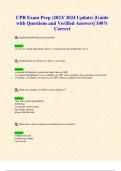
CPR Exam Prep (2023/ 2024 Update) |Guide with Questions and Verified Answers| 100% Correct Q: Implanted defibrillator or pacemaker Answer: -if you see a lump indicating a device, avoid placing the pad directly over it Q: Defibrillation for infants less than 1 year of age Answer: -a manual defibrillator is preferred rather than an AED -if a manual defibrillator is not available, an AED with a pediatric does attenuator is preferred -if neither is available, you may use an AED without a pediatric dose attenuator Q: What are examples of effective team dynamics? Answer: clear roles and responsibilities debriefing constructive intervention knowledge sharing always take the lead Q: What does a chest compression feedback device monitor? Answer: compression rate compression depth chest recoil Q: Mouth-to-mouth breaths: adults, children, and infants Answer: -3 steps -mouth-to-mouth breathing is a quick and effective way to provide oxygen to a victim when a barrier mask is not available -each breath you take contains 21% oxygen. When you provide a rescue breath, the air you breathe into a victim contains about 17% oxygen Q: Step 1: mouth-to-mouth breaths: adults, children, and infants Answer: -hold the victim's airway open with a head tilt-chin lift -pinch the nose closed with your thumb and index finger Q: Step 2: mouth-to-mouth breaths: adults, children, and infants Answer: -take a regular breath and seal your lips around the victim's mouth, creating an airtight seal -give 1 breath and blow for 1 second -watch for the chest to rise as you give each breath Q: Step 3: mouth-to-mouth breaths: adults, children, and infants Answer: -give a second breath (blowing for about 1 second) while watching for chest rise Q: Your adult friend suddenly collapse at home, and you determine she needs CPR. You begin CPR, starting with chest compressions, and are about to deliver breaths by using mouth-to-mouth breaths. You open the airway with a head tilt-chin lift. What is the sequence of your next actions? Answer: 1. Pinch the nose and seal your lips around the victim's mouth 2. Give 1 breath and blow for about 1 second 3. Watch for chest rise while giving the breath 4. Give a second breath (blowing for about 1 second, watching the chest rise) Q: Mouth-to-mouth-and-nose breathing: infants Answer: 3 steps Q: Step 1: mouth-to-mouth-and-nose breathing: infants Answer: open the infant's airway with a head tilt-chin lift Q: Step 2: mouth-to-mouth-and-nose breathing: infants Answer: place your mouth over the infant's mouth and nose to create an airtight seal Q: Step 3: mouth-to-mouth-and-nose breathing: infants Answer: give one breath, blowing for about 1 second. Watch for the chest to rise as you give the breath Q: What is a correct approach for AED pad placement for infants and children less than 8 years of age? Answer: as indicated on the pad packages
Written for
- Institution
- CPR
- Course
- CPR
Document information
- Uploaded on
- November 2, 2023
- Number of pages
- 33
- Written in
- 2023/2024
- Type
- Exam (elaborations)
- Contains
- Questions & answers
Subjects
- cpr certification test
- cpr test
- cpr
-
cpr exam prep update guide with ques
-
what is a correct approach for aed pad placement f
-
implanted defibrillator or pacemaker

Also available in package deal