Probleem 6 European Law
Leerdoelen:
1) What are the rights of EU citizens? (including the justifications/limitations)?
E-lesson Free movement of persons Part I: EU citizenship
Article 20 TFEU states that ‘Every person holding the nationality of a Member State shall be a citizen of the Union’. EU citizenship is
additional (komt bovenop) to, and conditional (is afhankelijk van) on, the national citizenship of an EU Member State.
Article 21 TFEU covers EU citizenship and gives the right to all EU citizens to reside (verblijven) and move freely within the territory of the
Member States.
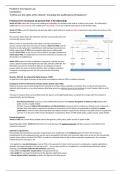
The overview below shows the distinction between economically active and
economically passive citizens:
When it comes to economically active citizens, the free movement of
persons consists of the free movement of workers (Article 45 TFEU) and the
freedom of self-employment /establishment (self-employed natural persons
falling under Article 49 TFEU and companies/legal persons falling under
Articles 49/54 TFEU). As we can see in the overview, the rights mentioned in
Article 21(1) TFEU are independent from the free movement of workers and
the freedom of establishment.
Article 21(2) grants the Union a legislative competence, and this has been
used to adopt the Citizenship Rights Directive (CRD, Directive 2004/38). This
CRD fleshes out the free movement rights for all categories of natural
persons within the Union in detail and defines their conditions and limits.
Companies, being legal persons, are not covered by the citizenship
provisions.
Directive 2004/38, the Citizenship Rights Directive (‘CRD’)
An overview of the rights of persons of entry/exit and residence under the CRD is as follows (schema).
Limitations of the Free Movement of Union citizens (Article 21(1) TFEU)
National measures may be obstructing the free movement of Union citizens regardless of whether they are directly discriminatory,
indirectly discriminatory, or non-discriminatory (the latter when they obstruct access to the territory of a host Member State to an EU
citizen).
The type of measures that can be justified under the express and implied justifications, provided they comply with the principle of
proportionality, are the following:
- Directly discriminatory measures can be justified ONLY based on the express derogations in Article 27 CRD (public policy,
public security or public health).
- All other measures (indirect discriminations, non-discrimination measures) which constitute an obstacle to the national of a
Member State who wishes to exercise his freedom of movement as an EU citizen can potentially be justified by implied
justifications, which are also called imperative/overriding/mandatory requirements relating to the public interest recognised in
case law or on the basis of the express derogations recognised by Article 27 CRD (public policy, public security, public health).
Express Derogations
Article 27 CRD sets out the three possible express derogations: public policy, public security or public health.
Regarding public health, Article 29 determines that only diseases with epidemic potential will allow measures restricting the free
movement of persons.
Imperative requirements
The principles governing these imperative requirements were established in the Gebhard-case (C-55/94) for the freedom of
establishment of self-employed persons and are also to be applied to all other free movement rights (such as the one for economically
inactive Union citizens in Article 21(1) TFEU). In order for a Member State to rely on these imperative requirements, the contested
national measures must (para. 37):
1. Be applied in a non-discriminatory manner (This is the equivalent of what in the Cassis test is mentioned as ‘equally applicable to
domestic and imported goods in law but not in fact’ – you can also read this as ‘be applied in a non-directly discriminatory manner’
meaning it also includes indirectly discriminatory measures);
2. Be justified by imperative requirements in the general interest;
3. Be suitable for securing the attainment of the objective which they pursue;
4. Not go beyond what is necessary to attain the objective that they pursue.
,
Leerdoelen:
1) What are the rights of EU citizens? (including the justifications/limitations)?
E-lesson Free movement of persons Part I: EU citizenship
Article 20 TFEU states that ‘Every person holding the nationality of a Member State shall be a citizen of the Union’. EU citizenship is
additional (komt bovenop) to, and conditional (is afhankelijk van) on, the national citizenship of an EU Member State.
Article 21 TFEU covers EU citizenship and gives the right to all EU citizens to reside (verblijven) and move freely within the territory of the
Member States.
The overview below shows the distinction between economically active and
economically passive citizens:
When it comes to economically active citizens, the free movement of
persons consists of the free movement of workers (Article 45 TFEU) and the
freedom of self-employment /establishment (self-employed natural persons
falling under Article 49 TFEU and companies/legal persons falling under
Articles 49/54 TFEU). As we can see in the overview, the rights mentioned in
Article 21(1) TFEU are independent from the free movement of workers and
the freedom of establishment.
Article 21(2) grants the Union a legislative competence, and this has been
used to adopt the Citizenship Rights Directive (CRD, Directive 2004/38). This
CRD fleshes out the free movement rights for all categories of natural
persons within the Union in detail and defines their conditions and limits.
Companies, being legal persons, are not covered by the citizenship
provisions.
Directive 2004/38, the Citizenship Rights Directive (‘CRD’)
An overview of the rights of persons of entry/exit and residence under the CRD is as follows (schema).
Limitations of the Free Movement of Union citizens (Article 21(1) TFEU)
National measures may be obstructing the free movement of Union citizens regardless of whether they are directly discriminatory,
indirectly discriminatory, or non-discriminatory (the latter when they obstruct access to the territory of a host Member State to an EU
citizen).
The type of measures that can be justified under the express and implied justifications, provided they comply with the principle of
proportionality, are the following:
- Directly discriminatory measures can be justified ONLY based on the express derogations in Article 27 CRD (public policy,
public security or public health).
- All other measures (indirect discriminations, non-discrimination measures) which constitute an obstacle to the national of a
Member State who wishes to exercise his freedom of movement as an EU citizen can potentially be justified by implied
justifications, which are also called imperative/overriding/mandatory requirements relating to the public interest recognised in
case law or on the basis of the express derogations recognised by Article 27 CRD (public policy, public security, public health).
Express Derogations
Article 27 CRD sets out the three possible express derogations: public policy, public security or public health.
Regarding public health, Article 29 determines that only diseases with epidemic potential will allow measures restricting the free
movement of persons.
Imperative requirements
The principles governing these imperative requirements were established in the Gebhard-case (C-55/94) for the freedom of
establishment of self-employed persons and are also to be applied to all other free movement rights (such as the one for economically
inactive Union citizens in Article 21(1) TFEU). In order for a Member State to rely on these imperative requirements, the contested
national measures must (para. 37):
1. Be applied in a non-discriminatory manner (This is the equivalent of what in the Cassis test is mentioned as ‘equally applicable to
domestic and imported goods in law but not in fact’ – you can also read this as ‘be applied in a non-directly discriminatory manner’
meaning it also includes indirectly discriminatory measures);
2. Be justified by imperative requirements in the general interest;
3. Be suitable for securing the attainment of the objective which they pursue;
4. Not go beyond what is necessary to attain the objective that they pursue.
,