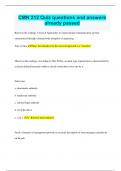
CMN 212 Quiz questions and answers already passed
CMN 212 Quiz questions and answers already passed Based on the readings, Classical Approaches to organizational communication are best characterized through a human body metaphor of organizing. True or false False, the metaphor for the classical approach is a "machine" (Based on the readings) According to Max Weber, an ideal-type organization is characterized by a clearly defined hierarchy within a closed system that is best run by a: Select one: a. charismatic authority b. traditional authority c. rational-legal authority d. all of the above e. A & C C. Rational-legal authority Fayol's elements of management provide an accurate description of what managers actually do on the job. True or false. False. According to the lesson, which of the following is not an organizing principle of the classical organization? Select one: a. Rules apply equally to all members b. The interest of the organization is more important than the interests of individual members c. Employees have the right to grievance and appeal d. The organization has no right to control member behavior Correct e. Obedience is owed to the office and not to the individual who holds it D. The organization has no right to control member behavior According to the lesson, in the classical organization, communication not related to work is only relevant when it gets in the way of work True or false True Communication is only relevant when it gets in the way of work Based on the readings, Time and motion studies were used to determine the: Select one: a. most time efficient way to accomplish tasks b. most appropriate number of employees a manager could oversee c. the best way for the organization to make a profit d. how to be most humane to employees A. the most time efficient way to accomplish tasks According to the lesson, which of the following is not a way to meet the communication challenges for the classical organization? Select one: a. Lateral Communication b. Adequate employee selection c. Redundancy d. Use of Communication & Information Technology b. adequate employee selection According to the lesson, which of the following is not one of Taylor's principles of scientific management? Select one: a. Scientific job design b. Scientific worker selection to match jobs c. Systematic soldiering among workers d. Adequate training and rewards e. Division of labor c. Systematic soldiering among workers According to the lesson, the classical Organization Theory emphasizes the Organization as an Instrument for Goal Achievement Select one: True False True The classical organization emphasizes the organization as an instrument for goal achievement Based on the readings, in a classical organization, the direction of communication flow is most often: Select one: a. upward b. downward c. across d. within b. downward this is a principle of the classical organization, communication is from the top down According to the lesson, which of the following is not true about informal communication? Select one: a. Information received through informal communication is trusted as much or more than that received through formal networks b. It is unplanned c. It enables "off the record" discussions d. Informal communication is more accurate than communication through formal channels d. informal communication is as accurate as communication formal channels According to the lesson, which of the following is not a basic assumption of human relations theory? Select one: a. Organizations should be cooperative systems b. Cooperative work is led by both the manager and the workers c. Individualistic behavior should be discouraged d. Meeting the needs of employees is a critical motivator of cooperation b. In human relations view of organizations, cooperative work is led by the manager alone Based on the readings, Theory X is representative of a manager influenced by _____ and Theory Y is representative of a manager who is influenced by ________ Select one: a. human relations movements : classical management theories b. classical management theories: human relations movements c. business motives : feel-good motives d. the best of human nature : worst of human nature b. classical management theories: human relations movements According to the lesson, an Organization Based on Human Relations Principles Will Be Less Hierarchical than the Classical Organization Select one: True False False Much as in the classical organization, Hierarchy is an important part of the human relations organization. The main difference in the human relations context is that managers or superiors are encouraged to meet the higher order needs of the employees (which was not the case in the classical organization). Based on the readings, Maslow's five types of need are arranged in a hierarchy of prepotency, meaning that: Select one: a. Some needs are more easily satisfied than others b. Higher-level needs are the most important needs c. Lower-level needs must be satisfied before an individual can move on to higher-level needs d. Needs can be defined as impotent or potent. c. Lower-level needs must be satisfied before an individual can move on to higher-level needs have to take care of the bottom before you can move up Based on the lesson, according to human resources theory, the employee's talents can be mobilized through: Select one: a. Giving them adequate information about their own jobs and about the performance of the organization as a whole c. Scientific job studies that specify what the employee should do d. Direct orders and detailed criticism by the employee's superior a. Giving them adequate information about their own jobs and about the performance of the organization as a whole Blake and Mouton believe that managers should always adopt a "middle-of-the-road management" style because it is good at compromising between production and people. Select one: True False False. Blake and mouton believe that all managers should adopt team management approach because such approach would maximize concern for both production and people Middle of the road is team management which is human resources According to the lesson, which organizational system does the human resources organization resemble the most? Select one: a. System II b. System I c. System IV d. System III c. System IV Based on the readings, it is obvious and well-supported by research that there is positive connection between job satisfaction and productivity, meaning more satisfied workers are more productive. Select one: True False False. The link between job satisfaction and productivity is not well-supported by research Which of the following is not a practice of successful human resources organizations as identified by Jeffrey Pfeffer? Select one: a. Sharing information b. Hiring freezes c. Employment security d. Self-managed teams and decentralization e. Reduction of status differences b. hiring freezes According to the lesson, systems theory originated with the study of: Select one: a. Robotics b. Communication c. Biology d. Organizations e. Sociology c. Biology Hierarchical ordering is a systems principle that implies that the functioning of one component of the system relies on other components of the system. Select one: True False False. According to the lesson, positive feedback changes a system through growth and development (reinforcement) Select one: True False True. According to the readings, _________ refers to the ability that open systems have to sustain themselves and grow Select one: a. Negative feedback b. Negative entropy c. Complexity d. Positive feedback c. negative entropy this is the definition Which system property states that a system should maintain the internal complexity necessary to cope with the complexity of its environment? Select one: a. Homeostasis b. Holism c. Requisite variety d. Negative entropy c. Requisite variety this is the definition According to the readings, in network analysis, the _________ of a communication link refers to whether the two people involved in the link have the same kind of relationship with each other. Select one: a. Strength b. Multiplexity c. Symmetry d. Density e. Complexity c. Symmetry kind of common sense when you think of it don't let this fool you According to the lesson, what is (are) the factor(s) that has (have) forced organizations to adapt more rapidly over the past 30 years? Select one: a. Technological change b. Globalization c. Social change d. All of the above e. A and B d. All of the above these are the main factors mentioned in class and lesson that have changed organizations According to the lesson, traditional hierarchical forms of organizations are slow to adapt because: Select one: a. The people at the top of these organizations tend to be older b. Information flow within these organizations tends to be slow c. Hierarchies tend to be inflexible d. All of the above e. B and C d. All of the above for this one just think traditional as being old and older people tend to move slow, also a main theme is that hierarchies are not flexible According to the lesson, which of the following is not a characteristic of network designs? Select one: a. They are assembled by brokers b. They tend to employ team based work organizations c. They have flat organizational structures d. They have clearer boundaries than more traditional organizational forms e. They make intensive use of information and communication technologies d. they have clearer boundaries than more traditional organizational forms According to the readings, given their complexity, networks do not change or evolve over time. Select one: True False False. networks are always changing and evolving based on the three topics mentioned earlier
Written for
- Institution
- CMN 212
- Course
- CMN 212
Document information
- Uploaded on
- November 1, 2023
- Number of pages
- 15
- Written in
- 2023/2024
- Type
- Exam (elaborations)
- Contains
- Questions & answers
Subjects
-
cmn 212 quiz questions and answers already passed

Also available in package deal