KEEP IT UP COACHING POINT
“Obstacles are what you see when you take your eyes off the goal.”
_____________________________________________________________________________________________
ELECTRICITY
Electricity – It is the study of electric charges.
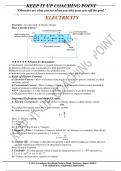
How Current Flows?
Points To Remember:
i) On demand, potential difference is created between two terminals.
ii) Electrons deficient zone is considered as high potential zone.
iii)Electrons rich zone is considered as low potential zone.
iv) It is the potential difference between two terminals which allow current to flow.
v) Kinds of Electric Current:
a) Electronic Current – Flow of electrons from negative terminal to positive terminal is called
electronic current.
b) Conventional Current – Flow of charge (which is an assumption) from positive terminal to
negative terminal is called conventional current.
i) Remember, it is the electrons which flow from negative to positive terminal.
ii) Charge never flows; it is just as assumption from positive to negative terminal.
Important Definitions and their S.I. units.
1) Electric Current (I) – i) The rate of flow of electric charge is called electric current.
OR
The charge flowing per unit time is called electric current.
ii) Mathematically, it is given by-
𝑸
𝑰=
𝒕
Here, I = Electric current.
Q = Charge.
t = Time.
iii) It’s SI unit is “Ampere”.
1 Ampere – When 1 Coulomb of charge is shifted in 1 sec between two terminals, then electric
current between those two terminals is 1 Ampere.
1𝐶
1𝐴=
1 𝑠𝑒𝑐
2) Charge (Q) – i) Charge is that physical quantity which when brought near similar physical
quantity experiences either force of attraction or repulsion.
ii) Its SI unit is Coulomb.
1 Coulomb – It is that quantity which is equal to charge present on 6 × 10¹⁸ electrons i.e.,
1 𝐶 = 6 × 1018 × 1.6 × 10−19.
iii) Charge can be positive, negative or neutral.
C-162, Govindpura Kardhani, Kalwar Road, Jhotwara, Jaipur-302012
Cell: 8890497070, 9782830493, 9649978593
, KEEP IT UP COACHING POINT
“Obstacles are what you see when you take your eyes off the goal.”
_____________________________________________________________________________________________
iv) All cations bear positive charge due to less number of electrons than protons. All anions bear
negative charge due to more number of electrons than protons.
v) Opposite charges attract each other whereas similar charges repel each other.
3) Potential Difference (V) – i) The electrical work done per coulomb of charge is called potential
difference.
ii) Mathematically, it is given by –
𝑊
𝑉=
𝑞
𝑊𝑜𝑟𝑘 𝑑𝑜𝑛𝑒
i.e., 𝑃𝑜𝑡𝑒𝑛𝑡𝑖𝑎𝑙 𝑑𝑖𝑓𝑓𝑒𝑟𝑒𝑛𝑐𝑒 = 𝐶ℎ𝑎𝑟𝑔𝑒
iii) Its SI unit is Volt (V).
1 Volt – When 1 J of electric work is done to shift 1 C of charge, then potential
difference between those two terminals is 1 Volt.
1𝐽
1 𝑉𝑜𝑙𝑡 =
1𝐶
In our household, 220V of potential difference is applied. It means 220 J of electric work is
done to shift one coulomb of charge between two terminals.
Electric Potential – It is the amount of electric work done to shift one unit positive charge from
infinity to reference point in electric field.
Different Units Of Electric Current
1 Ampere = 1000 milli Ampere = 103 𝑚 𝐴
1 Ampere = 106 micro Ampere = 106 𝜇𝐴
4) Resistance (R) – i) It is the property of all conductors to resist flow of charge.
OR
Obstruction offered by other electrons and atoms of same material in path of moving electrons is called
resistance.
ii) Its SI unit is ohm (Ω).
iii) Greater is the resistance, more is the obstruction and hence, lesser is the flow of charge.
Silver (Ag) is the best conductor whereas lead (Pb) is the worst conductor. It means resistance of
Ag is least whereas resistance of Pb is highest.
Factors Affecting Resistance
i) Length of Conductor - 𝑅 ∝ 𝑙
1
ii) Area of Cross – Section – 𝑅 ∝ 𝐴
𝑉
Thicker is the wire, lesser is the resistance and from Ohm’s law, 𝐼 = 𝑅, but V = 220 Volt is
1
constant. Therefore, 𝐼 ∝ 𝑅.
iii) Type of Material – Resistance varies metal to metal.
iv) Temperature – 𝑅 ∝ 𝑇.
What causes resistance???
i) Other electrons and atoms of the same material come on the way of moving electrons which are
responsible for flow of charge.
ii) As a result, these other electrons and atoms collide with moving electrons.
iii) As we know, K.E α v2, so moving electrons loss their energy and this lost energy converts as heat
energy.
iv) It is the resistance of material which causes heating effect in a current carrying material.
5) Specific Resistance / Resistivity (𝝆) – i) For a given conductor, at constant
temperature, resistance depends on the following factors:
1
𝑅 ∝ 𝑙 𝑎𝑛𝑑 𝑅 ∝
𝐴
ii) Combining above two equations:
C-162, Govindpura Kardhani, Kalwar Road, Jhotwara, Jaipur-302012
Cell: 8890497070, 9782830493, 9649978593
, KEEP IT UP COACHING POINT
“Obstacles are what you see when you take your eyes off the goal.”
_____________________________________________________________________________________________
𝑙
𝑅 ∝
𝐴
𝑙
𝑅=𝜌
𝐴
Here, 𝜌 is a proportionate constant called resistivity/ specific resistance of the conductor.
Let 𝑙 = 1 u, A = 1 u2.
Therefore, above equation becomes-
1𝑢
𝑅= 𝜌
1 𝑢2
𝜌=𝑅 ×𝑢
Specific resistance is nothing but the resistance of that conductor whose length is 1 unit
and area of cross – section is 1 sq. unit.
Its SI unit is 𝑜ℎ𝑚 (𝛺) − 𝑚 / 𝑜ℎ𝑚(𝛺) − 𝑐𝑚
Factors Affecting Specific Resistance
i) Type of Material – Like resistance, resistivity also varies material to material.
ii) Temperature – Resistivity is directly proportional to temperature. It means higher is the temperature,
higher is the resistivity.
Remember, resistivity of a conductor is independent of its length and area of cross section
unlike resistance.
OHM’S LAW
1) For a given conductor, at a constant temperature, potential difference in the circuit is
directly proportional to the current flowing in the circuit.
2) It means, if current flowing in the circuit is of ‘I’ Ampere and potential difference of the circuit is of
‘V’ Volts, then
𝑉 ∝𝐼
𝑉 = 𝐼𝑅
R is constant for given material.
The above equation is called Ohm’s Equation.
Explanation:
i) x – axis represents I (in Amp.).
ii) y – axis represents V (in Volts).
iii) Straight line slope confirms 𝑉 ∝ 𝐼.
iv) Slope OA gives resistance of the conductor.
Some Important Definitions –
1 Ohm (Ω) – 1 Ohm is the resistance of that conductor in which potential difference between two
terminals is 1 Volt and current flowing between those two terminals is of 1 Ampere.
C-162, Govindpura Kardhani, Kalwar Road, Jhotwara, Jaipur-302012
Cell: 8890497070, 9782830493, 9649978593
, KEEP IT UP COACHING POINT
“Obstacles are what you see when you take your eyes off the goal.”
_____________________________________________________________________________________________
1𝑉
1𝛺=
1𝐴
1 Ohm – meter (Ω-m) – 1 Ω-m is the resistivity of that conductor whose resistance is 1 Ω, length is 1 m
and area of cross – section is 1 m2.
Electrons present in 1 C of charge
1.6 × 10⁻¹⁹ 𝐶 𝑜𝑓 𝑐ℎ𝑎𝑟𝑔𝑒 = 1 𝑒 −
1×1
∴ 1 𝐶 𝑜𝑓 𝑐ℎ𝑎𝑟𝑔𝑒 = 𝑒 − = 6.25 × 10¹⁸ 𝑒 −
1.6 × 10⁻¹⁹
Explanation Of Some Important Points
➢ An electrician wears rubber sole shoes while doing electric work because:
i) Human body acts as a conductor with 0 Volt potential difference.
ii) So, by mistake, if he touches live wire, then, current passes through body.
iii) Rubber sole acts as an insulator, thus prevents flow of current and protects him from severe problems.
➢ Electrical appliances like refrigerator, cooler, air conditioners, televisions etc. possess very
thick wiring whereas small devices like tube lights, electrical bulbs etc. possess thin wiring
because-
1
i) As we know, 𝑅 ∝ 𝐴, so thicker is the wire, lesser is the resistance.
𝑉 1
ii) Also, from Ohm’s law, 𝐼 = 𝑅, but V = 220 Volt is constant. Therefore, 𝐼 ∝ 𝑅 . Lesser is the resistance,
more is the amount of current.
Due to above, wiring of devices which require more current is kept thick.
𝑅
When a wire of resistance R Ω is divided into n equal parts, then resistance of each part = 𝑛 as 𝑅 ∝
𝑙.
For example – When a copper wire of length 100 m, resistance 10Ω is divided into 10 equal parts, then
10
resistance of each part = 10 = 1 𝛺 .
Cause of Resistance in a Conductor
➢ Metals are electropositive in nature i.e., they have the tendency to lose electrons.
➢ These lost free electrons are responsible for current to flow and hence, good conductors.
Any species to be a good conductor must have either free electrons or split into constituent ions
Types of Materials
Character Conductors Resistors Insulators
Rate of flow of Very fast Slowly Not at all flows.
charge
Resistance Very less High Exceptionally high
Resistivity 10 𝛺𝑚 𝑡𝑜 10 𝛺𝑚 44 × 10−6 𝛺𝑚 𝑡𝑜 100
−8 −6
1010 𝛺𝑚 𝑡𝑜 1017 𝛺𝑚
× 10−6 𝛺𝑚
Examples All metals Most alloys like Wood, glass, cloth,
nichrome, magnanin etc rubber, diamond.
The criterion of classifying materials is based on their resistivity.
ALLOYS
Homogeneous mixture of two or more metals, one metal and one non – metal but can never be two non –
metals are called alloys.
Important Alloys and Their Composition
Alloy Composition
Brass Cu + Zn
Bronze Cu + Sn
Constantan Cu + Ni
C-162, Govindpura Kardhani, Kalwar Road, Jhotwara, Jaipur-302012
Cell: 8890497070, 9782830493, 9649978593
“Obstacles are what you see when you take your eyes off the goal.”
_____________________________________________________________________________________________
ELECTRICITY
Electricity – It is the study of electric charges.
How Current Flows?
Points To Remember:
i) On demand, potential difference is created between two terminals.
ii) Electrons deficient zone is considered as high potential zone.
iii)Electrons rich zone is considered as low potential zone.
iv) It is the potential difference between two terminals which allow current to flow.
v) Kinds of Electric Current:
a) Electronic Current – Flow of electrons from negative terminal to positive terminal is called
electronic current.
b) Conventional Current – Flow of charge (which is an assumption) from positive terminal to
negative terminal is called conventional current.
i) Remember, it is the electrons which flow from negative to positive terminal.
ii) Charge never flows; it is just as assumption from positive to negative terminal.
Important Definitions and their S.I. units.
1) Electric Current (I) – i) The rate of flow of electric charge is called electric current.
OR
The charge flowing per unit time is called electric current.
ii) Mathematically, it is given by-
𝑸
𝑰=
𝒕
Here, I = Electric current.
Q = Charge.
t = Time.
iii) It’s SI unit is “Ampere”.
1 Ampere – When 1 Coulomb of charge is shifted in 1 sec between two terminals, then electric
current between those two terminals is 1 Ampere.
1𝐶
1𝐴=
1 𝑠𝑒𝑐
2) Charge (Q) – i) Charge is that physical quantity which when brought near similar physical
quantity experiences either force of attraction or repulsion.
ii) Its SI unit is Coulomb.
1 Coulomb – It is that quantity which is equal to charge present on 6 × 10¹⁸ electrons i.e.,
1 𝐶 = 6 × 1018 × 1.6 × 10−19.
iii) Charge can be positive, negative or neutral.
C-162, Govindpura Kardhani, Kalwar Road, Jhotwara, Jaipur-302012
Cell: 8890497070, 9782830493, 9649978593
, KEEP IT UP COACHING POINT
“Obstacles are what you see when you take your eyes off the goal.”
_____________________________________________________________________________________________
iv) All cations bear positive charge due to less number of electrons than protons. All anions bear
negative charge due to more number of electrons than protons.
v) Opposite charges attract each other whereas similar charges repel each other.
3) Potential Difference (V) – i) The electrical work done per coulomb of charge is called potential
difference.
ii) Mathematically, it is given by –
𝑊
𝑉=
𝑞
𝑊𝑜𝑟𝑘 𝑑𝑜𝑛𝑒
i.e., 𝑃𝑜𝑡𝑒𝑛𝑡𝑖𝑎𝑙 𝑑𝑖𝑓𝑓𝑒𝑟𝑒𝑛𝑐𝑒 = 𝐶ℎ𝑎𝑟𝑔𝑒
iii) Its SI unit is Volt (V).
1 Volt – When 1 J of electric work is done to shift 1 C of charge, then potential
difference between those two terminals is 1 Volt.
1𝐽
1 𝑉𝑜𝑙𝑡 =
1𝐶
In our household, 220V of potential difference is applied. It means 220 J of electric work is
done to shift one coulomb of charge between two terminals.
Electric Potential – It is the amount of electric work done to shift one unit positive charge from
infinity to reference point in electric field.
Different Units Of Electric Current
1 Ampere = 1000 milli Ampere = 103 𝑚 𝐴
1 Ampere = 106 micro Ampere = 106 𝜇𝐴
4) Resistance (R) – i) It is the property of all conductors to resist flow of charge.
OR
Obstruction offered by other electrons and atoms of same material in path of moving electrons is called
resistance.
ii) Its SI unit is ohm (Ω).
iii) Greater is the resistance, more is the obstruction and hence, lesser is the flow of charge.
Silver (Ag) is the best conductor whereas lead (Pb) is the worst conductor. It means resistance of
Ag is least whereas resistance of Pb is highest.
Factors Affecting Resistance
i) Length of Conductor - 𝑅 ∝ 𝑙
1
ii) Area of Cross – Section – 𝑅 ∝ 𝐴
𝑉
Thicker is the wire, lesser is the resistance and from Ohm’s law, 𝐼 = 𝑅, but V = 220 Volt is
1
constant. Therefore, 𝐼 ∝ 𝑅.
iii) Type of Material – Resistance varies metal to metal.
iv) Temperature – 𝑅 ∝ 𝑇.
What causes resistance???
i) Other electrons and atoms of the same material come on the way of moving electrons which are
responsible for flow of charge.
ii) As a result, these other electrons and atoms collide with moving electrons.
iii) As we know, K.E α v2, so moving electrons loss their energy and this lost energy converts as heat
energy.
iv) It is the resistance of material which causes heating effect in a current carrying material.
5) Specific Resistance / Resistivity (𝝆) – i) For a given conductor, at constant
temperature, resistance depends on the following factors:
1
𝑅 ∝ 𝑙 𝑎𝑛𝑑 𝑅 ∝
𝐴
ii) Combining above two equations:
C-162, Govindpura Kardhani, Kalwar Road, Jhotwara, Jaipur-302012
Cell: 8890497070, 9782830493, 9649978593
, KEEP IT UP COACHING POINT
“Obstacles are what you see when you take your eyes off the goal.”
_____________________________________________________________________________________________
𝑙
𝑅 ∝
𝐴
𝑙
𝑅=𝜌
𝐴
Here, 𝜌 is a proportionate constant called resistivity/ specific resistance of the conductor.
Let 𝑙 = 1 u, A = 1 u2.
Therefore, above equation becomes-
1𝑢
𝑅= 𝜌
1 𝑢2
𝜌=𝑅 ×𝑢
Specific resistance is nothing but the resistance of that conductor whose length is 1 unit
and area of cross – section is 1 sq. unit.
Its SI unit is 𝑜ℎ𝑚 (𝛺) − 𝑚 / 𝑜ℎ𝑚(𝛺) − 𝑐𝑚
Factors Affecting Specific Resistance
i) Type of Material – Like resistance, resistivity also varies material to material.
ii) Temperature – Resistivity is directly proportional to temperature. It means higher is the temperature,
higher is the resistivity.
Remember, resistivity of a conductor is independent of its length and area of cross section
unlike resistance.
OHM’S LAW
1) For a given conductor, at a constant temperature, potential difference in the circuit is
directly proportional to the current flowing in the circuit.
2) It means, if current flowing in the circuit is of ‘I’ Ampere and potential difference of the circuit is of
‘V’ Volts, then
𝑉 ∝𝐼
𝑉 = 𝐼𝑅
R is constant for given material.
The above equation is called Ohm’s Equation.
Explanation:
i) x – axis represents I (in Amp.).
ii) y – axis represents V (in Volts).
iii) Straight line slope confirms 𝑉 ∝ 𝐼.
iv) Slope OA gives resistance of the conductor.
Some Important Definitions –
1 Ohm (Ω) – 1 Ohm is the resistance of that conductor in which potential difference between two
terminals is 1 Volt and current flowing between those two terminals is of 1 Ampere.
C-162, Govindpura Kardhani, Kalwar Road, Jhotwara, Jaipur-302012
Cell: 8890497070, 9782830493, 9649978593
, KEEP IT UP COACHING POINT
“Obstacles are what you see when you take your eyes off the goal.”
_____________________________________________________________________________________________
1𝑉
1𝛺=
1𝐴
1 Ohm – meter (Ω-m) – 1 Ω-m is the resistivity of that conductor whose resistance is 1 Ω, length is 1 m
and area of cross – section is 1 m2.
Electrons present in 1 C of charge
1.6 × 10⁻¹⁹ 𝐶 𝑜𝑓 𝑐ℎ𝑎𝑟𝑔𝑒 = 1 𝑒 −
1×1
∴ 1 𝐶 𝑜𝑓 𝑐ℎ𝑎𝑟𝑔𝑒 = 𝑒 − = 6.25 × 10¹⁸ 𝑒 −
1.6 × 10⁻¹⁹
Explanation Of Some Important Points
➢ An electrician wears rubber sole shoes while doing electric work because:
i) Human body acts as a conductor with 0 Volt potential difference.
ii) So, by mistake, if he touches live wire, then, current passes through body.
iii) Rubber sole acts as an insulator, thus prevents flow of current and protects him from severe problems.
➢ Electrical appliances like refrigerator, cooler, air conditioners, televisions etc. possess very
thick wiring whereas small devices like tube lights, electrical bulbs etc. possess thin wiring
because-
1
i) As we know, 𝑅 ∝ 𝐴, so thicker is the wire, lesser is the resistance.
𝑉 1
ii) Also, from Ohm’s law, 𝐼 = 𝑅, but V = 220 Volt is constant. Therefore, 𝐼 ∝ 𝑅 . Lesser is the resistance,
more is the amount of current.
Due to above, wiring of devices which require more current is kept thick.
𝑅
When a wire of resistance R Ω is divided into n equal parts, then resistance of each part = 𝑛 as 𝑅 ∝
𝑙.
For example – When a copper wire of length 100 m, resistance 10Ω is divided into 10 equal parts, then
10
resistance of each part = 10 = 1 𝛺 .
Cause of Resistance in a Conductor
➢ Metals are electropositive in nature i.e., they have the tendency to lose electrons.
➢ These lost free electrons are responsible for current to flow and hence, good conductors.
Any species to be a good conductor must have either free electrons or split into constituent ions
Types of Materials
Character Conductors Resistors Insulators
Rate of flow of Very fast Slowly Not at all flows.
charge
Resistance Very less High Exceptionally high
Resistivity 10 𝛺𝑚 𝑡𝑜 10 𝛺𝑚 44 × 10−6 𝛺𝑚 𝑡𝑜 100
−8 −6
1010 𝛺𝑚 𝑡𝑜 1017 𝛺𝑚
× 10−6 𝛺𝑚
Examples All metals Most alloys like Wood, glass, cloth,
nichrome, magnanin etc rubber, diamond.
The criterion of classifying materials is based on their resistivity.
ALLOYS
Homogeneous mixture of two or more metals, one metal and one non – metal but can never be two non –
metals are called alloys.
Important Alloys and Their Composition
Alloy Composition
Brass Cu + Zn
Bronze Cu + Sn
Constantan Cu + Ni
C-162, Govindpura Kardhani, Kalwar Road, Jhotwara, Jaipur-302012
Cell: 8890497070, 9782830493, 9649978593