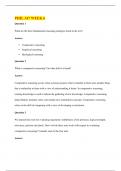
PHIL 347 WEEK 6 Question 1 What are the three fundamental reasoning strategies listed in the text? Answer • Comparative reasoning • Empirical reasoning • Ideological reasoning Question 2 What is comparative reasoning? On what skill is it based? Ans
PHIL 347 WEEK 6 Question 1 What are the three fundamental reasoning strategies listed in the text? Answer • Comparative reasoning • Empirical reasoning • Ideological reasoning Question 2 What is comparative reasoning? On what skill is it based? Answer Comparative reasoning occurs when a person projects what is familiar to them onto another thing that is unfamiliar to them with a view of understanding it better. In comparative reasoning, existing knowledge is used to inform the gathering of new knowledge. Comparative reasoning helps thinkers interpret, infer, and explain new (unfamiliar) concepts. Comparative reasoning relies on the skill of comparing with a view of developing a conclusion. Question 3 We learned four tests for evaluating arguments: truthfulness of the premises, logical strength, relevance, and non-circularity. How well do these tests work with respect to evaluating comparative reasoning? Consider each of the four tests. Answer Comparative reasoning does not seek to determine whether a conclusion is true or not but to hypothesize, illustrate, and illuminate concepts using previously acquired knowledge. The four tests of evaluating arguments do not work well in evaluating comparative reasoning. Instead of the four tests, the five criteria of simplicity, familiarity, productivity, comprehensiveness, and testability would work better in evaluating comparative reasoning. Truth of the premises does not work in comparative reasoning because concepts under comparison are not linked in ways that a thinker would say one is truer than the other. Logical strength shows dissimilarity or similarity thereby making comparisons plausible but not logical or illogical. Relevance is not directly evident in comparative reasoning. A thinker must go out of their way to make observations that show relevance. Non-circularity does not apply in critical reasoning because comparative inferences originates from familiar towards unfamiliar concepts. Question 4 Briefly explain how we can determine if one comparison is more comprehensive than another. Answer We can determine the comprehensiveness of a comparison using the notable features contained in that comparison. In that case, one should check for the following features in the comparison; 1. Are the premises true? 2. How difficult is it to imagine counter-arguments? 3. Are the
Written for
- Institution
- PHIL 347
- Course
- PHIL 347
Document information
- Uploaded on
- November 1, 2023
- Number of pages
- 7
- Written in
- 2023/2024
- Type
- Exam (elaborations)
- Contains
- Questions & answers
Subjects
-
phil 347 week 6 question 1 what are the three fu

Also available in package deal