Discipline Assignment 3
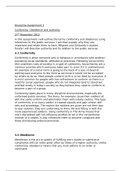
Conformity, Obedience and authority
27th November 2015
In this assignment I will outline the terms conformity and obedience using
references to the public services. I will then explain why they are
important and relate them to Asch, Milgram and Zimbardo’s studies.
Finally I will describe authority and its relation to the public services.
3.1 Conformity
Conformity is when someone acts or behaves in accordance with another/
prevailing social standards, attitudes or practices. Following social norms
(the unwritten rules of society) is a type of conformity. Social Norms are a
common practise which everyone takes part in, even if it is unintentional.
An example of a social norm is going to the back of a que, instead of
walking past everyone to the front as we know it would not be accepted
by others to do so. Most people conform to fit in or be liked by everyone. It
is most common for people with low self-esteem to conform as there is a
need for social approval, people who do not integrate tend to stand out
and feel lonely in today’s society so they believe they need to conform to
become a part of a group.
Conformity takes place in every discipline environments, especially the
uniformed public services. The Army, for example, issue their soldiers all
with the same uniform and administer them with a daily routine. This type
of conformity is so every soldier is treated equally and gain similar skill
sets and knowledge. The routine the soldiers are given are not their day-
to-day routines, they are conforming to Army life and fitting in with the
more experienced soldiers. Using conformity in The Army means that
one’s disciplined self can influence another to act in the conventional
manner of a soldier, it also influences them to become compliant with
those distributing orders/commands.
3.2 Obedience
Obedience is the act or quality of fulfilling one’s duties or submissive
compliance with an order given often by those of a higher authority. Unlike
conformity, obedience means that you must adhere to an order or
command.
, The practice of obedience ensures the public services are efficient with
their work and remain in a discipline state. An act of compliance/
obedience would be a squadron leader in the Royal Air Force asking a pilot
officer to carry out an errand and them completing this without tension
building between them. Following orders like this is essential in the
services as there is a clear structure of authority. They always give orders
with an intended objective to be achieved. Following orders are not the
only form of obedience, complying with the standard rules and regulations
of an everyday job are also part of being obedient.
Conscious obedience is when you make an effort to follow the orders you
have been given, you are fully aware that you are carrying them out.
Unconscious obedience is when you have done something so many times
that you do not need to think out it and no longer realise you are, it may
be part of your everyday routine. This would be like your captain in The
Navy asking you to complete a water-based exercise and you doing so,
this is conscious obedience as you know you are doing this. An example of
unconscious obedience would be waking up in the morning and them
ironing their uniforms, this is a regular part of their routine so they would
not need to think about it.
Status as a factor in obedience means that when there is a hierarchical
structure present people are likely to follow orders from those of a higher
status than them. This. Can be seen in The Army, if a private was to tell
another private that he needed to get a haircut he is not likely to listen as
they are the same status. On the other hand, if his sergeant was to tell
him, he would follow the order and get a haircut immediately. In the
services, obedience relies on your rank as people are going to respect you
more if you are higher than them and want to be compliant to be noticed.
Status can ensure obedience as most people in the services want to excel
and gain a promotion, this would only be possible if they show they can
follow orders.
There are many ways of ensuring discipline and obedience are retained.
Fear is one way of this, disobedience in the services can have serious
consequences so by assuring them that there will be punishments it
makes them fear the thought of becoming disobedient. There would also
be that fear of not being able to develop in that career (e.g. promotions) if
you were not to follow orders. This leads on to rewards, when the
services offer rewards people are more likely to comply as they know they
can gain something from it. Rewards that are commonly distributed to
obedient soldiers consist of promotions, increased leave and medals as
they do no receive financial rewards. Honour/ love towards your service
is a positive influence on retaining obedience as if someone appreciates
their job they are more likely to excel within it and try their best to follow
every order given. The affection for their team members would also mean
that they would develop as a result of obedience towards their duty.
Conformity, Obedience and authority
27th November 2015
In this assignment I will outline the terms conformity and obedience using
references to the public services. I will then explain why they are
important and relate them to Asch, Milgram and Zimbardo’s studies.
Finally I will describe authority and its relation to the public services.
3.1 Conformity
Conformity is when someone acts or behaves in accordance with another/
prevailing social standards, attitudes or practices. Following social norms
(the unwritten rules of society) is a type of conformity. Social Norms are a
common practise which everyone takes part in, even if it is unintentional.
An example of a social norm is going to the back of a que, instead of
walking past everyone to the front as we know it would not be accepted
by others to do so. Most people conform to fit in or be liked by everyone. It
is most common for people with low self-esteem to conform as there is a
need for social approval, people who do not integrate tend to stand out
and feel lonely in today’s society so they believe they need to conform to
become a part of a group.
Conformity takes place in every discipline environments, especially the
uniformed public services. The Army, for example, issue their soldiers all
with the same uniform and administer them with a daily routine. This type
of conformity is so every soldier is treated equally and gain similar skill
sets and knowledge. The routine the soldiers are given are not their day-
to-day routines, they are conforming to Army life and fitting in with the
more experienced soldiers. Using conformity in The Army means that
one’s disciplined self can influence another to act in the conventional
manner of a soldier, it also influences them to become compliant with
those distributing orders/commands.
3.2 Obedience
Obedience is the act or quality of fulfilling one’s duties or submissive
compliance with an order given often by those of a higher authority. Unlike
conformity, obedience means that you must adhere to an order or
command.
, The practice of obedience ensures the public services are efficient with
their work and remain in a discipline state. An act of compliance/
obedience would be a squadron leader in the Royal Air Force asking a pilot
officer to carry out an errand and them completing this without tension
building between them. Following orders like this is essential in the
services as there is a clear structure of authority. They always give orders
with an intended objective to be achieved. Following orders are not the
only form of obedience, complying with the standard rules and regulations
of an everyday job are also part of being obedient.
Conscious obedience is when you make an effort to follow the orders you
have been given, you are fully aware that you are carrying them out.
Unconscious obedience is when you have done something so many times
that you do not need to think out it and no longer realise you are, it may
be part of your everyday routine. This would be like your captain in The
Navy asking you to complete a water-based exercise and you doing so,
this is conscious obedience as you know you are doing this. An example of
unconscious obedience would be waking up in the morning and them
ironing their uniforms, this is a regular part of their routine so they would
not need to think about it.
Status as a factor in obedience means that when there is a hierarchical
structure present people are likely to follow orders from those of a higher
status than them. This. Can be seen in The Army, if a private was to tell
another private that he needed to get a haircut he is not likely to listen as
they are the same status. On the other hand, if his sergeant was to tell
him, he would follow the order and get a haircut immediately. In the
services, obedience relies on your rank as people are going to respect you
more if you are higher than them and want to be compliant to be noticed.
Status can ensure obedience as most people in the services want to excel
and gain a promotion, this would only be possible if they show they can
follow orders.
There are many ways of ensuring discipline and obedience are retained.
Fear is one way of this, disobedience in the services can have serious
consequences so by assuring them that there will be punishments it
makes them fear the thought of becoming disobedient. There would also
be that fear of not being able to develop in that career (e.g. promotions) if
you were not to follow orders. This leads on to rewards, when the
services offer rewards people are more likely to comply as they know they
can gain something from it. Rewards that are commonly distributed to
obedient soldiers consist of promotions, increased leave and medals as
they do no receive financial rewards. Honour/ love towards your service
is a positive influence on retaining obedience as if someone appreciates
their job they are more likely to excel within it and try their best to follow
every order given. The affection for their team members would also mean
that they would develop as a result of obedience towards their duty.