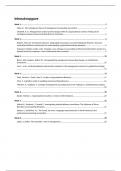
Inhoudsopgave
Week 1.......................................................................................................................................................... 2
Otley, D., The contingency theory of management accounting and control........................................................2
Chenhall, R. H., Management control systems design within its organizational context: Findings from
contingency-based research and directions for the future..................................................................................4
Week 2.......................................................................................................................................................... 6
Roberts, Peter W.; Greenwood, Royston, Integrating transaction cost and institutional theories: Toward a
constrained-efficiency framework for understanding organizational design adoption.......................................6
Tsamenyi, Mathew, Cullen, John, Gonzalez, Jose, Changes in accounting and financial information system in a
Spanish electricity company: A new institutional theory analysis.......................................................................9
Week 3........................................................................................................................................................ 10
Burns, John; Scapens, Robert W., Conceptualizing management accounting change: an institutional
framework..........................................................................................................................................................10
Cruz, I. et al., Institutionalization and practice variation in the management control of a global/local setting
............................................................................................................................................................................13
Week 4........................................................................................................................................................ 13
Gioia, Dennis A.; Poole, Peter P., Scripts in Organizational Behavior,................................................................13
Choo, F., Cognitive scripts in auditing and accounting behaviour......................................................................16
Tillmann, K., Goddard, A., Strategic management accounting and sense-making in a multinational company
............................................................................................................................................................................18
Week 6........................................................................................................................................................ 20
Becker, Markus C., Organizational routines: a review of the literature.............................................................20
Week 7........................................................................................................................................................ 25
Malsch B., Gendron Y., Grazzini F., Investigating interdisciplinary translations: The influence of Pierre
Bourdieu on accounting literature.....................................................................................................................25
Spence, C. and Brivot, M., ‘No French, no more’: language-based exclusion in North America’s first
professional accounting association..................................................................................................................27
Week 8........................................................................................................................................................ 28
Sathe, V. (1983). The controller’s role in management......................................................................................28
,Week 1
Otley, D., The contingency theory of management accounting and
control
The contingency theory: there is no one-size-fits-all approach to managing or organizing a company.
It is to identify specific aspects of an accounting system which are associated with certain
circumstances. Following three areas are needed to be paid attention on:
- Which aspects need to be looked at in the MCSs?
o Every study uses different aspects to look at the MCSs.
- Which circumstances should be looked at?
o Different circumstances make comparability difficult.
- What do we understand as an appropriate matching?
o Organizations have been using performance to indicate how appropriate the
matching is but this only has a little impact on the MCSs.
RAPM: Reliance on Accounting Performance Measures Multiple studies identified that RAPM can
vary depending on the context and that a more precise understanding of the concept is needed for
better management practices.
Environmental uncertainty When an organization faces this, it is important to be flexible and
adaptable to manage unexpected activities. However, hostility (vijandigheid) causes for a greater
reliance on accounting controls (especially budgets).
Strategy There are 4 organisational types: defenders, prospectors, analyzers and reactors.
Defenders undertake little production innovation whereas prospectors are continually searching for
new market opportunities.
The contingency work on the relationship between strategy and MCS design and use is fragmented in
several ways:
- There is a reliance on simple generic strategy characterizations that may fail to capture the
complexity of organizational strategies.
- It is not always clear whether what is being measured is an espoused or realizes strategy and
if it is even used in sub-units of the organization.
Culture Major dimensions on which cultures could be distinguished are:
- Power distance
- Individualism
- Masculinity
- Uncertainty avoidance
- Short-term vs long-term emphasis
It is almost impossible to generalize about the effects of culture on MCS design and use because:
- National culture is an average of a wide range of variation of variation between individuals.
- Culture has an impact on behaviour and attitudes. Results will contain significant amounts of
noise.
Effectiveness The most used measure of effectiveness is the financial performance. The problem with
this is that profitability is affected by a huge range of factors other than MCS design or use which
causes noise. Secondly, poor financial performance can cause more attention to the financial control
techniques. In this case the financial performance can vary or change based on different situations,
making it a variable that is influenced by contingencies or specific conditions.
,
, Chenhall, R. H., Management control systems design within its
organizational context: Findings from contingency-based research
and directions for the future
To make recommendations to a particular organization it is necessary that the specific attributes of
the environment be identified:
The external environment
The difference between uncertainty and risk is:
- Risk is concerned with situations in which probabilities can be attached to events occurring.
- Uncertainty defines situations in which probabilities cannot be attached and even the
elements of the environment may not be predictable.
These 2 do not provide a comprehensive description of the environment. A useful taxanomy of
environmental variables are:
- turbulence (risky, unpredictable, fluctuating, ambiguous),
- hostility (stressful, dominating, restrictive),
- diversity (variety in products, inputs, customers),
- complexity (rapidly developing technologies).
The more uncertain the external environment the more open and externally focused the MCS.
The more hostile and turbulent the external environment the greater the reliance on formal
controls and an emphasis on traditional budgets.
Where MCS focused on tight financial controls are used in uncertain external environments they
will be used together with an emphasis on flexible, interpersonal interactions.
Generic concepts of technology
Three generic types of technology of importance to MCS design maybe identified from the
organizational literature:
- complexity
- task uncertainty
- and interdependence.
Technologies characterized by more (less) standardized and automated processes are served by
more(less)traditional formal MCS with highly (less)developed process controls; high (low) budget use
and high(low) budgetary controls.
Contemporary technologies
Over the past 20 years MCS research has developed to consider the role of advanced technologies
such as Just in Time (JIT), Total Quality Management (TQM) and Flexible Manufacturing (FM) as
dimensions of context. JIT is best suited to open, informal, organic forms of controls. Similar
arguments may be made for implementing innovative MCS in TQM and FM situations. These
technologies have high variability and low analyzability. The low analyzability derives from the need
to continually exploit potential complementarities between the various elements of TQM practices.
Organizational structure
Generally, it is believed that more organic structures are suited to uncertain environments. However,
it should be noted that Lawrence and Lorsch (1967) identified a need for higher levels of
differentiation to cope with diverse and uncertain environments and that this causes potential
integration problems which require sophisticated liaison mechanisms (integrative personnel,
meetings), rather than rules and procedures.
Week 1.......................................................................................................................................................... 2
Otley, D., The contingency theory of management accounting and control........................................................2
Chenhall, R. H., Management control systems design within its organizational context: Findings from
contingency-based research and directions for the future..................................................................................4
Week 2.......................................................................................................................................................... 6
Roberts, Peter W.; Greenwood, Royston, Integrating transaction cost and institutional theories: Toward a
constrained-efficiency framework for understanding organizational design adoption.......................................6
Tsamenyi, Mathew, Cullen, John, Gonzalez, Jose, Changes in accounting and financial information system in a
Spanish electricity company: A new institutional theory analysis.......................................................................9
Week 3........................................................................................................................................................ 10
Burns, John; Scapens, Robert W., Conceptualizing management accounting change: an institutional
framework..........................................................................................................................................................10
Cruz, I. et al., Institutionalization and practice variation in the management control of a global/local setting
............................................................................................................................................................................13
Week 4........................................................................................................................................................ 13
Gioia, Dennis A.; Poole, Peter P., Scripts in Organizational Behavior,................................................................13
Choo, F., Cognitive scripts in auditing and accounting behaviour......................................................................16
Tillmann, K., Goddard, A., Strategic management accounting and sense-making in a multinational company
............................................................................................................................................................................18
Week 6........................................................................................................................................................ 20
Becker, Markus C., Organizational routines: a review of the literature.............................................................20
Week 7........................................................................................................................................................ 25
Malsch B., Gendron Y., Grazzini F., Investigating interdisciplinary translations: The influence of Pierre
Bourdieu on accounting literature.....................................................................................................................25
Spence, C. and Brivot, M., ‘No French, no more’: language-based exclusion in North America’s first
professional accounting association..................................................................................................................27
Week 8........................................................................................................................................................ 28
Sathe, V. (1983). The controller’s role in management......................................................................................28
,Week 1
Otley, D., The contingency theory of management accounting and
control
The contingency theory: there is no one-size-fits-all approach to managing or organizing a company.
It is to identify specific aspects of an accounting system which are associated with certain
circumstances. Following three areas are needed to be paid attention on:
- Which aspects need to be looked at in the MCSs?
o Every study uses different aspects to look at the MCSs.
- Which circumstances should be looked at?
o Different circumstances make comparability difficult.
- What do we understand as an appropriate matching?
o Organizations have been using performance to indicate how appropriate the
matching is but this only has a little impact on the MCSs.
RAPM: Reliance on Accounting Performance Measures Multiple studies identified that RAPM can
vary depending on the context and that a more precise understanding of the concept is needed for
better management practices.
Environmental uncertainty When an organization faces this, it is important to be flexible and
adaptable to manage unexpected activities. However, hostility (vijandigheid) causes for a greater
reliance on accounting controls (especially budgets).
Strategy There are 4 organisational types: defenders, prospectors, analyzers and reactors.
Defenders undertake little production innovation whereas prospectors are continually searching for
new market opportunities.
The contingency work on the relationship between strategy and MCS design and use is fragmented in
several ways:
- There is a reliance on simple generic strategy characterizations that may fail to capture the
complexity of organizational strategies.
- It is not always clear whether what is being measured is an espoused or realizes strategy and
if it is even used in sub-units of the organization.
Culture Major dimensions on which cultures could be distinguished are:
- Power distance
- Individualism
- Masculinity
- Uncertainty avoidance
- Short-term vs long-term emphasis
It is almost impossible to generalize about the effects of culture on MCS design and use because:
- National culture is an average of a wide range of variation of variation between individuals.
- Culture has an impact on behaviour and attitudes. Results will contain significant amounts of
noise.
Effectiveness The most used measure of effectiveness is the financial performance. The problem with
this is that profitability is affected by a huge range of factors other than MCS design or use which
causes noise. Secondly, poor financial performance can cause more attention to the financial control
techniques. In this case the financial performance can vary or change based on different situations,
making it a variable that is influenced by contingencies or specific conditions.
,
, Chenhall, R. H., Management control systems design within its
organizational context: Findings from contingency-based research
and directions for the future
To make recommendations to a particular organization it is necessary that the specific attributes of
the environment be identified:
The external environment
The difference between uncertainty and risk is:
- Risk is concerned with situations in which probabilities can be attached to events occurring.
- Uncertainty defines situations in which probabilities cannot be attached and even the
elements of the environment may not be predictable.
These 2 do not provide a comprehensive description of the environment. A useful taxanomy of
environmental variables are:
- turbulence (risky, unpredictable, fluctuating, ambiguous),
- hostility (stressful, dominating, restrictive),
- diversity (variety in products, inputs, customers),
- complexity (rapidly developing technologies).
The more uncertain the external environment the more open and externally focused the MCS.
The more hostile and turbulent the external environment the greater the reliance on formal
controls and an emphasis on traditional budgets.
Where MCS focused on tight financial controls are used in uncertain external environments they
will be used together with an emphasis on flexible, interpersonal interactions.
Generic concepts of technology
Three generic types of technology of importance to MCS design maybe identified from the
organizational literature:
- complexity
- task uncertainty
- and interdependence.
Technologies characterized by more (less) standardized and automated processes are served by
more(less)traditional formal MCS with highly (less)developed process controls; high (low) budget use
and high(low) budgetary controls.
Contemporary technologies
Over the past 20 years MCS research has developed to consider the role of advanced technologies
such as Just in Time (JIT), Total Quality Management (TQM) and Flexible Manufacturing (FM) as
dimensions of context. JIT is best suited to open, informal, organic forms of controls. Similar
arguments may be made for implementing innovative MCS in TQM and FM situations. These
technologies have high variability and low analyzability. The low analyzability derives from the need
to continually exploit potential complementarities between the various elements of TQM practices.
Organizational structure
Generally, it is believed that more organic structures are suited to uncertain environments. However,
it should be noted that Lawrence and Lorsch (1967) identified a need for higher levels of
differentiation to cope with diverse and uncertain environments and that this causes potential
integration problems which require sophisticated liaison mechanisms (integrative personnel,
meetings), rather than rules and procedures.