Summary materials, module 1
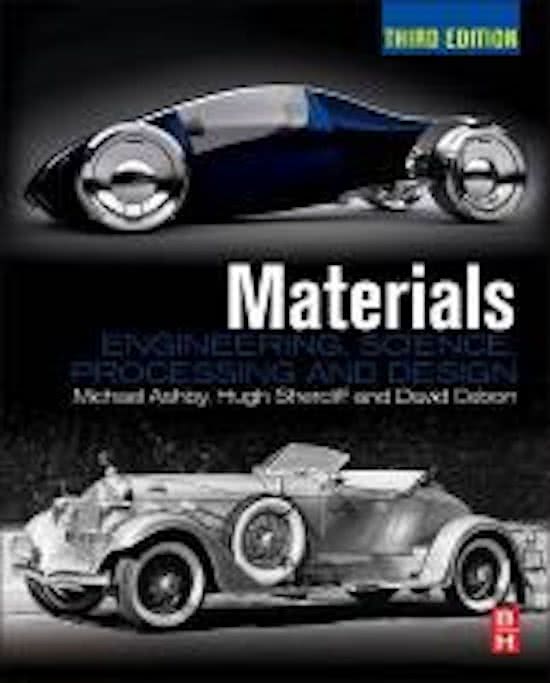
Chapters 1 through 9 of Materials: engineering, science, processing and design
Chapter 1: Introduction: materials – history and
character
Several categories of material properties:
Mechanical properties: properties that have to do with how safely a certain material can
carry a load. Mechanical properties include:
o Density (ρ): mass per unit volume.
o Elastic stiffnes (E): the higher E (Elastic modulus), the stiffer the material.
o Yield strength (σy): the ease with which an object can be permanently bent.
o Tensile strength (σts): indicates the amount of force that can be applied before the
material fails.
o Fracture toughness (K1c): the resistance of materials to cracking and fracture (tougher
materials have a high K1c).
Thermal properties: properties that indicate what happens to the material when the
temperature changes. Thermal properties include:
o Maximum service temperature (Tmax): the temperature above which the use of a
certain material is impractical.
o Thermal expansion coefficient (α): the amount of expansion a certain material
undergoes when heated.
o Thermal conductivity (λ): the rate at which heat flow through the material when the
material is heated.
Low λ insulator.
High λ conductor.
o Heat capacity (Cp): the amount of heat (energy) a certain material takes to make the
temperature of the material rise by a given amount (for example 1 K).
o Thermal diffusivity (a): measures the rate of transfer of heat of a material from the
hot side to the cold side, proportional to λ/ Cp.
Electrical, magnetic and optical properties:
o Resistivity (ρe): high resistivity means low electrical conductivity.
o Electrical conductivity (κe): high electrical conductivity means low resistivity.
o Dielectric constant (εD): materials with a high dielectric constant respond to an
electric field by shifting their electrons about.
o Absorbing/reflecting light
Chemical properties
Environmental properties
Design-limiting properties: in order to achieve a desired level of performance, the choice of materials
for a product is limited. Materials are chosen by identifying design-limiting properties, applying limits
to them and screening out those that do not meet the limits.
1
, Chapter 2: Family trees: organizing materials and
processes
Both materials and processing methods can be classified into categories: family class sub-class
particular member (e.g. metals aluminium alloys 6000 series alloy 6061).
Classifying materials
Metals:
o Advantages: high stiffness (E), easily deformed (low σy), tough (high K1c), good
electrical + thermal conductors.
o Disadvantages: reactive, corrode rapidly if not protected.
Ceramics:
o Advantages: high stiffness (E), hardness, abrasion-resistant, retain strength in high
temperatures, resist corrosion well, good electrical insulators.
o Disadvantage: brittle (low K1c).
Glasses: same advantages and disadvantages as ceramics, plus the advantage that glass is
transparent.
Polymers: organic solids based on long chains of carbon (or sometimes silicon).
o Advantages: low density (light), strong (strength per unit weight is comparable to that
of metals), easy to shape.
o Disadvantages: flexible (though this can be an advantage), properties depend on
temperature.
Elastomers:
o Advantages: low density (light), very flexible, strong and tough.
o Disadvantage: properties depend on temperature.
Hybrids: combinations of two or more materials.
o Advantage: combining materials results in the hybrid having the advantages of all of
these materials.
o Disadvantages: expensive, relatively difficult to form and join.
Two types of material property charts:
Bar chart: a plot of one property for all the materials in the universe.
Bubble chart: a plot of two properties for materials material families distinctly separated.
Classifying processes
Primary processes (shaping): creates shapes.
o Casting
o Moulding
o Deformation
o Power methods
o Methods for forming composites
o Special methods (e.g. rapid prototyping)
Secondary processes: modify shapes or properties.
o Machining (adds features to an already shaped body)
o Heat treatment (enhances surface or bulk properties, e.g. heat-treating glass to make
it bullet-proof)
o Joining
o Surface treatment
2
Chapters 1 through 9 of Materials: engineering, science, processing and design
Chapter 1: Introduction: materials – history and
character
Several categories of material properties:
Mechanical properties: properties that have to do with how safely a certain material can
carry a load. Mechanical properties include:
o Density (ρ): mass per unit volume.
o Elastic stiffnes (E): the higher E (Elastic modulus), the stiffer the material.
o Yield strength (σy): the ease with which an object can be permanently bent.
o Tensile strength (σts): indicates the amount of force that can be applied before the
material fails.
o Fracture toughness (K1c): the resistance of materials to cracking and fracture (tougher
materials have a high K1c).
Thermal properties: properties that indicate what happens to the material when the
temperature changes. Thermal properties include:
o Maximum service temperature (Tmax): the temperature above which the use of a
certain material is impractical.
o Thermal expansion coefficient (α): the amount of expansion a certain material
undergoes when heated.
o Thermal conductivity (λ): the rate at which heat flow through the material when the
material is heated.
Low λ insulator.
High λ conductor.
o Heat capacity (Cp): the amount of heat (energy) a certain material takes to make the
temperature of the material rise by a given amount (for example 1 K).
o Thermal diffusivity (a): measures the rate of transfer of heat of a material from the
hot side to the cold side, proportional to λ/ Cp.
Electrical, magnetic and optical properties:
o Resistivity (ρe): high resistivity means low electrical conductivity.
o Electrical conductivity (κe): high electrical conductivity means low resistivity.
o Dielectric constant (εD): materials with a high dielectric constant respond to an
electric field by shifting their electrons about.
o Absorbing/reflecting light
Chemical properties
Environmental properties
Design-limiting properties: in order to achieve a desired level of performance, the choice of materials
for a product is limited. Materials are chosen by identifying design-limiting properties, applying limits
to them and screening out those that do not meet the limits.
1
, Chapter 2: Family trees: organizing materials and
processes
Both materials and processing methods can be classified into categories: family class sub-class
particular member (e.g. metals aluminium alloys 6000 series alloy 6061).
Classifying materials
Metals:
o Advantages: high stiffness (E), easily deformed (low σy), tough (high K1c), good
electrical + thermal conductors.
o Disadvantages: reactive, corrode rapidly if not protected.
Ceramics:
o Advantages: high stiffness (E), hardness, abrasion-resistant, retain strength in high
temperatures, resist corrosion well, good electrical insulators.
o Disadvantage: brittle (low K1c).
Glasses: same advantages and disadvantages as ceramics, plus the advantage that glass is
transparent.
Polymers: organic solids based on long chains of carbon (or sometimes silicon).
o Advantages: low density (light), strong (strength per unit weight is comparable to that
of metals), easy to shape.
o Disadvantages: flexible (though this can be an advantage), properties depend on
temperature.
Elastomers:
o Advantages: low density (light), very flexible, strong and tough.
o Disadvantage: properties depend on temperature.
Hybrids: combinations of two or more materials.
o Advantage: combining materials results in the hybrid having the advantages of all of
these materials.
o Disadvantages: expensive, relatively difficult to form and join.
Two types of material property charts:
Bar chart: a plot of one property for all the materials in the universe.
Bubble chart: a plot of two properties for materials material families distinctly separated.
Classifying processes
Primary processes (shaping): creates shapes.
o Casting
o Moulding
o Deformation
o Power methods
o Methods for forming composites
o Special methods (e.g. rapid prototyping)
Secondary processes: modify shapes or properties.
o Machining (adds features to an already shaped body)
o Heat treatment (enhances surface or bulk properties, e.g. heat-treating glass to make
it bullet-proof)
o Joining
o Surface treatment
2