Summarised by Georgia Horrigan
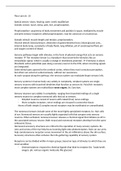
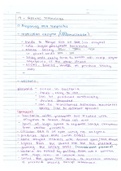
CHAPTER 3: WHAT IS MONEY (pg. 97)
Money has taken different forms at Learning objectives:
different times, but it has always been 3.1 Describe what money is
important to people and to the
economy 3.2 List and summarise the functions of money
3.3 Identify different types of payment systems
Chapter summary pg. 107-108
3.4 Compare and contrast the M1 & M2 money supplies
3.1. MEANING OF MONEY
Economic meaning differs from conversational/conventional meaning
Money (aka money supply) = anything that is generally accepted as payment for goods
or services or in the repayment of debts
Currency = one type of money (eg. bills & coins)
This = what most people mean to when they say “money” (too narrow for economists)
Cheques accepted as payment, therefore chequing account deposits = money as well
Other things (savings deposits) = money too since they can be converted into currency
Term “money” often used to refer to “wealth” (conventionally)
Economists make NB distinction between these two
Money = currency, demand deposits & other things used to make purchases
Wealth = total collection of pieces of property that serve to store value (assets like stocks,
bonds, cars, property, art etc.)
Term “money” used to refer to “income” (conventionally)
Income = flow of earnings per unit of time
Money = a stock (certain amount at a given point in time)
3.2. FUNCTION OF MONEY
3 primary functions: a medium of exchange, a unit of account, a store of value
1. Medium of exchange:
Distinguishes money from other assets such as stocks, bonds, & houses
Money = used to pay for goods & services
Promotes economic efficiency by minimising time spent in exchanging goods & services
Economy without money = barter economy
o Goods & services traded directly for other goods & services
, o Time spent trying to exchange goods/services = transaction cost
o Search to find someone who can provide the good/service you want but who also is
willing to accept the good/service you have to offer = difficult & time consuming
o Therefore transaction costs = high in barter economies due to need to satisfy “double
coincidence of wants”
Money promotes efficiency: avoids problem double coincidence of wants, saves time &
allows people to specialise
Need for money = so strong that almost every society invests & uses it
For a commodity to function as money it must be:
o easily standardized (simple to determine value)
Examples of commodities used as money:
o widely accepted
* Wampum (string of beads) – Native Americans
o divisible (able to make “change”)
* Tobacco & whiskey – early American colonists
o easy to carry
* Cigarettes – prisoner-of-war camps in WWII
o long-lasting (must not deteriorate quickly)
2. Unit of account:
Money = used to measure value in an economy
Imagine barter economy without this function:
o 1000 different items in a supermarket where the price of a pound of chicken = 4 pounds of
butter & the price of a pound of fish = 8 pounds of tomatoes… how do you compare price
of chicken & fish to choose which to buy?
o For comparison to be possible in this scenario, each item would have to have 999
different prices to allow you compare it to any of the other items (it would take a very long
time to read all the prices)
o Solution: have all prices given in units of money, thus each good only requires one price
Money = lowers transaction costs by reducing number of prices that need to be considered
Benefits of this function become larger as the economy becomes larger & more complex
3. Store of value
Money = a repository of purchasing power available over time
Used to save purchasing power from time income is received until time it is spent
Useful because most of us don’t want to spend income immediately, but prefer to wait until
we have the time or desire to shop
Money not unique store of value ; any asset (stocks, bonds etc.) can be used to store
wealth, and can be more valuable since they earn higher interest rates
Money = still used/preferred to other assets due to liquidity
o Liquidity = the relative ease & speed with which an asset can be converted into a medium
of exchange
2
CHAPTER 3: WHAT IS MONEY (pg. 97)
Money has taken different forms at Learning objectives:
different times, but it has always been 3.1 Describe what money is
important to people and to the
economy 3.2 List and summarise the functions of money
3.3 Identify different types of payment systems
Chapter summary pg. 107-108
3.4 Compare and contrast the M1 & M2 money supplies
3.1. MEANING OF MONEY
Economic meaning differs from conversational/conventional meaning
Money (aka money supply) = anything that is generally accepted as payment for goods
or services or in the repayment of debts
Currency = one type of money (eg. bills & coins)
This = what most people mean to when they say “money” (too narrow for economists)
Cheques accepted as payment, therefore chequing account deposits = money as well
Other things (savings deposits) = money too since they can be converted into currency
Term “money” often used to refer to “wealth” (conventionally)
Economists make NB distinction between these two
Money = currency, demand deposits & other things used to make purchases
Wealth = total collection of pieces of property that serve to store value (assets like stocks,
bonds, cars, property, art etc.)
Term “money” used to refer to “income” (conventionally)
Income = flow of earnings per unit of time
Money = a stock (certain amount at a given point in time)
3.2. FUNCTION OF MONEY
3 primary functions: a medium of exchange, a unit of account, a store of value
1. Medium of exchange:
Distinguishes money from other assets such as stocks, bonds, & houses
Money = used to pay for goods & services
Promotes economic efficiency by minimising time spent in exchanging goods & services
Economy without money = barter economy
o Goods & services traded directly for other goods & services
, o Time spent trying to exchange goods/services = transaction cost
o Search to find someone who can provide the good/service you want but who also is
willing to accept the good/service you have to offer = difficult & time consuming
o Therefore transaction costs = high in barter economies due to need to satisfy “double
coincidence of wants”
Money promotes efficiency: avoids problem double coincidence of wants, saves time &
allows people to specialise
Need for money = so strong that almost every society invests & uses it
For a commodity to function as money it must be:
o easily standardized (simple to determine value)
Examples of commodities used as money:
o widely accepted
* Wampum (string of beads) – Native Americans
o divisible (able to make “change”)
* Tobacco & whiskey – early American colonists
o easy to carry
* Cigarettes – prisoner-of-war camps in WWII
o long-lasting (must not deteriorate quickly)
2. Unit of account:
Money = used to measure value in an economy
Imagine barter economy without this function:
o 1000 different items in a supermarket where the price of a pound of chicken = 4 pounds of
butter & the price of a pound of fish = 8 pounds of tomatoes… how do you compare price
of chicken & fish to choose which to buy?
o For comparison to be possible in this scenario, each item would have to have 999
different prices to allow you compare it to any of the other items (it would take a very long
time to read all the prices)
o Solution: have all prices given in units of money, thus each good only requires one price
Money = lowers transaction costs by reducing number of prices that need to be considered
Benefits of this function become larger as the economy becomes larger & more complex
3. Store of value
Money = a repository of purchasing power available over time
Used to save purchasing power from time income is received until time it is spent
Useful because most of us don’t want to spend income immediately, but prefer to wait until
we have the time or desire to shop
Money not unique store of value ; any asset (stocks, bonds etc.) can be used to store
wealth, and can be more valuable since they earn higher interest rates
Money = still used/preferred to other assets due to liquidity
o Liquidity = the relative ease & speed with which an asset can be converted into a medium
of exchange
2