NCLEX Renal| latest questions and answers with complete solution
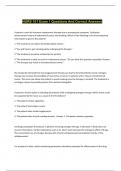
NCLEX Renal| latest questions and answers with complete solution A client has been admitted to the hospital for urinary tract infection an dehydration. The nurse determines that the client has received adequate volume replacement if the BUN drops to: 1. 3 mg/dL 2. 15 mg/dL 3. 29 mg/dL 4. 35 mg/dL - 2. The normal blood urea nitrogen level is 8 to 25 mg/dL. Values such as those in options 3 and 4 reflect continued dehydration. Option 1 reflects a lower than normal value, which may occur with fluid volume overload, among other conditions. An adult client has had lab work done as part of a routine physical exam. The nurse interprets that the client may have a mild degree of renal insufficiency if which of the following serum creatinine levels is noted? 1. 0.2 mg/dL 2. 0.5 mg/dL 3. 1.9 mg/dL 4. 3.5 mg/dL - 3. The normal serum creatinine level for adults is 0.6 to 1.3 mg/dL. The client with a mild degree of renal insufficiency would have a slightly elevated level. A creatinine level of 0.2 mg/dL is low, and a level of 0.5 mg/dL is just below normal. A creatinine level of 3.5 mg/dL may be associated with acute or chronic renal failure. The nurse instructs a client with renal failure who is receiving hemodialysis about dietary modifications. The nurse determines that the client understands these dietary modifications if the client selects which items from the menu? 1. Cream of wheat, blueberries, coffee 2. Sausage and eggs, banana, orange juice. 3. Bacon, cantaloupe melon, tomato juice. 4. Cured pork, grits, strawberries, orange juice. - 1. The diet for a client with renal failure who is receiving hemodialysis should include controlled amounts of sodium, phosphorus, calcium, potassium, and fluids. Options 2, 3, and 4 are high in sodium, phosphorus and potassium. The client with acute renal failure has a serum potassium level of 6.0 mEq/L. The nurse would plan which of the following as a priority action? 1. Check the sodium level. 2. Place the client on a cardiac monitor. 3. Encourage increased vegetables in the diet. 4. Allow an extra 500 mL of fluid intake to dilute the electrolyte concentration. - 2. The client with hyperkalemia is at risk of developing cardiac dysrhythmias and cardiac arrest. Because of this, the client should be placed on a cardiac monitor. Fluid intake is not increased because it contributes to fluid overload and would not affect the serum potassium level significantly. Vegetables are a natural source of potassium in the diet, and their use would not be increased. The nurse also may assess the sodium level because sodium is another electrolyte commonly measured with the potassium level. However, this is not a priority action of the nurse. The client
Written for
- Institution
- NCLEX Renal
- Course
- NCLEX Renal
Document information
- Uploaded on
- October 29, 2023
- Number of pages
- 14
- Written in
- 2023/2024
- Type
- Exam (elaborations)
- Contains
- Questions & answers
Subjects
-
nclex renal latest questions and answers with c