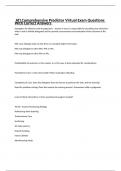
ATI Comprehensive Predictor Virtual Exam Questions With Correct Answers
Delegation for effective task management. - Answer A nurse is responsible for providing clear directions when a task is initially delegated and for periodic reassessment and evaluation of the outcome of the task. RNs must delegate tasks so that they can complete higher level tasks. RNs may delegate to other RNs, PNs or APs. PNs may delegate to other PNs or APs. Predictability of outcome: Is this routine, or is this new, is there potential for complications Potential for harm: Is the client stable? Risks? Aspiration, Bleeding Complexity of Care: Does the delegatee have the license to perform the task, and the training? Need for problem solving: Does this require the nursing process? Assessment skills or judgment Level of client interaction: Is there psychosocial support needed? TO PN - Answer Monitoring findings Reinforcing client teaching Tracheostomy Care Suctioning NG tube patency Enteral Feedings Insert Catheter Administering Meds TO AP - Answer ADLs Bathing, Grooming, Dressing, Toliet Ambulating Feeding Positioning Routine tasks Bed making Specimen Collection, I and Os Vitals For stable clients Concepts of management—Strategies to identify solutions to community health problems - Answer Planning Organizing: Controlling: Directing: Staffing: Planning: - Answer What needs to be done, and who is going to do it Organizing: - Answer Lines of authority, communications, and where decisions are made Directing: - Answer Influences and motivates people to perform Controlling: - Answer The evaluation of performance and unit goals to ensure outcomes are met Staffing: - Answer Adequate staffing, and staffing mix Characteristics of managers: - Answer Hold formal positions of authority and power, Possess clinical expertise, Network with members of the team, Coach subordinates, Make decisions for the organization: Resources, Budget, Hiring, and Firing Conflict Management between health care workers - Answer Autonomy: - Answer The ability of the client to make personal decisions, even when those decisions might not be in the client's own best interest Beneficence: - Answer Care that is in the best interest of the client Fidelity: - Answer Keeping one's promise to the client about care that was offered Justice: - Answer Fair treatment in matters related to physical and psychosocial care and use of resources Nonmaleficence: - Answer The nurse's obligation to avoid causing harm to the client Veracity: - Answer The nurse's duty to tell the truth Examples when an incident report should be filed: - Answer Medication errors, Procedure/treatment errors, Equipment related injuries/errors, Needlestick injuries, Client falls, Visitor/Volunteer injuries, Threat made to client or staff, Loss of property. Establishing Priorities---Facility Protocols: Triage evaluation of peds - Answer Emergent: Urgent Nonurgent: Expectant: Emergent: - Answer Highest priority, life threatening injuries but also have high survival rate once stable Urgent: - Answer Second highest priority can wait 40-60 mins for treatment Nonurgent: - Answer Minor injuries that are not life threatening and do not need immediate attention Expectant: - Answer Lowest priority, expected to die, Comfort care, but not restorative care Determining Priority Care for a group of clients - Answer Prioritizing Care for multiple home care clients - Answer Life before limb Acute before Chronic Actual problems before potential problems Listen carefully to clients and don't assume Trends vs Transient findings Complications vs expected findings Prioritizing Care for post op clients - Answer Airway, Breathing, Circulation, Disability, Examination/Exposure Maslow's Hierarchy - Answer Physiological, Safety and Security, Love and Belonging, Self-esteem, Self-Actualization Speaking to a client who has a hearing Impairment - Answer Learn the clients' preferred method of communications and make accommodations. Avoid covering your mouth Sit and face the client Speak slowly and clearly Encourage the use of hearing devices Try lowering vocal pitch before increasing volume Do not shout Use brief sentences with simple words Minimize background noise Ask for a sign language interpreter if necessary Write down what clients do not understand Fractures: Care for a new Cast - Answer Show the procedure on a doll Assist with crutches and use Assess for warmth Assess skin Apply ice for 24hrs Assess Neuro Status Elevate the cast for the first 48 hours to prevent swelling Cover area of cast with plastic Use mole skin over rough areas Provide skin and perineal care The cast will feel warm but will not burn client Report pain that is not relieved in one hour Turn client every 2 hrs to dry Monitor for drainage Teach the parent to perform neuro checks Preparing the body for viewing - Answer Maintain privacy Remove all tubes Remove all personal belongings to be given to the family Cleanse and align the body supine with a pillow under the head Place the arms outside of the blanket palms down, Keep dentures in place Close eyes Apply fresh linens with absorbent pads on bed and a gown Brush the client's hair, Place hair pieces Remove excess supplies, equipment, and soilded linens Dim the lights and minimize noise Necessary Loss: - Answer A loss related to a change that is part of the cycle of life Actual Loss - Answer : Any loss of a values person, item or status Perceived loss: - Answer Any loss that is not obvious to others Maturational or developmental loss: - Answer Any loss expected of life. (Child leaving for college) Situational loss: - Answer Any unanticipated loss caused by an external event (home loss by tornado) Anticipatory loss: - Answer Experienced before the loss happens Stages of grief - Answer Denial, Anger, Bargaining, Depression, Acceptance. Advance directives: - Answer Legal documents that direct end of life issues Living Will: - Answer Directive documents for medical treatment per the client's wishes Health Care Proxy/Durable Power attorney: - Answer A document that appoints someone to make medical decisions when the client is no longer able to do son on his own behalf. Rest and Sleep—Promoting Sleep Factors that interfere with sleep - Answer Illness: Can require more sleep or disrupt sleep Current life events: Traveling or work hours change Emotional stress: Anxiety, fear, grief Diet: Caffeine consumption, heavy meals before bedtime Exercise: Promotes sleep if at least 2 hours before bedtime Fatigue: Exhausting or stressful work makes falling asleep difficult Sleep environment: Too light, wrong temp or too noisy Medications: Some can induce sleep, some can interfere Bedtime routine, Limit waking clients, Promote quiet, Help with hygiene, CPAP, Sleep products Limit alcohol, caffeine and nicotine at least 4 hours before bedtime. Limit fluids 2-4 hours before bed time Engage in muscle relaxation if anxious or stressed Narcolepsy - Answer Exercise regularly, Eat small meals high in protein, Avoid sitting too long/warm environments /alcohol, Avoid accidents, driving or heights, Take naps when drowsy, Take stimulants Medication effecting urinary output Indications for use of diuretics - Answer Management of blood pressure Excretion of edematous fluid related to heart failure, Kidney and Liver disease Prevention of kidney failure Emergency Response Plan - Answer Facility Protocols: Appropriate client for discharge in event of community disaster First discharge or relocate ambulatory clients requiring minimal care. Next, make arrangements for continuation of care for clients who require some assistance which could be provided in the home or tertiary care facility Do not discharge or relocate clients who are unstable of require continuing nursing care and assessment unless they are in imminent danger. Discharge on the fact that some will likely be able to stay Handling Hazardous and Infectious materials Cancer treatment options: Implanted internal radiation device - Answer Follow protocol for proper removal of dressings and bed linens from the room Waste products should not be touched by anyone Place the client in a private room and keep the door closed as often as possible Place a radiation warning sign on the door Wear a dosimeter film badge that records personal amount of radiation expose Pregnant nurses or children should not come into contact with the client or radiation source Limit visitors to 30 min visits and maintain 6 feet from the source Wear a lead apron while providing care keeping the front of the apron facing the radiation source Keep a lead container in the client's room if the delivery method could allow spontaneous loss of radioactive material. Tongs should be available for placing material into this container Brachytherapy: - Answer This can be placed in vagina, abdomen or IV with radionuclide iodine which is absorbed by the thyroid. Standard Precautions---- - Answer 1. All body fluids, except sweat 2. Nonintact skin and mucous membranes 3. These apply to all clients regardless of condition 4. If hands are not viably soiled alcohol hand rub should be used 5. Antimicrobial soap should be used if hands are soiled or contaminated with spores 6. Remove gloves and complete hand hygiene between each client 7. Masks, eye protection, and face shields are required when care might cause splashing or spraying of body fluids 8. This client does not require a private room unless they are unable to maintain appropriate hygienic practices Isolation Guidelines: - Answer 1. Hand hygiene and the use of barrier precautions 2. These precautions apply to every client, regardless of the diagnosis 3. Change PPE after contact with each client and between procedures with the same client, if in contact with large amounts of blood or blood fluids (compromising the PPE) 4. Higher risk for loneliness explain the reason for isolation and provide sensory stimulation Airborne Precautions - Answer 1. Private room 2. Masks and respiratory protections (N95 for TB) 3. Negative pressure airflow exchange of at least 6-12 exchanges per hour 4. If splashing or spraying is possible wear full face protection 1. - Answer Private room Droplet Precautions - Answer 1. A private room or room with clients with the same disease a. Ensure that clients have their own equipment 2. Masks for providers and visitors
Written for
- Institution
- ATI Comprehensive Predictor
- Course
- ATI Comprehensive Predictor
Document information
- Uploaded on
- October 29, 2023
- Number of pages
- 31
- Written in
- 2023/2024
- Type
- Exam (elaborations)
- Contains
- Questions & answers
Subjects
-
ati comprehensive predictor stuvia
-
ati comprehensive predictor virtual exam question
-
delegation for effective task management a nurse
-
to pn monitoring findings reinforcing client teach

Also available in package deal