PRAXIS 5002 – LA WITH 100% CORRECT ANSWERS
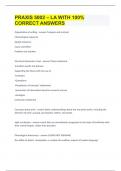
Organization of writing Compare and contrast Chronological sequence Spatial sequence Cause and effect Problem and solution Structural elements in text Thesis statement Transition words and phrases Supporting the thesis with the use of -Examples -Quotations -Paraphrases of excerpts' statements -Summaries of information found in research sources -Analogies Conclusion statement Concepts about print Basic understandings about the way print works, including the direction of print, spacing, punctuation, letters, and words. sight vocabulary words that are immediately recognized on the basis of familiarity with their overall shapes, rather than decoded Phonological Awareness SOUND NOT MEANING the ability to detect, manipulate, or analyze the auditory aspects of spoken language -rhyming and syllabification -blending sounds into words - pic-tur-bo-k -onset/rhime -segmenting -recognizing smaller words in the big word Phonemic Awareness SUBSET OF SKILLS W/IN Phonological Awareness The ability to hear, identify, and manipulate the individual sounds, PHONEMES, in SPOKEN WORDS. Phonemic Awareness Skills 1. Sound matching 2. Sound isolation 3. Sound blending 4.Sound substitution 5. Sound sound deletion 6. Sound segmentation phoneme in a language, the smallest distinctive sound unit. =44 in English the word 'mat' has three phonemes: /m/ /a/ /t/. Why is phonemic awareness important? Essential to learning to read in an alphabetic writing system, because letters represent Sounds or phonemes. Without phonemic awareness, phonics makes little sense. Fundamental to mapping speech to print. Why is Phonemic Awareness Difficult? There are 26 letters in the English language but a total of 44 phonemes. Sounds are represented in 250 different spellings. phonogram the common elements in word families (e.g., the letter sequence "and" in sand, hand, band, and land). Onset and Rime -Parts of spoken language that are smaller than syllables but larger than phonemes -ONSET is the initial consonant(s) sound of a syllable (the b- of bag; the sw- of swim) -RIME is the part of the syllable that contains the vowel and all that follows it (the -ag of bag; the -and of band) Decoding READING ALOUD CORRECLTY ability to use knowledge of letter-sound relationships and letter/syllable patterns, to translate print into speech (correctly pronounce written words). letter-sound correspondence Making a connection between individual letters and the sounds they represent (graphophonics). syllabication rules 1. Every syllable has one vowel sound 2. The number of vowel sounds in a word equals the number of syllables 3. A one syllable word is never divided 4. Consonant blends and diagraphs are never separated 5. When a word has a "ck" or an "x" in it, the word is usually divided after the "ck" or "x" 6. A compound word is divided between the two words that maake the compound word 7. When two or more consonants come between two vowels in a word, it is usually divided between the first two consonants 8. When a single consonant comes between two vowels in a word, it is usually divided after the consonant if the vowel is short 9. When a single consonant comes between two cowels ina word, it is usually divided before the consonant if the vowel is long 10. when tow vowels come together in a word, and are sounded separately, divide the word between the two vowels Rhyming Awareness the ability to recognize, isolate, and generate corresponding sounds, especially ending sounds segmenting and blending Breaking down a word into syllables or phonemes and then putting back together; , Sound out, blend together C-A-T CAT Alphabetic Principle (graphophonemic awareness) the understanding that written words are composed of patterns of letters that represent the sounds of spoken words. Two parts: 1. words are made up of letters and each letter has a specific sound 2. the correspondence between sounds and letters leads to phonological reading. language acquisition the process by which infants learn to understand and speak their native language print awareness children's understanding of the forms and functions of written language from many things like signs, book, wrappers, etc. Motivation and Reading SELF-EFFICACY- students' self concepts and value they place on reading are critical to their success GENDER- gender differences were identified as early as third grade; found that third grade boys are equally self-confident as girls about their reading, self-report valuing reading less than girls CHOICE- having wide selection of interesting books SOCIAL INTERACTION - reading groups effective Reading Fluency The ability to read with speed, accuracy, and proper expression (prosody). Teaching Fluency 1) MODEL - Teachers model fluency to students daily - read alouds. 2) REPETITION OF EASY TEXT- Help students practice orally rereading text that is reasonably easy for them. 3) TEXT LEVEL - text is at student's independent reading level. 4) CHOICE - variety of reading materials, including stories, nonfiction, and poetry. 5) READER'S THEATRE - reader's theater FLUENCY BUILDING ESP. DIALOGUES S's READ PARTS OF A "SCRIPT" REREAD OFTEN TO BUILD FLUENCY repeated readings A strategic approach designed to increase reading fluency and comprehension... repeated reading, students read and re-read a selected short passage until they reach a satisfactory level of fluency. Reader Response Allows readers to interpret the text in various ways. Allows readers to bring: personality traits, memories of the past and present experiences to the text. Forces the readers to look past the words of the text, and search for deeper meanings. Stages of Literacy Development 1st - awareness/exploration of spoken and written lang 2nd - experimenting with reading and writing 3rd - early learning of reading/writing in educational setting 4th - transitional reading/writing (grade 2-3) 5th - competent reading and writing (4th grade and beyond) decoding and encoding ENCODING = (WRITING) putting sounds together to make a written word (exercise, students write down what teacher says to them) DECODING (READING) - converting written words into sounds
Written for
- Institution
- Praxis 5002
- Course
- Praxis 5002
Document information
- Uploaded on
- October 29, 2023
- Number of pages
- 8
- Written in
- 2023/2024
- Type
- Exam (elaborations)
- Contains
- Questions & answers
Subjects

Also available in package deal