HMPYC80/104/0/2017
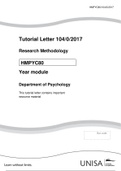
Tutorial Letter 104/0/2017
Research Methodology
HMPYC80
Year module
Department of Psychology
This tutorial letter contains important
resource material
Bar code
,Contents Page
About this resource 3
Bracketing 4
Constructionist research 5
Content analysis: An example 8
Correlation coefficient 12
Discourse analysis 16
Ethics 20
Factorial analysis of variance 37
Hypotheses 48
Hypothesis testing 51
Interpretive research 55
Interviews 57
Latent and manifest variables 58
Learning activity: What is it? 73
Multiple regression analysis 75
Observation 83
One-way analysis of variance 84
On-line resource material 87
Paradigms 88
Portfolio 92
Positivism 98
Project planning and management 100
Qualitative analysis 103
Quantitative data analysis 107
Regression analysis 121
Relationship between variables 124
Reporting research (Oral presentation) 134
Reporting research (Scientific journal article) 140
Research: What is it? 147
Research and course journal 149
Research design (Introduction) 152
Research problems and questions 154
Research proposal (Structure of) 157
T test 159
Text: What is it? 168
Triangulation 169
Variables 170
2 HMPYC80/104
, About this resource A
What is this tutorial This tutorial letter is a resource. It is, in fact, a collection of resources.
letter? Each of these resources is a text about a particular theme. Each resource
has a title that briefly indicates what the resource is about.
How do I find the correct The resources are organised alphabetically. Thus one uses Tutorial Letter
resource in this tutorial 104 as one would use a dictionary. For example, if you need information
letter? on Interviews you would look under I.
How do the resources The resources are separate themes. However, in some cases one resource
link with each other? may refer to another resource. Such references are indicated by enclosing
the title of the resource between angular brackets (< ... >). For example,
if the Correlation Coefficient resource has a reference to Hypothesis
Testing the reference would be embedded in the text as follows: “In
<hypothesis testing> there are a number of different methods ...”. This
means you can learn more about hypothesis testing in a resource called:
Hypothesis testing.
When do I use these The learning activities in Tutorial Letters 102 and 103 have references to
resources? these resources. Each learning activity has a resource section. The
resource sections contain the references to the resources in question.
Thus you use a resource when you need the information in question for a
particular learning activity.
HMPYC80/104 3
, Bracketing B
<Qualitative analysis> involves understanding material as an insider and therefore requires that you
cultivate an open and empathetic attitude. Phenomenology, for instance, involves trying to understand a
person's life-world from their own perspective. As Dreyer Kruger (a leading South African
phenomenologist) puts it: "It is necessary to give up manipulation of the phenomenon in favour of allowing
this to show itself by an intimate communion with it" (1990, p. 404). Often your preconceived notions can
get in the way of empathetic understanding and you therefore need to try and 'bracket' them, or put them to
one side. Imagine what it would have been like if you knew absolutely nothing about the topic being studied
and your only source of information were the data you have collected.
__________________________________________________________________________
Here is a short extract from an interview with James, a self-confessed paedophile (someone
who engages in sexual activities with children) who operates in the Gauteng area:
Are you a violent paedophile?
No, I've never hurt a child in my life. The things I do to children they like.
Like what?
Touching them, making love to them.
And if a child says 'please stop' would you stop?
Yes, of course, immediately. I'll never force myself on a child.
Burrows (1995)
What pre-suppositions would one have to bracket to understand James' world from his
perspective? Does bracketing pre-suppositions mean the same as giving them up entirely? Is
it possible (or desirable) to have an 'intimate communion' with the phenomenon of
paedophilia?
_____________________________________________________________________________
References
Burrows, S. (1995, October). Found object. Proceedings of the 1st Annual South African Qualitative
Methods Conference (A spanner in the works of the factory of truth). University of the
Witwatersrand, Johannesburg.
Kruger, D. (1990). The question of knowing and truth in psychology and psychotherapy. In Mouton, J. &
Joubert, D. (Eds.) Knowledge and method in the human sciences. Pretoria: Human Sciences
Research Council.
4 HMPYC80/104
Tutorial Letter 104/0/2017
Research Methodology
HMPYC80
Year module
Department of Psychology
This tutorial letter contains important
resource material
Bar code
,Contents Page
About this resource 3
Bracketing 4
Constructionist research 5
Content analysis: An example 8
Correlation coefficient 12
Discourse analysis 16
Ethics 20
Factorial analysis of variance 37
Hypotheses 48
Hypothesis testing 51
Interpretive research 55
Interviews 57
Latent and manifest variables 58
Learning activity: What is it? 73
Multiple regression analysis 75
Observation 83
One-way analysis of variance 84
On-line resource material 87
Paradigms 88
Portfolio 92
Positivism 98
Project planning and management 100
Qualitative analysis 103
Quantitative data analysis 107
Regression analysis 121
Relationship between variables 124
Reporting research (Oral presentation) 134
Reporting research (Scientific journal article) 140
Research: What is it? 147
Research and course journal 149
Research design (Introduction) 152
Research problems and questions 154
Research proposal (Structure of) 157
T test 159
Text: What is it? 168
Triangulation 169
Variables 170
2 HMPYC80/104
, About this resource A
What is this tutorial This tutorial letter is a resource. It is, in fact, a collection of resources.
letter? Each of these resources is a text about a particular theme. Each resource
has a title that briefly indicates what the resource is about.
How do I find the correct The resources are organised alphabetically. Thus one uses Tutorial Letter
resource in this tutorial 104 as one would use a dictionary. For example, if you need information
letter? on Interviews you would look under I.
How do the resources The resources are separate themes. However, in some cases one resource
link with each other? may refer to another resource. Such references are indicated by enclosing
the title of the resource between angular brackets (< ... >). For example,
if the Correlation Coefficient resource has a reference to Hypothesis
Testing the reference would be embedded in the text as follows: “In
<hypothesis testing> there are a number of different methods ...”. This
means you can learn more about hypothesis testing in a resource called:
Hypothesis testing.
When do I use these The learning activities in Tutorial Letters 102 and 103 have references to
resources? these resources. Each learning activity has a resource section. The
resource sections contain the references to the resources in question.
Thus you use a resource when you need the information in question for a
particular learning activity.
HMPYC80/104 3
, Bracketing B
<Qualitative analysis> involves understanding material as an insider and therefore requires that you
cultivate an open and empathetic attitude. Phenomenology, for instance, involves trying to understand a
person's life-world from their own perspective. As Dreyer Kruger (a leading South African
phenomenologist) puts it: "It is necessary to give up manipulation of the phenomenon in favour of allowing
this to show itself by an intimate communion with it" (1990, p. 404). Often your preconceived notions can
get in the way of empathetic understanding and you therefore need to try and 'bracket' them, or put them to
one side. Imagine what it would have been like if you knew absolutely nothing about the topic being studied
and your only source of information were the data you have collected.
__________________________________________________________________________
Here is a short extract from an interview with James, a self-confessed paedophile (someone
who engages in sexual activities with children) who operates in the Gauteng area:
Are you a violent paedophile?
No, I've never hurt a child in my life. The things I do to children they like.
Like what?
Touching them, making love to them.
And if a child says 'please stop' would you stop?
Yes, of course, immediately. I'll never force myself on a child.
Burrows (1995)
What pre-suppositions would one have to bracket to understand James' world from his
perspective? Does bracketing pre-suppositions mean the same as giving them up entirely? Is
it possible (or desirable) to have an 'intimate communion' with the phenomenon of
paedophilia?
_____________________________________________________________________________
References
Burrows, S. (1995, October). Found object. Proceedings of the 1st Annual South African Qualitative
Methods Conference (A spanner in the works of the factory of truth). University of the
Witwatersrand, Johannesburg.
Kruger, D. (1990). The question of knowing and truth in psychology and psychotherapy. In Mouton, J. &
Joubert, D. (Eds.) Knowledge and method in the human sciences. Pretoria: Human Sciences
Research Council.
4 HMPYC80/104