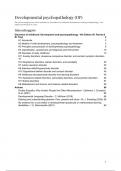
Developmental psychopathology (DP)
Een samenvoeging van online artikelen en Disorders of childhood: Development and psychopathology - 4th
Edition (R. Parritz & M. Troy).
Inhoudsopgave
Disorders of childhood: Development and psychopathology - 4th Edition (R. Parritz &
M. Troy) 2
H1 Introductie 2
H2 Models of child development, psychopathology and treatment 3
H3 Principles and practices of developmental psychopathology 8
H4 Classification, assessment and diagnosis and intervention 10
H5 Disorders of early childhood 13
H11 Anxiety disorders, obsessive-compulsive disorder, and somatic symptom disorders
19
H12 Depressive disorders, bipolar disorders, and suicidality 25
H7 Autism spectrum disorder 30
H9 Attention-deficit/hyperactivity disorder 36
H10 Oppositional defiant disorder and conduct disorder 40
H6 Intellectual developmental disorder and learning disorders 45
H14 Substance-related disorders, personality disorders, and psychotic disorders 52
H13 Eating disorders 57
H8 Maltreatment and trauma- and stressor-related disorders 59
Articles 66
Double Empathy: Why Autistic People Are Often Misunderstood - Catherine J. Crompton
et al. (2021) 66
Developmental Language Disorder - C. McKean (2018) 66
Defining and understanding dyslexia: Past, present and future - M. J. Snowling (2020) 68
No evidence for a core deficit in developmental dyscalculia or mathematical learning
disabilities - I. E. Mammarella (2021) 69
1
,Disorders of childhood: Development and
psychopathology - 4th Edition (R. Parritz & M. Troy)
H1 Introductie
Definitions
- Psychopathology = intens, frequent, and/or persistent maladaptive patterns of
emotions, cognition and behaviour.
- Developmental psychopathology = these maladaptive patterns occur in the context of
typical development and result in the current and potential impairment of infants,
children and adolescents.
- Developmental epidemiology = the frequencies and patterns of disorders in children
and adolescents.
- Prevalence = all current cases of a set of disorders.
- Incidence = number of new cases in a given time period.
What is normal?
Descriptions of ‘normality’ often focus on:
● Statistical deviance = the infrequency of emotions, cognitions and/or behaviours.
○ A child’s behaviour is considered a disorder when it’s not inline with the
behaviour of peers.
■ E.g. it’s common for teens to become less dependent, but Emma is
still clinging on to her mother.
● Sociocultural norms = the beliefs and expectations - in a certain place or time - about
the kind of emotions, cognitions and behaviours that are acceptable or problematic.
○ E.g. in gypsy communities very aggressive behaviour from boys is normal
and desired, but in other sociocultural groups such aggressive behaviour is
considered a disorder.
● Mental health definitions = theoretical or clinically based notions of distress and
dysfunction.
○ “Mental health is not simply the absence of a mental disorder.”- CDC, 2021.
○ Children who don’t have a mental disorder can still have a poor quality of life.
The role of values
A key value judgement is the distinction between adaptation or maladaptation and personal
or group standards of different types of adaption.
Types of adaptation:
1. Poor adaptation
2. Adequate adaptation
3. Optimal adaptation
❖ Optimal adaption or adequate adaptation do not guarantee smooth sailing. There will
be challenges, but those are inevitable for growth.
The impact of values on definitions of disorder
Sometimes people only focus on the ‘good’ extreme of a continuum. Hereby a judgement is
made about what types of extreme characteristics that are accepted.
2
, ● E.g. focus on too little empathy, but not on too much empathy.
Disorder rates
To estimate the rates of disorders, a few things are taken into account:
- identifying children who experience distress and dysfunction.
- calculating levels of general disorders and specific subtypes of disorders.
- tracking changing trends in disorders.
When people want to seek help for their mental health, they’ll often encounter a few barriers:
1. Negative perceptions about mental health → stigmatisation of mental health.
2. A lack of funding for the mental health care system.
3. A high cost of care.
4. Long waitlists in order to get the care they need.
H2 Models of child development, psychopathology and treatment
The role of theory
There are a few models about development, psychopathology and treatment:
1. Physiological models
2. Psychodynamic models
3. Behavioural and cognitive models
4. Humanistic and positive psychology models
5. Family models
6. Sociocultural models
❖ These models are not totally comprehensive, so they sometimes complement each
other.
Physiological models
Physiological models propose that there is a physiological (genetic, biological etc.) basis for
all psychological processes and events.
- Brain structure and function
Within the neurosciences two types are researched:
● Grey matter = processes and functions.
● White matter = connectivity within and between regions.
❖ Atypical brain structure, like reduced gray matter (associated with
general distress and dysfunction), are often observed in youth with
disorders.
➢ The same applies for reduced white matter.
Because of the knowledge gained from neurosciences, scientist are able to make
medications that target neurotransmitters.
- Sensitive/ critical periods = a period in life when the environment has an extra
powerful impact on the person.
- Our brains are quite flexible in terms of overcoming damage, they have neural
plasticity. But there is also a need to stabilization. The initially sculpted by
experience neural networks are stabilised in normal development.
= the ability of the brain to respond to psychological and
environmental challenges and insults.
3
, Early experiences of stress and trauma have a negative impact on the development of
biological systems.
- Genes
People have a genotype which is your gene information and your phenotype is an
expression of this information.
Research in genes looks at two types:
1) Behavior genetics: the study of the joint effects of hereditary and environment;
nature-nurture debat.
a) Epigenetics = research on the effect of experience and environment
on the regulation of gene expression.
i) Focus on the activity instead of the presence
2) Molecular genetics: the study of the structure and function of genes at the
molecular level.
When two different genotypes respond to environmental variation in different ways,
it’s called gene-by-environment-by-time interactions(GxE). And there are also the
gene-by-environment-by-time effects(GxExT)
There are several models that are used within the gene research:
1. Polygenic model; a model about disorders and the influence that the
cumulative effect of genes .
2. Diathesis-stress model; a model that sees psychological disorders as a result
from the interaction between inherent vulnerability and environmental
stressors.
Different susceptibility/biological sensitvity = the theory that some children are more
susceptible(vatbaar) to positive and negative environmental conditions.
● This theory is mostly explained with two types of children:
○ Orchid children; these children are really reactive to their
circumstances.
○ Dandelion children; these children do quite well in positive and
negative circumstances.
Psychodynamic models
Psychodynamic models explain personality and behaviour in terms of unconscious
psychological processes.
These models focus on several themes:
- The impact of unconscious processes on typical and atypical personality
development.
- Conflicts among processes and structures of the mind.
- Stages of development, with different stages associated with distinctive emotional,
intellectual and social challenges
- The lasting impact of more (or less) successful resolutions of stage-related
challenges on later outcomes.
A quote that embodies these models: “The past is never dead. It’s not even past.”- W.
Faulkner (1950’s)
➢ A fixation-regression model suggests that individuals who didn’t work through their
developmental issues are ‘stuck’ in the past. And the disorders are rooted in traumas
or conflicts experienced during early childhood.
The contemporary psychodynamic approaches continue to emphasise:
● unconscious cognitive, affective and motivational processes.
4
Een samenvoeging van online artikelen en Disorders of childhood: Development and psychopathology - 4th
Edition (R. Parritz & M. Troy).
Inhoudsopgave
Disorders of childhood: Development and psychopathology - 4th Edition (R. Parritz &
M. Troy) 2
H1 Introductie 2
H2 Models of child development, psychopathology and treatment 3
H3 Principles and practices of developmental psychopathology 8
H4 Classification, assessment and diagnosis and intervention 10
H5 Disorders of early childhood 13
H11 Anxiety disorders, obsessive-compulsive disorder, and somatic symptom disorders
19
H12 Depressive disorders, bipolar disorders, and suicidality 25
H7 Autism spectrum disorder 30
H9 Attention-deficit/hyperactivity disorder 36
H10 Oppositional defiant disorder and conduct disorder 40
H6 Intellectual developmental disorder and learning disorders 45
H14 Substance-related disorders, personality disorders, and psychotic disorders 52
H13 Eating disorders 57
H8 Maltreatment and trauma- and stressor-related disorders 59
Articles 66
Double Empathy: Why Autistic People Are Often Misunderstood - Catherine J. Crompton
et al. (2021) 66
Developmental Language Disorder - C. McKean (2018) 66
Defining and understanding dyslexia: Past, present and future - M. J. Snowling (2020) 68
No evidence for a core deficit in developmental dyscalculia or mathematical learning
disabilities - I. E. Mammarella (2021) 69
1
,Disorders of childhood: Development and
psychopathology - 4th Edition (R. Parritz & M. Troy)
H1 Introductie
Definitions
- Psychopathology = intens, frequent, and/or persistent maladaptive patterns of
emotions, cognition and behaviour.
- Developmental psychopathology = these maladaptive patterns occur in the context of
typical development and result in the current and potential impairment of infants,
children and adolescents.
- Developmental epidemiology = the frequencies and patterns of disorders in children
and adolescents.
- Prevalence = all current cases of a set of disorders.
- Incidence = number of new cases in a given time period.
What is normal?
Descriptions of ‘normality’ often focus on:
● Statistical deviance = the infrequency of emotions, cognitions and/or behaviours.
○ A child’s behaviour is considered a disorder when it’s not inline with the
behaviour of peers.
■ E.g. it’s common for teens to become less dependent, but Emma is
still clinging on to her mother.
● Sociocultural norms = the beliefs and expectations - in a certain place or time - about
the kind of emotions, cognitions and behaviours that are acceptable or problematic.
○ E.g. in gypsy communities very aggressive behaviour from boys is normal
and desired, but in other sociocultural groups such aggressive behaviour is
considered a disorder.
● Mental health definitions = theoretical or clinically based notions of distress and
dysfunction.
○ “Mental health is not simply the absence of a mental disorder.”- CDC, 2021.
○ Children who don’t have a mental disorder can still have a poor quality of life.
The role of values
A key value judgement is the distinction between adaptation or maladaptation and personal
or group standards of different types of adaption.
Types of adaptation:
1. Poor adaptation
2. Adequate adaptation
3. Optimal adaptation
❖ Optimal adaption or adequate adaptation do not guarantee smooth sailing. There will
be challenges, but those are inevitable for growth.
The impact of values on definitions of disorder
Sometimes people only focus on the ‘good’ extreme of a continuum. Hereby a judgement is
made about what types of extreme characteristics that are accepted.
2
, ● E.g. focus on too little empathy, but not on too much empathy.
Disorder rates
To estimate the rates of disorders, a few things are taken into account:
- identifying children who experience distress and dysfunction.
- calculating levels of general disorders and specific subtypes of disorders.
- tracking changing trends in disorders.
When people want to seek help for their mental health, they’ll often encounter a few barriers:
1. Negative perceptions about mental health → stigmatisation of mental health.
2. A lack of funding for the mental health care system.
3. A high cost of care.
4. Long waitlists in order to get the care they need.
H2 Models of child development, psychopathology and treatment
The role of theory
There are a few models about development, psychopathology and treatment:
1. Physiological models
2. Psychodynamic models
3. Behavioural and cognitive models
4. Humanistic and positive psychology models
5. Family models
6. Sociocultural models
❖ These models are not totally comprehensive, so they sometimes complement each
other.
Physiological models
Physiological models propose that there is a physiological (genetic, biological etc.) basis for
all psychological processes and events.
- Brain structure and function
Within the neurosciences two types are researched:
● Grey matter = processes and functions.
● White matter = connectivity within and between regions.
❖ Atypical brain structure, like reduced gray matter (associated with
general distress and dysfunction), are often observed in youth with
disorders.
➢ The same applies for reduced white matter.
Because of the knowledge gained from neurosciences, scientist are able to make
medications that target neurotransmitters.
- Sensitive/ critical periods = a period in life when the environment has an extra
powerful impact on the person.
- Our brains are quite flexible in terms of overcoming damage, they have neural
plasticity. But there is also a need to stabilization. The initially sculpted by
experience neural networks are stabilised in normal development.
= the ability of the brain to respond to psychological and
environmental challenges and insults.
3
, Early experiences of stress and trauma have a negative impact on the development of
biological systems.
- Genes
People have a genotype which is your gene information and your phenotype is an
expression of this information.
Research in genes looks at two types:
1) Behavior genetics: the study of the joint effects of hereditary and environment;
nature-nurture debat.
a) Epigenetics = research on the effect of experience and environment
on the regulation of gene expression.
i) Focus on the activity instead of the presence
2) Molecular genetics: the study of the structure and function of genes at the
molecular level.
When two different genotypes respond to environmental variation in different ways,
it’s called gene-by-environment-by-time interactions(GxE). And there are also the
gene-by-environment-by-time effects(GxExT)
There are several models that are used within the gene research:
1. Polygenic model; a model about disorders and the influence that the
cumulative effect of genes .
2. Diathesis-stress model; a model that sees psychological disorders as a result
from the interaction between inherent vulnerability and environmental
stressors.
Different susceptibility/biological sensitvity = the theory that some children are more
susceptible(vatbaar) to positive and negative environmental conditions.
● This theory is mostly explained with two types of children:
○ Orchid children; these children are really reactive to their
circumstances.
○ Dandelion children; these children do quite well in positive and
negative circumstances.
Psychodynamic models
Psychodynamic models explain personality and behaviour in terms of unconscious
psychological processes.
These models focus on several themes:
- The impact of unconscious processes on typical and atypical personality
development.
- Conflicts among processes and structures of the mind.
- Stages of development, with different stages associated with distinctive emotional,
intellectual and social challenges
- The lasting impact of more (or less) successful resolutions of stage-related
challenges on later outcomes.
A quote that embodies these models: “The past is never dead. It’s not even past.”- W.
Faulkner (1950’s)
➢ A fixation-regression model suggests that individuals who didn’t work through their
developmental issues are ‘stuck’ in the past. And the disorders are rooted in traumas
or conflicts experienced during early childhood.
The contemporary psychodynamic approaches continue to emphasise:
● unconscious cognitive, affective and motivational processes.
4