

Introduction to Philosophy PHI1024F
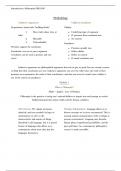
Methodology
Deductive Arguments Validity & Soundness
Propositions: claims/info “building blocks” Validity:
1. Have truth values (true or Underlying logic of argument
false) IF premises then conclusion true
2. Shareable No content
3. Untranslatable
Soundness:
Premises support the conclusion.
Premises actually true
Conclusion: sets out to prove argument Relies validity
(conclusion can be used as premise and vice Refers to content
versa) If sound conclusion true
Inductive arguments are philosophical arguments that aim to give us good (but not certain) reasons
to think that their conclusions are true. Inductive arguments can never be valid (since the truth of their
premises never guarantees the truth of their conclusions), and thus can never be sound (since validity is
one of the criteria of soundness).
Module 1
What is Philosophy?
Philia + Sophia - Love of Wisdom
Philosophy is the practice of using one's rational abilities to inquire into and attempt to resolve
fundamental questions about reality and the human condition.
Self reference: We employ pronouns, Stimulus-Independence: Language allows us to
indexical, and even symbols (in logic or discuss concepts we've never encountered. This is
mathematics) to refer to the unusual animal communication (refer to things in
characteristics and natures of things present environment). Language may describe
identified in the language; this is a special distant places, hypothetical possibilities, and the
feature of languages that allows us to past and future. So, contemporary philosophy's
communicate about more than just the essence is made accessible.
languages themselves.
, Introduction to Philosophy PHI1024F
Analytical & continental schools of thought
Wittgenstein:
1st Phase: advocated a correspondence theory of reference – words and phrases in language refer to
things in real world. (he rejected it later)
2nd Phase (Later Wittgenstein) Usage Base Theory: A language game is a set of rules for word-
action pairings. Language – the rules of their use determine their meaning, comes with a form of
life and if you’re not in it you won’t understand it.
Carnap:
Thinks forms of life are closed conceptual schemes. If word/concept is taken out it results in a fake
philosophical problem.
Wittgenstein thinks philosophy is a therapy for getting rid of grant conclusions. It describes how
language is used. Wittgenstein commits being self-referentially inconsistent (fallacy), he’s mounting a
substantial argument himself, beyond our knowledge.
Critique:
Wittgenstein’s put out a proposition and his argument: Everything is a language game. To interpret
those games, we need look inside the language, there’s nothing outside of it hence if philosophy is a
language game, then it just tells us how to use language.
Our Argument is that him proposing this idea is something new therefore we go against his idea,
committing a fallacy (self-referentially inconsistent). His route to it is wrong.
Conclusion:
The historical, social, and cultural background of arguments are emphasized in continental
philosophy. Hegel believed that in order to arrive at the "correct" answer, one must first delve into
philosophical problems in order to identify their underlying contradictions. To "surmount" a philosophical
difficulty or point of view, one must first identify its true and false aspects, and then develop a new
viewpoint that incorporates the former while rejecting the latter. Continentals typically acknowledge their
intellectual roots, but this is not always the case.
Problems are disentangled in an analytic approach. Dualism is either true or false; there is no
middle ground since it precisely defines a problem and considers all viable solutions, knowing that one is
the correct one regardless of historical context, which it views as contingent.
African Philosophy – The value of intercultural philosophy
Plato’s Cave - individuals with unphilosophical lives are like prisoners in a cave who can only see the wall
of a cave, the fire is used to cast shadows by puppeteers and the prisoners can see the shadows, never the
real objects. Ultimately, people who didn’t reflect on their lives are then like the prisoners in the cave
Methodology
Deductive Arguments Validity & Soundness
Propositions: claims/info “building blocks” Validity:
1. Have truth values (true or Underlying logic of argument
false) IF premises then conclusion true
2. Shareable No content
3. Untranslatable
Soundness:
Premises support the conclusion.
Premises actually true
Conclusion: sets out to prove argument Relies validity
(conclusion can be used as premise and vice Refers to content
versa) If sound conclusion true
Inductive arguments are philosophical arguments that aim to give us good (but not certain) reasons
to think that their conclusions are true. Inductive arguments can never be valid (since the truth of their
premises never guarantees the truth of their conclusions), and thus can never be sound (since validity is
one of the criteria of soundness).
Module 1
What is Philosophy?
Philia + Sophia - Love of Wisdom
Philosophy is the practice of using one's rational abilities to inquire into and attempt to resolve
fundamental questions about reality and the human condition.
Self reference: We employ pronouns, Stimulus-Independence: Language allows us to
indexical, and even symbols (in logic or discuss concepts we've never encountered. This is
mathematics) to refer to the unusual animal communication (refer to things in
characteristics and natures of things present environment). Language may describe
identified in the language; this is a special distant places, hypothetical possibilities, and the
feature of languages that allows us to past and future. So, contemporary philosophy's
communicate about more than just the essence is made accessible.
languages themselves.
, Introduction to Philosophy PHI1024F
Analytical & continental schools of thought
Wittgenstein:
1st Phase: advocated a correspondence theory of reference – words and phrases in language refer to
things in real world. (he rejected it later)
2nd Phase (Later Wittgenstein) Usage Base Theory: A language game is a set of rules for word-
action pairings. Language – the rules of their use determine their meaning, comes with a form of
life and if you’re not in it you won’t understand it.
Carnap:
Thinks forms of life are closed conceptual schemes. If word/concept is taken out it results in a fake
philosophical problem.
Wittgenstein thinks philosophy is a therapy for getting rid of grant conclusions. It describes how
language is used. Wittgenstein commits being self-referentially inconsistent (fallacy), he’s mounting a
substantial argument himself, beyond our knowledge.
Critique:
Wittgenstein’s put out a proposition and his argument: Everything is a language game. To interpret
those games, we need look inside the language, there’s nothing outside of it hence if philosophy is a
language game, then it just tells us how to use language.
Our Argument is that him proposing this idea is something new therefore we go against his idea,
committing a fallacy (self-referentially inconsistent). His route to it is wrong.
Conclusion:
The historical, social, and cultural background of arguments are emphasized in continental
philosophy. Hegel believed that in order to arrive at the "correct" answer, one must first delve into
philosophical problems in order to identify their underlying contradictions. To "surmount" a philosophical
difficulty or point of view, one must first identify its true and false aspects, and then develop a new
viewpoint that incorporates the former while rejecting the latter. Continentals typically acknowledge their
intellectual roots, but this is not always the case.
Problems are disentangled in an analytic approach. Dualism is either true or false; there is no
middle ground since it precisely defines a problem and considers all viable solutions, knowing that one is
the correct one regardless of historical context, which it views as contingent.
African Philosophy – The value of intercultural philosophy
Plato’s Cave - individuals with unphilosophical lives are like prisoners in a cave who can only see the wall
of a cave, the fire is used to cast shadows by puppeteers and the prisoners can see the shadows, never the
real objects. Ultimately, people who didn’t reflect on their lives are then like the prisoners in the cave


