Notes BUS1007S
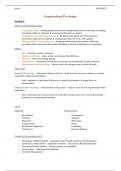
Organizational Psychology
Section A
What do I/O psychologists do?
- Treat people fairly – treating people from diverse backgrounds fairly (resourcing, developing,
rewarding employee relations) & assessing performance accurately.
- Making jobs more interesting/satisfying – designing jobs people will find satisfying,
motivating employees to perform & creating teams that will work well together.
- Helping people be more productive – designing work patterns that enhance efficiency,
providing skills training and developing & helping to meet the challenges of competition.
Others:
- DEI – diversity, equality, inclusion.
- Health & wellbeing – stress, safety, psychological healthfulness.
- Research – discovery, testing sharing.
- Sustainability – behavioral technologies to promote environmentally friendly behavior.
- Humanitarian work psychology – decent work, alleviating poverty, global aid work.
The I in IOP
Industrial Psychology – what person brings to the job – tends to focus on ways to improve, evaluate,
and predict employee performance.
- Goal: capitalize on individual differences to predict performance & strong focus on
measurement.
Organizational Psychology – what job does to the person – tends to focus on how organizations affect
individuals.
- Goal: understand how social context of work affects people, grew out of social psychology –
primarily uses experimental methods.
I vs O
Industrial Organizational
- Recruitment - Socialization
- Selection - Attitudes
- Placement - Motivation
- Compensation - Stress
- Performance Appraisal - Leadership
- Training (?) - Decision Making
Context of the emergence of IP
o Psychology (William Wundt) – generations after Wundt embraces “psychotechnics”
o Economics (Adam Smith) – industrial revolution – concern for efficient production
o Evolution (Charles Darwin) – Human species not immutable
o Social reform – education and healthcare
o Scientific Management
, Notes BUS1007S
Fredrick W. Taylor (1865-1915)
Trained as an engineer, 1883: began experiments at the Midvale and Bethlehem Steel plant, Invented
scientific management, 1909: Shop Management, 1911: The Principles of scientific management
Scientific management
- Time and motion studies
- Scientifically design efficient work methods
- Select the best workers
- Train workers in “one best way” method
- Reward them for the “one best way”
Pig iron experiments:
Taylor showed that workers who handled heavy iron ingots could be more productive if they took rest
breaks – increased efficiency of work.
- Training when to work and when to rest raised productivity from 12.5 to 47.0 tons moved per
day
- Less fatigue reported
- Increased wages
- Costs dropped from 9.2 to 3.9 cents per ton
Founding Figures in early IOP
- Lillian Gilbreth (1878-1972)
Trained as an engineer, mother of modern management, in 1908, made statement about the need to
consider human workers, as they were the most important element in industry. Her husband, Frank
Gilbreth, joined her: focused on human motion, broke jobs down to their most basic elements, they
called these basic motions “therbligs”.
- Walter Dill Scott (1869-1955)
Applied psychology to advertising, first to directly apply psychology to a business issue, WW1:
Instrumental in application of personnel procedures in army.
- Hugo Munsterberg (1863-1916)
Harvard psychology professor on invitation of William James, employee testing and validation,
eyewitness testimony, experiment design, 1913: psychology and industrial efficiency.
War and early IOP – WW1 – The great war
WW1 (1917-1918)
Push by Robert Yerkes
- American psychological association president
- Argued that psych could be greatly utilized in the war effort.
- Most proposal not accepted, those were focused mainly on the assessment of recruits.
Organizational Psychology
Section A
What do I/O psychologists do?
- Treat people fairly – treating people from diverse backgrounds fairly (resourcing, developing,
rewarding employee relations) & assessing performance accurately.
- Making jobs more interesting/satisfying – designing jobs people will find satisfying,
motivating employees to perform & creating teams that will work well together.
- Helping people be more productive – designing work patterns that enhance efficiency,
providing skills training and developing & helping to meet the challenges of competition.
Others:
- DEI – diversity, equality, inclusion.
- Health & wellbeing – stress, safety, psychological healthfulness.
- Research – discovery, testing sharing.
- Sustainability – behavioral technologies to promote environmentally friendly behavior.
- Humanitarian work psychology – decent work, alleviating poverty, global aid work.
The I in IOP
Industrial Psychology – what person brings to the job – tends to focus on ways to improve, evaluate,
and predict employee performance.
- Goal: capitalize on individual differences to predict performance & strong focus on
measurement.
Organizational Psychology – what job does to the person – tends to focus on how organizations affect
individuals.
- Goal: understand how social context of work affects people, grew out of social psychology –
primarily uses experimental methods.
I vs O
Industrial Organizational
- Recruitment - Socialization
- Selection - Attitudes
- Placement - Motivation
- Compensation - Stress
- Performance Appraisal - Leadership
- Training (?) - Decision Making
Context of the emergence of IP
o Psychology (William Wundt) – generations after Wundt embraces “psychotechnics”
o Economics (Adam Smith) – industrial revolution – concern for efficient production
o Evolution (Charles Darwin) – Human species not immutable
o Social reform – education and healthcare
o Scientific Management
, Notes BUS1007S
Fredrick W. Taylor (1865-1915)
Trained as an engineer, 1883: began experiments at the Midvale and Bethlehem Steel plant, Invented
scientific management, 1909: Shop Management, 1911: The Principles of scientific management
Scientific management
- Time and motion studies
- Scientifically design efficient work methods
- Select the best workers
- Train workers in “one best way” method
- Reward them for the “one best way”
Pig iron experiments:
Taylor showed that workers who handled heavy iron ingots could be more productive if they took rest
breaks – increased efficiency of work.
- Training when to work and when to rest raised productivity from 12.5 to 47.0 tons moved per
day
- Less fatigue reported
- Increased wages
- Costs dropped from 9.2 to 3.9 cents per ton
Founding Figures in early IOP
- Lillian Gilbreth (1878-1972)
Trained as an engineer, mother of modern management, in 1908, made statement about the need to
consider human workers, as they were the most important element in industry. Her husband, Frank
Gilbreth, joined her: focused on human motion, broke jobs down to their most basic elements, they
called these basic motions “therbligs”.
- Walter Dill Scott (1869-1955)
Applied psychology to advertising, first to directly apply psychology to a business issue, WW1:
Instrumental in application of personnel procedures in army.
- Hugo Munsterberg (1863-1916)
Harvard psychology professor on invitation of William James, employee testing and validation,
eyewitness testimony, experiment design, 1913: psychology and industrial efficiency.
War and early IOP – WW1 – The great war
WW1 (1917-1918)
Push by Robert Yerkes
- American psychological association president
- Argued that psych could be greatly utilized in the war effort.
- Most proposal not accepted, those were focused mainly on the assessment of recruits.