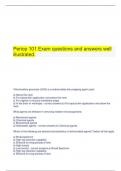
Periop 101 Exam questions and answers well illustrated.
Periop 101 Exam questions and answers well illustrated. Chlorhexidine gluconate (CHG) is a antimicrobial skin prepping agent used: a) Above the neck b) For topical skin application only below the neck c) For vaginal or mucous membrane preps d) In the brain or meninges - correct answers.b) For topical skin application only below the neck. What agents are effective in removing resident microorganisms: a) Mechanical agents b) Chemical agents c) Biochemical agents d) Hydrostatic agents - correct answers.b) Chemical agents Which of the following are desired characteristics of antimicrobial agents? Select all that apply a) Broad spectrum b) High log reduction capability c) Effective for long periods of time d) High toxicity e) Low toxicity - correct answers.a) Broad Spectrum b) High log reduction capability c) Effective for long periods of time Which of the following statements is correct regarding hair removal from a surgical patient? a) Hair should be removed from the surgical site before any surgical procedure. b) Hair should be removed from the surgical site by using clippers or razors. c) Hair should be removed from the surgical site only when the hair is so thick that it will interfere with the procedure. d) All of the above - correct answers.c) Hair should be removed from the surgical site only when the hair is so thick that it will interfere with the procedure. What does AORN's guideline for Preoperaitve patient skin antisepsis recommend for prepping areas with high microbial counts? a) Prep them first b) Prep them last c) Prep them during the procedure d) Prep them whenever necessary - correct answers.b)Prep them last Which of the following should be avoided during hair removal? a) Use of clippers b) Clipping of hair against the grain of hair growth c) Nicking or cutting the skin d) Removal of loose hair from prepped area - correct answers.c) Nicking or cutting the skin Which of the following observations are critical when doing skin antisepsis on pediatric patients: a) Take measures to prevent the loss of body heat b) The relatively small bodies of pediatric patients require smaller amounts of antimicrobial agents c) Children are not sensitive to chemical agents. d) The whole body must be prepped irrespective of the operative site. - correct answers.a) Take measures to prevent the loss of body heat Which actions should the perioperative nurse take in prepping an extremity when a tourniquet is used? Select all that apply a) Drape the tourniquet with a cloth towel to keep solution from going under the tourniquet. b) Start prepping at the level of the tourniquet. c) Start the prep at the incision site and extend both distally and proximally to include the entire extremity. d) Use an assistive device to support the extremity during the prep. e) Use an impervious drape to protect the tourniquet. - correct answers.c)Start the prep at the incision site and extend both distally and proximally to include the entire extremity. d) Use an assistive device to support the extremity during the prep. e) Use an impervious drape to protect the tourniquet. Which of the following is True about iodophor paint and iodophor scrub? a) A paint has a detergent additive, a scrub does not. b) A scrub has a detergent additive, a paint does not. c) Iodophors have a low fungicidal and high bacterial kill rate. d) Iodophors have a high persistence activity. - correct answers.b) A scrub has a detergent additive, a paint does not. Perioperative nursing documentation of the skin prep procedure should include which of the following components? Select all that apply a) Antiseptic agent used b) Hair removal if performed c) Name of person holding the limb if applicable d) Name of the person performing the prep e) Placement of blotting towels f) Preoperative assessment of the skin at the operative site. - correct answers.a) Antiseptic agent used b) Hair removal if performed d) Name of the person performing the prep f) Preoperative assessment of the skin at the operative site. By which route are antibiotics most commonly administered by the perioperative nurse during intraoperative phase? a) Intramuscular b) Intravenous c) Irrigation solution d) Subcutaneous - correct answers.c) Irrigation solution The perioperative nurse's role in preparing and administering medications includes: Select all that apply a) Administering all medications ordered by the surgeon b) Assessing the patient's medication allergies and use of herbal or dietary supplements c) Verifying the administration of the correct medication, dose, and route. d)Checking expiration date of medication - correct answers.b) Assessing the patient's medication allergies and use of herbal or dietary supplements c) Verifying the administration of the correct medication, dose, and route. d)Checking expiration date of medication Based on your knowledge of medications, identify the true statements from those given below. Select all that apply. a) Papaverine and Ringer's lactate solution can be administered safely. b) Radiographic dyes are a risk to patients allergic to iodine and shellfish. c) Radiographic dyes are instilled directly into an organ or duct with a catheter or tube. d) Miotic agents are used to reduce intraocular pressure. - correct answers.b) Radiographic dyes are a risk to patients allergic to iodine and shellfish. c) Radiographic dyes are instilled directly into an organ or duct with a catheter or tube. d) Miotic agents are used to reduce intraocular pressure. In addition to hyponatremia, which of the following conditions can be a result of improper fluid management? a) Hypertension b) Hypervolemia c) Hypotension d) Hyperkalemia - correct answers.b) Hypervolemia During the medication administration phase of the medication use process, nursing assessment should include which of the following factors? Select all that apply. a) Current medications, including herbal b) Immunization status c) Medication allergies d) Patient weight in pounds and kilograms - correct answers.a) Current medications, including herbal c) Medication allergies d) Patient weight in pounds and kilograms What are the most common roles of the perioperative nurse in preparing medications and solutions? Select all that apply. a) Preparing medications and solutions per the physician's preference card b) Administering medications intravenously c) Preparing and labeling medications and solutions d) Document and verify by verbally reading back to the provider all verbal orders, per facility policy. - correct answers.a) Preparing medications and solutions per the physician's preference card c) Preparing and labeling medications and solutions d) Document and verify by verbally reading back to the provider all verbal orders, per facility policy. When medication is administered from the sterile field, it is removed from an original container by the RN circulator and presented to the scrub person. It should immediately and clearly labeled with: Select all that apply a) Concentration and amount b) Date prepared c) Expiration date when used within 24 hours d) Expiration time if less than 24 hours e) Initials of RN preparing the medication - correct answers.a) Concentration and amount b) Date prepared d) Expiration time if less than 24 hours e) Initials of RN preparing the medication Computerized provider order entry systems (CPOE), especially those with clinical rule-based decision support aids, can help reduce medication errors. True or False - correct answers.True Components of the electrosurgical circuit include: a) Active electrode, dispersive electrode, and generator. b) Dispersive electrode, fiber, and generator. c) Active electrode, dispersive electrode, generator, and scratch pad. d) Dispersive electrode, fiber, generator, and key. - correct answers.a) Active electrode, dispersive electrode, and generator. To reduce the possibility of an injury or burn, which of the following most accurately describes where the perioperative RN should place the dispersive electrode?
Written for
- Institution
- Periop 101
- Course
- Periop 101
Document information
- Uploaded on
- October 24, 2023
- Number of pages
- 35
- Written in
- 2023/2024
- Type
- Exam (elaborations)
- Contains
- Questions & answers
Subjects

Also available in package deal