100% satisfaction guarantee Immediately available after payment Both online and in PDF No strings attached 4.6 TrustPilot
logo-home
Exam (elaborations)

Hockenberry: Wongs Nursing Care of Infants and Children 12th Edition Test Bank

Rating
-
Sold
1
Pages
949
Grade
A+
Uploaded on
24-10-2023
Written in
2025/2026

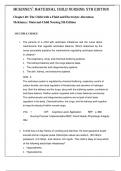
Test Bank for Wongs Nursing Care of Infants and Children 12th Edition Hockenberry/ TEST BANK FOR WONGS NURSING CARE OF INFANTS AND CHILDREN 12TH EDITION HOCKENBERRY (2024), CHAPTER 1-34 COMPLETE QUESTIONS AND ANSWERS Chapter 01: Perspectives of Pediatric Nursing Hockenberry: Wong’s Nursing Care of Infants and Children, 12th Edition MULTIPLE CHOICE 1. What is the major cause of death for children in the United States? a. Heart disease b. Childhood cancer c. Injuries d. Congenital anomalies ANS: C Unintentional injuries (accidents) are the leading cause of death after age 1 year through adolescence. The leading cause of death for those younger than 1 year is congenital anomalies, and childhood cancers and heart disease cause a significantly lower percentage of deaths in children older than 1 year of age. DIF: Cognitive Level: Understanding TOP: Nursing Process: Planning MSC: Client Needs: Health Promotion and Maintenance 2. Parents of a hospitalized toddler ask the nurse, “What is meant by family-centered care?” The nurse should respond with which statement? a. Family-centered care reduces the effect of cultural diversity on the family. b. Family-centered care encourages family dependence on the health care system. c. Family-centered care recognizes that the family is the constant in a child’s life. d. Family-centered care avoids expecting families to be part of the decision-making process. ANS: C The three key components of family-centered care are respect, collaboration, and support. Family-centered care recognizes the family as the constant in the child’s life. The family should be enabled and empowered to work with the health care system and is expected to be part of the decision-making process. The nurse should also support the family’s cultural diversity, not reduce its effect. DIF: Cognitive Level: Applying TOP: Nursing Process: Implementation MSC: Client Needs: Health Promotion and Maintenance 3. Evidence-based practice (EBP), a decision-making model, is best described as which? a. Using information in textbooks to guide care b. Combining knowledge with clinical experience and intuition c. Using a professional code of ethics as a means for decision making d. Gathering all evidence that applies to the child’s health and family situation ANS: B EBP helps focus on measurable outcomes; the use of demonstrated, effective interventions; and questioning the best approach. EBP involves decision making based on the integration of the best research evidence combined with clinical expertise and patient values. DIF: Cognitive Level: Remembering TOP: Nursing Process: Planning MSC: Client Needs: Safe and Effective Care Environment cP 4. The nurse is talking to a group of parents of school-age children at an after-school program about childhood health problems. Which statement should the nurse include in the teaching? a. Childhood obesity is the most common nutritional problem among children. b. Immunization rates are the same among children of different races and ethnicity. c. Dental caries is not a problem commonly seen in children since the introduction of fluorinated water. d. Mental health problems are typically not seen in school-age children but may be diagnosed in adolescents. ANS: A When teaching parents of school-age children about childhood health problems, the nurse should include information about childhood obesity because it is the most common problem among children and is associated with type 2 diabetes. Teaching parents about ways to prevent obesity is important to include. Immunization rates differ depending on the child’s race and ethnicity; dental caries continues to be a common chronic disease in childhood; and mental health problems are seen in children as young as school age, not just in adolescents. DIF: Cognitive Level: Applying TOP: Integrated Process: Teaching/Learning MSC: Client Needs: Health Promotion and Maintenance 5. The nurse is planning care for a hospitalized preschool-aged child. Which should the nurse plan to ensure atraumatic care? a. Limit explanation of procedures because the child is preschool aged. b. Ask that all family members leave the room when performing procedures. c. Allow the child to choose the type of juice to drink with the administration of oral medications. d. Explain that EMLA cream cannot be used for the morning lab draw because there is not time for it to be effective. ANS: C The overriding goal in providing atraumatic care is first, do no harm. Allowing the child, a choice of juice to drink when taking oral medications provides the child with a sense of control. The preschool child should be prepared before procedures, so limiting explanations of procedures would increase anxiety. The family should be allowed to stay with the child during procedures, minimizing stress. Lidocaine/prilocaine (EMLA) cream is a topical local anesthetic. The nurse should plan to use the prescribed cream in time for morning laboratory draws to minimize pain. DIF: Cognitive Level: Applying TOP: Nursing Process: Planning MSC: Client Needs: Health Promotion and Maintenance 6. Which situation denotes a nontherapeutic nurse–patient–family relationship? a. The nurse is planning to read a favorite fairy tale to a patient. b. During shift report, the nurse is criticizing parents for not visiting their child. c. The nurse is discussing with a fellow nurse the emotional draw to a certain patient. d. The nurse is working with a family to find ways to decrease the family’s dependence on health care providers. ANS: B cP Criticizing parents for not visiting in shift report is nontherapeutic and shows an under involvement with the parents. Reading a fairy tale is a therapeutic and age-appropriate action. Discussing feelings of an emotional draw with a fellow nurse is therapeutic and shows a willingness to understand feelings. Working with parents to decrease dependence on health care providers is therapeutic and helps to empower the family. DIF: Cognitive Level: Analyzing TOP: Integrated Process: Caring MSC: Client Needs: Psychosocial Integrity 7. The nurse is aware that which age-group is at risk for childhood injury because of the cognitive characteristic of magical and egocentric thinking? a. Preschool b. Young school age c. Middle school age d. Adolescent ANS: A Preschool children have the cognitive characteristic of magical and egocentric thinking, meaning they are unable to comprehend danger to self or others. Young and middle school-aged children have transitional cognitive processes, and they may attempt dangerous acts without detailed planning but recognize danger to themselves or others. Adolescents have formal operational cognitive processes and are preoccupied with abstract thinking. DIF: Cognitive Level: Understanding TOP: Nursing Process: Assessment MSC: Client Needs: Safe and Effective Care Environment 8. The school nurse is assessing children for risk factors related to childhood injuries. Which child has the most risk factors related to childhood injury? a. Female, multiple siblings, stable home life b. Male, high activity level, stressful home life c. Male, even tempered, history of previous injuries d. Female, reacts negatively to new situations, no serious previous injuries ANS: B Boys have a preponderance for injuries over girls because of a difference in behavioral characteristics, a high activity temperament is associated with risk-taking behaviors, and stress predisposes children to increased risk taking and self-destructive behaviors. Therefore, a male child with a high activity level and living in a stressful environment has the highest number of risk factors. A girl with several siblings and a stable home life is low risk. A boy with previous injuries has two risk factors, but an even temper is not a risk factor for injuries. A girl who reacts negatively to new situations but has no previous serious illnesses has only one risk factor. DIF: Cognitive Level: Analyzing TOP: Nursing Process: Assessment MSC: Client Needs: Safe and Effective Care Environment 9. An adolescent patient wants to make decisions about treatment options, along with his parents. Which moral value is the nurse displaying when supporting the adolescent to make decisions? a. Justice b. Autonomy c. Beneficence d. Nonmaleficence ANS: B cP Autonomy is the patient’s right to be self-governing. The adolescent is trying to be autonomous, so the nurse is supporting this value. Justice is the concept of fairness. Beneficence is the obligation to promote the patient’s well-being. Nonmaleficence is the obligation to minimize or prevent harm. DIF: Cognitive Level: Analyzing TOP: Nursing Process: Evaluation MSC: Client Needs: Health Promotion and Maintenance MULTIPLE RESPONSE 1. Which responsibilities are included in the pediatric nurse’s promotion of the health and well-being of children? (Select all that apply.) a. Promoting disease prevention b. Providing financial assistance c. Providing support and counseling d. Establishing lifelong friendships e. Establishing a therapeutic relationship f. Participating in ethical decision making ANS: A, C, E, F The pediatric nurse’s role includes promoting disease prevention, providing support and counseling, establishing a therapeutic relationship, and participating in ethical decision making; a pediatric nurse does not need to establish lifelong friendships or provide financial assistance to children and their families. Boundaries should be set and clear. DIF: Cognitive Level: Applying TOP: Nursing Process: Planning MSC: Client Needs: Health Promotion and Maintenance 2. The nurse is conducting a teaching session for parents on nutrition. Which characteristics of families should the nurse consider, that can cause families to struggle in providing adequate nutrition? (Select all that apply.) a. Homelessness b. Lower income c. Migrant status d. Working parents e. Single parent status ANS: A, B, C Families that struggle with lower incomes, homelessness, and migrant status generally lack the resources to provide their children with adequate food intake, nutritious foods such as fresh fruits and vegetables, and appropriate protein intake. Working parents and single parent status do not mean the families will struggle to provide adequate nutrition. DIF: Cognitive Level: Applying TOP: Integrated Process: Teaching/Learning MSC: Client Needs: Health Promotion and Maintenance cP 3. The nurse is preparing to complete documentation on a patient’s chart. Which should be included in documentation of nursing care? (Select all that apply.) a. Reassessments b. Incident reports c. Initial assessments d. Nursing care provided e. Patient’s response of care provided ANS: A, C, D, E The patient’s medical record should include initial assessments, reassessments, nursing care provided, and the patient’s response of care provided. Incident reports are not documented in the patient’s chart. DIF: Cognitive Level: Applying TOP: Integrated Process: Communication and Documentation MSC: Client Needs: Safe and Effective Care Environment 4. Which actions by the nurse demonstrate over involvement with patients and their families? (Select all that apply.) a. Buying clothes for the patients b. Showing favoritism toward a patient c. Focusing on technical aspects of care d. Spending off-duty time with patients and families e. Asking questions if families are not participating in care ANS: A, B, D Actions that show over involvement include buying clothes for patients, showing favoritism toward a patient, and spending off-duty time with patients and families. Focusing on technical aspects of care is an action that indicates under involvement, and asking questions if families are not participating in care indicates a positive action. DIF: Cognitive Level: Analyzing TOP: Integrated Process: Caring MSC: Client Needs: Health Promotion and Maintenance 5. Which are included in the evaluation step of the nursing process? (Select all that apply.) a. Determination if the outcome has been met b. Ascertaining if the plan requires modification c. Establish priorities and selecting expected patient goals d. Selecting alternative interventions if the outcome has not been met e. Determining if a risk or actual dysfunctional health problem exists ANS: A, B, D Evaluation is the last step in the nursing process. The nurse gathers, sorts, and analyzes data to determine whether (1) the established outcome has been met, (2) the nursing interventions were appropriate, (3) the plan requires modification, or (4) other alternatives should be considered. Establishing priorities and selecting expected patient goals are done in the outcomes identification stage. Determining if a risk or actual dysfunctional health problem exists is done in the diagnosis stage of the nursing process. DIF: Cognitive Level: Understanding TOP: Nursing Process: Evaluation MSC: Client Needs: Health Promotion and Maintenance cP 6. Which should the nurse teach to parents regarding oral health of children? (Select all that apply.) a. Fluoridated water should be used. b. Early childhood caries is a preventable disease. c. Dental caries is a rare chronic disease of childhood. d. Dental hygiene should begin with the first tooth eruption. e. Childhood caries does not happen until after 2 years of age. ANS: A, B, D Oral health instructions to parents of children should include use of fluoridated water and dental hygiene beginning with the first tooth eruption. In addition, early childhood caries is a preventable disease and should be included in the teaching session. Dental caries is a common, not rare, chronic disease of childhood. Childhood caries may begin before the first birthday. DIF: Cognitive Level: Applying TOP: Integrated Process: Teaching/Learning MSC: Client Needs: Health Promotion and Maintenance 7. The school nurse is explaining to older school children that obesity increases the risk for which disorders? (Select all that apply.) a. Asthma b. Hypertension c. Dyslipidemia d. Irritable bowel disease e. Altered glucose metabolism ANS: B, C, E Overweight youth have increased risk for a cluster of cardiovascular factors that include hypertension, altered glucose metabolism, and dyslipidemia. Irritable bowel disease and asthma are not linked to obesity. DIF: Cognitive Level: Applying TOP: Integrated Process: Teaching/Learning MSC: Client Needs: Health Promotion and Maintenance 8. Which actions by the nurse demonstrate clinical reasoning? (Select all that apply.) a. Basing decisions on intuition b. Considering alternative action c. Using formal and informal thinking to gather data d. Giving deliberate thought to a patient’s problem e. Developing an outcome focused on optimum patient care ANS: B, C, D, E Clinical reasoning is a cognitive process that uses formal and informal thinking to gather and analyze patient data, evaluate the significance of the information, and consider alternative actions. Clinical reasoning is a complex developmental process based on rational and deliberate thought and developing an outcome focused on optimum patient care. Clinical reasoning is based on the scientific method of inquiry; it is not based solely on intuition. DIF: Cognitive Level: Applying TOP: Nursing Process: Evaluation MSC: Client Needs: Safe and Effective Care Environment COMPLETION cP 1. The nurse is determining if a newborn is classified in the low birth weight (LBW) category of less than 2500 g. The newborn’s weight is 5 pounds, 4 oz. What is the newborn’s weight in grams? Record your answer in a whole number. ANS: 2386 Convert the 4 oz to a decimal by dividing 4 by 16 = 0.25. Use 5.25 pounds and divide by 2.2 to get 2.386 kg. Multiply by 1000 to convert to grams = 2386. DIF: Cognitive Level: Applying TOP: Nursing Process: Implementation MSC: Client Needs: Health Promotion and Maintenance

Show more Read less


Whoops! We can’t load your doc right now. Try again or contact support.

Document information

Uploaded on
October 24, 2023
Number of pages
949
Written in
2025/2026
Type
Exam (elaborations)
Contains
Questions & answers

Subjects

Content preview

TEST BANK FOR WONGS NURSING
CARE OF INFANTS AND CHILDREN
12TH EDITION HOCKENBERRY

,Chapter 1.Perspectives of Pediatric Nursing

MULTIPLE CHOICE

1. The clinic nurse is reviewing statistics on infant mortality for the United States versus other


m
countries. Compared with other countries that have a population of at least 25 million, the nurse
makes which determination?


co
a. The United States is ranked last among 27 countries.


.
b. The United States is ranked similar to 20 other developed countries.


nk
c. The United States is ranked in the middle of 20 other developed countries.
d. The United States is ranked highest among 27 other industrialized countries.

a
kt
ANS: A
n
Although the death rate has decreased, the United States still ranks last in infant mortality among
ba

nations with a population of at least 25 million. The United States has the highest infant death
rate of developed nations.
st


DIF: Cognitive Level: Remembering REF: MCS: 6
.te


TOP: Nursing Process: Assessment MSC: Client Needs: Health Promotion and Maintenance
w


2. Which is the leading cause of death in infants younger than 1 year in the United States?
w


a. Congenital anomalies
w


b. Sudden infant death syndrome
c. Disorders related to short gestation and low birth weight
d. Maternal complications specific to the perinatal period


ANS: A

,Congenital anomalies account for 20.1% of deaths in infants younger than 1 year compared with
sudden infant death syndrome, which accounts for 8.2%; disorders related to short gestation and
unspecified low birth weight, which account for 16.5%; and maternal complications such as
infections specific to the perinatal period, which account for 6.1% of deaths in infants younger
than 1 year of age.

DIF: Cognitive Level: Remembering REF: MCS: 7 TOP: Nursing Process: Planning


m
MSC: Client Needs: Health Promotion and Maintenance


co
3. What is the major cause of death for children older than 1 year in the United States?


.
a. Heart disease


nk
b. Childhood cancer
c. Unintentional injuries
d. Congenital anomalies
a
n kt
ANS: C
ba

Unintentional injuries (accidents) are the leading cause of death after age 1 year through
adolescence. The leading cause of death for those younger than 1 year is congenital anomalies,
st


and childhood cancers and heart disease cause a significantly lower percentage of deaths in
children older than 1 year of age.
.te


DIF: Cognitive Level: Understanding REF: MCS: 7 TOP: Nursing Process: Planning
w


MSC: Client Needs: Health Promotion and Maintenance
w


4. In addition to injuries, what are the leading causes of death in adolescents ages 15 to 19 years?
w


a. Suicide and cancer
b. Suicide and homicide
c. Drowning and cancer
d. Homicide and heart disease


Downloaded
Downloaded
by: PASSGRADES
by: SuperA |
|
Distribution of this document is illegal

, Stuvia.com - The Marketplace to Buy and Sell your Study Material


ANS: B

Suicide and homicide account for 16.7% of deaths in this age group. Suicide and cancer account
for 10.9% of deaths, heart disease and cancer account for approximately 5.5%, and homicide and
heart disease account for 10.9% of the deaths in this age group.

DIF: Cognitive Level: Remembering REF: MCS: 7 TOP: Nursing Process: Planning


m
MSC: Client Needs: Health Promotion and Maintenance


co
5. The nurse is planning a teaching session to adolescents about deaths by unintentional injuries.
Which should the nurse include in the session with regard to deaths caused by injuries?


.
nk
a. More deaths occur in males.
b. More deaths occur in females.


a
c. The pattern of deaths does not vary according to age and sex.
kt
d. The pattern of deaths does not vary widely among different ethnic groups.
n
ANS: A
ba


The majority of deaths from unintentional injuries occur in males. The pattern of death does vary
st


greatly among different ethnic groups, and the causes of unintentional deaths vary with age and
gender.
.te


DIF: Cognitive Level: Applying REF: pp. 7-8
w


TOP: Integrated Process: Teaching/Learning
w


MSC: Client Needs: Health Promotion and Maintenance
w


6. What do mortality statistics describe?

a. Disease occurring regularly within a geographic location
b. The number of individuals who have died over a specific period
c. The prevalence of specific illness in the population at a particular time


Downloaded
Downloaded
by: PASSGRADES
by: SuperA |
|
Distribution of this document is illegal

Get to know the seller

Seller avatar
Reputation scores are based on the amount of documents a seller has sold for a fee and the reviews they have received for those documents. There are three levels: Bronze, Silver and Gold. The better the reputation, the more your can rely on the quality of the sellers work.
Sirih chamberlin college of nursing
View profile
Follow You need to be logged in order to follow users or courses
Sold
670
Member since
3 year
Number of followers
525
Documents
834
Last sold
4 days ago
Best Stuvia Study Materials by Sirih

I am just a student like you. Kindly support and inquire for any study material that you need. I am friendly so don't hesitate to reach out.

4.1

63 reviews

5
40
4
7
3
5
2
5
1
6

Recently viewed by you

Why students choose Stuvia

Created by fellow students, verified by reviews

Quality you can trust: written by students who passed their tests and reviewed by others who've used these notes.

Didn't get what you expected? Choose another document

No worries! You can instantly pick a different document that better fits what you're looking for.

Pay as you like, start learning right away

No subscription, no commitments. Pay the way you're used to via credit card and download your PDF document instantly.

Student with book image

“Bought, downloaded, and aced it. It really can be that simple.”

Alisha Student

Frequently asked questions