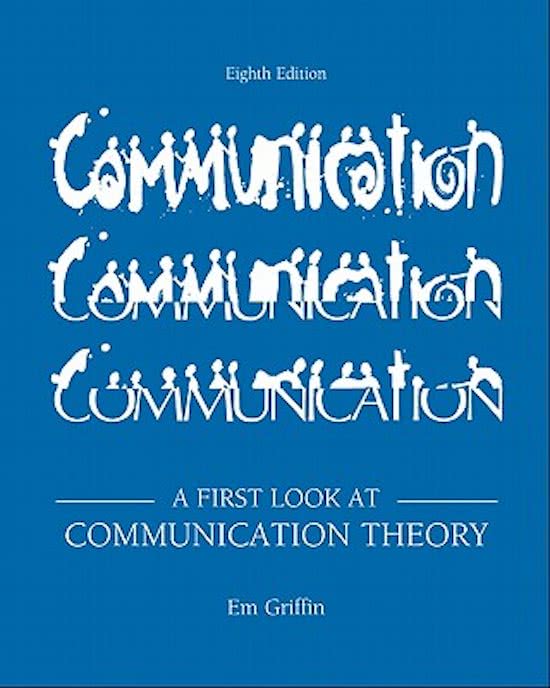
A First Look at Communication Theory
Chapter 1
Communication
- The relational process of creating and interpreting messages that elicit (draw out a
reaction) a response.
- Has a beginning (creation of the massage), a middle (the message’s characteristics),
and an end (the interpretation of the message and response to it).
What shape our communication choices?
1. Context
2. The relationship between the communicators
3. Our internal motives
Levels of every message:
1. Content level: The topic addressed by the message
2. Relationship level: How each person thinks and feels about the other
Polysemic
- A quality of symbols that means they’re open to multiple interpretations
Theory
- A set of systematic, informed hunches about the way things work
- They grow and mature over time
1. A set of hunches
- We aren’t yet sure if we have the answer
- Plural, because a theory is not just one inspired thought or isolated idea
2. Informed hunches
- Hunches should be informed; we can’t draw conclusions based on one conversation
- You should do research
3. Hunches that are systematic
- A theory not only lays out multiple ideas, but also specifies the relationships among
them. It connects the dots
Images of theory
- Nets (detailed, but maybe too much)
- Lenses (highlights the important, from your own perspective, close up so not overall)
- Maps (purpose is navigating)
,Chapter 2
Different perspectives on theory
- Objective theories
- Interpretive theories
Objective theories
- The truth is singular
- Unbiased observation
- Uncovering cause-and-effect relationships
Interpretive theories
- Multiple truths possible
- Meaning and value to texts
- The way language constructs realities
- Truth is subjective, depending on a person's experience
Dimension 1 – Ways of knowing: Discovering truths (O) or creating multiple realities (I)
- Objective:
o There is one truth that only need to be discovered
o No one person can know it all, so individual researchers pool their findings
and build a collective pool of knowledge about how the world works
o Good theories are mirrors of nature, true as long as conditions remain the
same
- Interpretive:
o Truth is socially constructed through communication
o Knowledge is viewed from a particular perspective
o Texts never interpret themselves
Dimension 2 – Human nature: Determinism (O) or free will (I)
- Objective:
o Determinism: Focus on human behaviour as a consequence of heredity and
environment
- Interpretive:
o Focus on conscious choices made by people
Dimension 3 – Purpose of theory: Universal laws (O) of interpretive guides
- Objective:
o Seeking for universal laws
o But, there is never complete proof
- Interpretive:
o Interpreting particular “texts” and give them meaning
o It’s not about proving, but about understanding
,Dimension 4 – The highest value: Objectivity (O) or emancipation (I)
- Objective:
o Finding out the truth
o Objective testing hypotheses
o Trying to exclude own values
o It is about what “is”
- Interpretive:
o About understanding
o Including own values of what’s right and wrong
o Research is there to make “the world a better place”
o It is about what “ought to be”
Dimension 5 – Objective or interpretive: Why is it important?
- You can’t fully understand a theory without knowing its assumptions about truth,
human nature, the purpose of theory, and its values
Chapter 3
What makes an objective theory good?
- Standard 1: prediction of future events
- Standard 2: explanation of future events
- Standard 3: relative simplicity
- Standard 4: hypotheses that can be tested
- Standard 5: practical utility
- Standard 6: quantitative research
What makes an interpretive theory good?
- Standard 1: clarification of values
- Standard 2: new understanding of people
- Standard 3: aesthetic appeal
- Standard 4: community of agreement
- Standard 5: reform of society
- Standard 6: qualitative research
Objective
Standard 1: prediction of future events
- Predicts what will happen
- Possible when dealing with senses over and over again
- Based on probability
Standard 2: explanation of the data
, - Explains an event of human behaviour
- Draws order out of chaos
- It provides us with an “informed hunch”
- Explains what is happening and why
- It explains both the process and results
Standard 3: relative simplicity
- The rule of parsimony: Given two plausible explanations for the same event, we
should first accept and test the simpler version
- As simple as possible
Standard 4: hypothesis can be tested
- It should be testable
- Falsifiability: requirement that scientific theory must be stated in a way that can be
tested and disproved if it’s wrong
- If there’s no way to prove a theory false, then any claim that it’s true seems hollow
Standard 5: practical utility
- Objective theory is useful
- Don’t dismiss a theory as impractical unless you understand it
Standard 6: quantitative research
- Most objective research depends on a comparison of differences or testing relations
(experiments and surveys)
- Numbers are more reliable than words
- Through experiments a cause-and-effect relationship
Interpretive
Standard 1: clarification of values
- Interpretive theory brings people’s values into the open
- Theorists acknowledge their own values
- They seek to unmask the ideology behind messages
Standard 2: new understanding of people
- It offers fresh insight into human condition
- Typically examines a one-of-a-kind speech community that exhibits specific
(language) style, or is a sub-culture
- Subjective understanding
- Self-referential imperative: the researcher includes her/his own values as it is
believed impossible not to do so. We are both the cause and the consequence of
what we observe
Standard 3: aesthetic appeal
- It should capture readers’ imaginations
Chapter 1
Communication
- The relational process of creating and interpreting messages that elicit (draw out a
reaction) a response.
- Has a beginning (creation of the massage), a middle (the message’s characteristics),
and an end (the interpretation of the message and response to it).
What shape our communication choices?
1. Context
2. The relationship between the communicators
3. Our internal motives
Levels of every message:
1. Content level: The topic addressed by the message
2. Relationship level: How each person thinks and feels about the other
Polysemic
- A quality of symbols that means they’re open to multiple interpretations
Theory
- A set of systematic, informed hunches about the way things work
- They grow and mature over time
1. A set of hunches
- We aren’t yet sure if we have the answer
- Plural, because a theory is not just one inspired thought or isolated idea
2. Informed hunches
- Hunches should be informed; we can’t draw conclusions based on one conversation
- You should do research
3. Hunches that are systematic
- A theory not only lays out multiple ideas, but also specifies the relationships among
them. It connects the dots
Images of theory
- Nets (detailed, but maybe too much)
- Lenses (highlights the important, from your own perspective, close up so not overall)
- Maps (purpose is navigating)
,Chapter 2
Different perspectives on theory
- Objective theories
- Interpretive theories
Objective theories
- The truth is singular
- Unbiased observation
- Uncovering cause-and-effect relationships
Interpretive theories
- Multiple truths possible
- Meaning and value to texts
- The way language constructs realities
- Truth is subjective, depending on a person's experience
Dimension 1 – Ways of knowing: Discovering truths (O) or creating multiple realities (I)
- Objective:
o There is one truth that only need to be discovered
o No one person can know it all, so individual researchers pool their findings
and build a collective pool of knowledge about how the world works
o Good theories are mirrors of nature, true as long as conditions remain the
same
- Interpretive:
o Truth is socially constructed through communication
o Knowledge is viewed from a particular perspective
o Texts never interpret themselves
Dimension 2 – Human nature: Determinism (O) or free will (I)
- Objective:
o Determinism: Focus on human behaviour as a consequence of heredity and
environment
- Interpretive:
o Focus on conscious choices made by people
Dimension 3 – Purpose of theory: Universal laws (O) of interpretive guides
- Objective:
o Seeking for universal laws
o But, there is never complete proof
- Interpretive:
o Interpreting particular “texts” and give them meaning
o It’s not about proving, but about understanding
,Dimension 4 – The highest value: Objectivity (O) or emancipation (I)
- Objective:
o Finding out the truth
o Objective testing hypotheses
o Trying to exclude own values
o It is about what “is”
- Interpretive:
o About understanding
o Including own values of what’s right and wrong
o Research is there to make “the world a better place”
o It is about what “ought to be”
Dimension 5 – Objective or interpretive: Why is it important?
- You can’t fully understand a theory without knowing its assumptions about truth,
human nature, the purpose of theory, and its values
Chapter 3
What makes an objective theory good?
- Standard 1: prediction of future events
- Standard 2: explanation of future events
- Standard 3: relative simplicity
- Standard 4: hypotheses that can be tested
- Standard 5: practical utility
- Standard 6: quantitative research
What makes an interpretive theory good?
- Standard 1: clarification of values
- Standard 2: new understanding of people
- Standard 3: aesthetic appeal
- Standard 4: community of agreement
- Standard 5: reform of society
- Standard 6: qualitative research
Objective
Standard 1: prediction of future events
- Predicts what will happen
- Possible when dealing with senses over and over again
- Based on probability
Standard 2: explanation of the data
, - Explains an event of human behaviour
- Draws order out of chaos
- It provides us with an “informed hunch”
- Explains what is happening and why
- It explains both the process and results
Standard 3: relative simplicity
- The rule of parsimony: Given two plausible explanations for the same event, we
should first accept and test the simpler version
- As simple as possible
Standard 4: hypothesis can be tested
- It should be testable
- Falsifiability: requirement that scientific theory must be stated in a way that can be
tested and disproved if it’s wrong
- If there’s no way to prove a theory false, then any claim that it’s true seems hollow
Standard 5: practical utility
- Objective theory is useful
- Don’t dismiss a theory as impractical unless you understand it
Standard 6: quantitative research
- Most objective research depends on a comparison of differences or testing relations
(experiments and surveys)
- Numbers are more reliable than words
- Through experiments a cause-and-effect relationship
Interpretive
Standard 1: clarification of values
- Interpretive theory brings people’s values into the open
- Theorists acknowledge their own values
- They seek to unmask the ideology behind messages
Standard 2: new understanding of people
- It offers fresh insight into human condition
- Typically examines a one-of-a-kind speech community that exhibits specific
(language) style, or is a sub-culture
- Subjective understanding
- Self-referential imperative: the researcher includes her/his own values as it is
believed impossible not to do so. We are both the cause and the consequence of
what we observe
Standard 3: aesthetic appeal
- It should capture readers’ imaginations