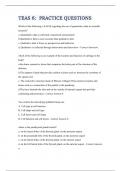
TEAS 6: PRACTICE QUESTIONS with 100% Correct Answers
Which of the following is FALSE regarding the use of quantitative data in scientific research? a. Quantitative data is collected a numerical measurement b.Quantitative data is more accurate than qualitative data c. Qualitative data is focus on perspectives and behaviors d. Qualitative is collected through observation and interviews - Correct Answer-b. which of the following is an example of the location and function of cartilage in the body? dense connective tissue that comprises the better part of the structure of the skeleton b.The support of pads that provide cushion at joints such as between the vertebrae of the spinal cord c. The connective structure made of fibrosis Collagen That connects muscles and bones such as a connection of the patella to the quadricep d.The layer beneath the skin and on the outside of internal organs that provides cushioning and protection - Correct Answer-b. Two criteria for classifying epithelial tissue are A. Cell type in cell function B. Cell shape and cell type C. Cell layers and cell shape D. Cell function and cell layers - Correct Answer-C. where is the parathyroid gland located? a. on the lateral lobes of the thyroid gland, on the posterior aspect. b. on the pyramidal lobe of the thyroid gland, on the posterior aspect c. on the lateral lobes of the thyroid gland, on the anterior aspect d. on the left lateral lobe of the thyroid gland, on the anterior aspect - Correct Answer- a. On average how many neutrons is one atom of bromine have? A. 35 B. 44.90 C. 45 D. 79.90 - Correct Answer-B On average how many protons is one atom of zinc have? A. 30 B. 35 C. 35.39 D. 65.39 - Correct Answer-A. 30 Which statement below correctly describes the movement of molecules in the body and or in relation to the external environment? A. Osmosis is the movement of a solution from an area of low solute concentration to an area of high solute concentration B. Diffusion is the process in the lungs by which oxygen is transported from the air to the blood C. Dissipation is a transport of molecules across a semi permeable membrane from an area of low concentration to high concentration requiring energy D. Reverse osmosis is the movement of molecules in a solution from an area of high concentration to an area of lower concentration - Correct Answer-B. When are the parasympathetic nerves active within the nervous system? A. When an individual experiences a strong emotions such as fear or Excitement B. When an individual feels pain or heat C. When an individual is either talking or walking D. When an individual is either resting or eating - Correct Answer-D. Which of the following best describes the relationship between the circulatory system and the integumentary system? A. Removal of excess heat from body B. Hormonal influence on blood pressure C.Regulation of blood pressure and volume D. Development of blood cells within marrow - Correct Answer-A. Which of the following statements describes the path of blood entering into the heart? A. Blood enters a heart through the pulmonary vein into the right atrium through the tricuspid valve to the right ventricle B. Once the right ventricle is for blood exit into the pulmonary artery and then empties into the left ventricle C. After traveling through the lungs oxygenated blood enters into the left atrium then through the mitral valve to the left ventricle D. Once the left ventricle is for the left tricuspid valve shut the ventricle contracts and blood exit through the aorta - Correct Answer-C. A part of which body system controls fluid loss protects deep tissues and synthesizes vitamin D? A. The skeletal system B. The muscular system C. The lymphatic system D. The integumentary system - Correct Answer-D. Which statement below accurately Describes the function of its element? A. Collagen is a spongy fatty compound that creates a padding between bones and other structures B. Hemoglobin is the amount of red blood cells that are present in blood which can reflect disease state hydration and blood loss C. Limp is tissue that forms into nodes through which blood is filtered and cleaned D. An antigen simulates the production of antibodies - Correct Answer-D. Which of the following does not exist in RNA? A. Uracil B. Thymine C. Cytosine D. Guanine - Correct Answer-B
Document information
- Uploaded on
- October 23, 2023
- Number of pages
- 18
- Written in
- 2023/2024
- Type
- Exam (elaborations)
- Contains
- Questions & answers