PATHOPHYSIOLOGY - MODULE 2 - EXAM 1 QUESTIONS WITH 100% CORRECT ANSWERS 2022/2023
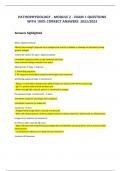
PATHOPHYSIOLOGY - MODULE 2 - EXAM 1 QUESTIONS WITH 100% CORRECT ANSWERS 2022/2023 Answers highlighted Define hypersensitivity Altered immunologic response to an antigen that results in disease or damage to individual (strong genetic linkage) 2 alternate names for type 1 hypersensitivity Immediate hypersensitivity or IgE mediated reactions most common allergic reactions are type 1 Mechanisms of type 1 response 1. Sensitizing exposure 2. Re exposure (immediate response and longer term response) Sensitizing exposure (type 1 mechanism) - Helper 2 t cells help b lymphocytes differentiate into plasma cells which produce IgE - IgE's Fc portion (stem) binds to mast cells - When enough IgE is bound, person is sensitized to antigen Re exposure (type 1 mechanism) - 2 types Immediate response and longer term response Immediate response (re exposure) symptoms <5 mins - Antigen binds to IgE which is bound to mast cells - Mast cell release granule contents (degranulation), release histamine, which leads to inflammation Longer term response (re exposure) 8-12 hours after, lasts 24-36 hours - Mast cells generate leukotrienes/prostaglandins and platelet activating factor which lead to further inflammation. - Local/systemic effects occur (tears/mucus secretion) 3 actions of histamine 1. increases vascular permeability 2. causes vasodilation 3. contracts bronchial smooth muscle tissue What is type 2 hypersensitivity (name) Antibody dependent cytotoxic hypersensitivity Where are antigens located that react with antibodies in type 2 response Ab react to Ag fixed to surface of various body cells/specific tissues Mechanisms of type 2 response (3) 1. cell destruction 2. inflammation 3. altered cell metabolism Cell destruction (type 2 mechanism) Ab (IgG/IgM) bind to Ag on tissue cell surface and: - Cause phagocytosis (opsonization) - Activate complement (result: phagocytosis/cell lysis) - E.g., blood transfusion reaction Inflammation (type 2 mechanism) - When Ab are bound to extracellular connective tissue - Ab activate complement which cause inflammatory response (activating mast cells - releasing histamine and acting as chemokines to attract monocytes/neutrophils) - Cell injury results from release of proteases - E.g., Goodpasture syndrome Altered cell metabolism (type 2 mechanism) - Ab attach to receptors on cell surface which change cell function (2 ways) - 1. Replacing chemical that normally fits in receptor (ligand), which inappropriately stimulates cell (e.g., graves disease - thyroid gland is stimulated inappropriately to produce thyroid hormone) - 2. Blocking/destroying receptor (e.g., myasthenia gravis - acetylcholine receptors on muscle cells are blocked) Where are Ag located that react with Ab in type 3 response Ab-ag complexes formed in circulation then deposited on cell surface Type 3 hypersensitivity (name) Immune complex mediated hypersensitivity General mechanism of type 3 response with example - Antibodies activate complement which: - Attract neutrophils/opsonize tissue - Lysosomal enzymes/inflammatory mediators released by neutrophils to produce inflammation/damage to underlying tissues - Not tissue specific - E.g., Systematic lupus erythematosus (SLE) Ab-Ag in systematic immune complex disorder vs ... Ab-ag complex deposited in wide range of body tissues (e.g., serum sickness) Ab-Ag in localized immune complex disorder Due to injected drug/vaccine/insect bite. Severe in some cases (e.g., Arthus Reaction) Which mechanism causes serum sickness and how is it caused Systematic immune complex disorder. Caused by antibiotics (penicillin), foods, drugs, venom Which mechanism causes Arthus reaction and how is it caused Localized immune complex disorder Caused by injected drug, insect sting, vaccine Type 4 hypersensitivity (name) Cell mediated hypersensitivity
Written for
- Institution
- PATHOPHYSIOLOGY
- Course
- PATHOPHYSIOLOGY
Document information
- Uploaded on
- October 23, 2023
- Number of pages
- 11
- Written in
- 2023/2024
- Type
- Exam (elaborations)
- Contains
- Questions & answers
Subjects
-
pathophysiology module 2 exam 1 questions
-
pathophysiology module 2 exam 1 questions wit

Also available in package deal