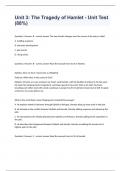
Unit 3 The Tragedy of Hamlet - Unit Test (88%) passed
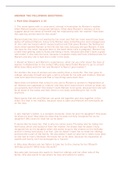
Unit 3 The Tragedy of Hamlet - Unit Test (88%)Question 1 Answer: B - correct answer The way Hamlet changes over the course of the play is called A. building suspense B. character development C. plot events D. rising action. Question 2 Answer: B - correct answer Read the excerpt from Act II of Hamlet. Ophelia: Alas! my lord, I have been so affrighted. Polonius: With what, in the name of God? Ophelia: My lord, as I was sewing in my closet, Lord Hamlet, with his doublet all unbrac'd; No hat upon his head; his stockings foul'd, Ungarter'd, and down-gyved to his ancle; Pale as his shirt; his knees knocking each other; And with a look so piteous in purport As if he had been loosed out of hell To speak of horrors, he comes before me. What is the most likely reason Shakespeare included this passage? A. He explains Hamlet's behavior through Ophelia's dialogue, thereby tying up loose ends in the plot. B. He introduces the conflict between Ophelia and Hamlet, thereby adding suspense and advancing the plot. C. He characterizes the relationship between Ophelia and Polonius, thereby adding to the exposition in the plot. D. He describes the background between Ophelia and Hamlet, thereby escalating the tension to its highest point in the plot. Question 3 Answer: C - correct answer Read the excerpt from Act IV of Hamlet. Hamlet: Rightly to be great Is not to stir without great argument, But greatly to find quarrel in a straw When honour's at the stake. What is the most likely reason Shakespeare repeats "great" and "greatly"? A. Shakespeare utilizes the repetition of "great" to help illustrate Hamlet's lack of a main point. B. By repeating the same word, Shakespeare shows that Hamlet is not sure of his point. C. Shakespeare capitalizes on the multiple meanings of "great" to help emphasize Hamlet's point. D. By using a word with multiple meanings, Shakespeare shows that Hamlet is not good at making his point. Question 4 Answer: C - correct answer Read the excerpt from Hamlet. Hamlet: O! that this too too solid flesh would melt, Thaw and resolve itself into a dew; Or that the Everlasting had not fix'd His canon 'gainst self-slaughter! O God! O God! How weary, stale, flat, and unprofitable Seem to me all the uses of this world. Fie on 't! O fie! 'tis an unweeded garden, That grows to seed; things rank and gross in nature Possess it merely. That it should come to this! Which phrase from the excerpt best reflects Hamlet's state of mind? A. Thaw and resolve itself into a dew; B. His canon 'gainst self-slaughter! C. How weary, stale, D. Fie on 't! O fie! Question 5 Answer: B - correct answer When a reader studies the combined effect of similes, metaphors, and allusions in Hamlet, the reader is analyzing the __________ choices. A. character B. language C. plot D. setting Question 6 Answer: A - correct answer Read the excerpt from Hamlet.
Written for
- Institution
- HIM
- Course
- HIM
Document information
- Uploaded on
- October 22, 2023
- Number of pages
- 11
- Written in
- 2023/2024
- Type
- Exam (elaborations)
- Contains
- Questions & answers
Subjects
-
unit 3 the tragedy of hamlet unit test 88

Also available in package deal