Work Psychology
Hoorcollege 1
Voorbereidende stof aan hoorcollege 1
Work = a set of coordinated and goal-directed activities that are conducted in exchange for
something else.
Contemporary work psychology is aimed at creating sustainable performance: maximizing
work performance as well as worker health and well-being.
Work psychology = the way workers’ behaviours, motivations, thoughts, emotions, health
and well-being relate to each other, and about ways to influence these concepts.
Relative deprivation model (Marie Jahoda, 1982): employment provides five classes of social
benefits (next to money):
1. Time structure
2. Opportunities for social contact
3. Sharing of a common purpose
4. Social identity or status
5. Regular activity
Personnel psychology = the link between workers’ characteristics and job requirements,
assuming that worker well-being and productivity are optimal when there is a good match
between the job and the worker.
New way of working (NWW) = flexibility in the timing of work, the place of work and the
facilitation of new media technologies.
ICT: redefining how, where and when work is performed.
The psychological contract = what employees and employers want and expect from each
other (stability and permanent employment flexibility and employability).
Intensification of work: increasing work hours and pressure, the need for lifelong learning
and the ability and willingness to continuously change the type of work one does.
Task analysis = any process that identifies and examines the demanding tasks that must be
performed by employees. Assists in achieving higher performance and safety standards.
- Behaviour description approach: focus on actual behaviours employees display in
executing tasks
- Behaviour requirements approach: focus on actual behaviours employees should
display in executing tasks
- Ability requirements approach: employees’ abilities, knowledge, skills, and personal
characteristics.
- Task characteristics approach: focus on objective characteristics of a task.
1. Data collection techniques: interviews etc.
2. Task representation techniques: graphic descriptions of tasks
3. Task simulation techniques: Mock-ups (simulate dynamic aspects of tasks) and
workspace designs (ergonomically laying out work environments)
,Werkelijke hoorcollege 1
Our domain
Psychology Work
◦ Behavior ◦ Goal-directed activity
◦ Motivations why do we act like we do. ◦ Coordinated activity
◦ Thoughts and emotions ◦ In exchange for something
This definition of work always rules out voluntary work, so there is always a grey area.
The importance of work (Money is not the most important part of work!)
Time structure structures your days
Opportunities for social contact
Sharing of a common purpose
Social identity or status
Regular activity being active, doing something, using your energy to do something.
Unemployment leads to health problems (because people get unhappy), and health
problems lead to unemployment at its turn. So, it is going in a circle.
Changing work
Many more people get self-employed. Also, people nowadays switch more of jobs, than
people did 50 years ago. Earlier generation had longer working hours and much more
demanding jobs, in underdeveloped countries this is still the case.
Early work psychology
1850-1930
Just after the industrial revolution
Mainly factory work
Poor conditions: long hours, low wages, minimal protection, very demanding work.
Simple, boring, repetitive work
Key question: how can we increase productivity?
Scientific Management (Taylorism): scientific because behaviour and work practices was
measured. Time and motion studies most effective way to perform a specific job.
Goal: to maximize efficiency managers should think, and employees should do.
Two assumptions: Employees are (1) lazy and (2) stupid
To tackle stupidity: simplify and standardize the duties
o Divide complex tasks into simple subtasks
o Determine the best way to carry out these subtasks
o Train the employee according to this 'one best way'
o Select the best employees for each subtask
To tackle laziness:
o Managers supervise and control employees extensively
o Pay-for-performance systems
The idea, then, of.. training a workman under a competent teacher into new working habits
until he continually and habitually works in accordance with scientific laws, which have been
developed by someone else, is directly antagonistic to the old idea that each workman can
best regulate his own way of doing the work... the philosophy of the old management puts
,the entire responsibility upon the workmen, while the philosophy of the new places a great
part of it upon the management. FW Taylor, The Principles of Scientific Management (1911)
p.63
Impact of Taylorism
Short term: increase in productivity
Long term: disengaged employees, high sickness absence, angry unions, strikes
1930 – present
Human relations movement: work should be adapted to people.
Attention for:
◦ Human needs and limitations jobs should reach these human needs.
◦ Working conditions
◦ Well-being, motivation, and satisfaction
Modern work psychology:
◦ Focuses on maximizing work performance while safeguarding employee well-being/health
◦ Objective = sustainable performance
◦ By design of the job, the working conditions, tasks, and work organization
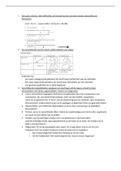
A work psychology framework
Work characteristics and personal characteristics lead to a certain behaviour, which leads to
a certain personal outcomes and work outcomes.
, 1: Work Characteristics
This is a so-called union model, from the outside in, it is more and more difficult to change.
2: Personal Characteristics
Personality
Experience
Physical capacities
Information processing capacity
Habitual processing capacity / TRAIT
◦ 'Trait‘
◦ Inter-individual differences what can they process
Current processing capacity / STATE
◦ Intra-individual differences what can they process right now?
◦ Fatigue (energy to exert effort)
◦ Motivation (willingness to exert effort)
3: Work Behaviour
Execution of the work
According to Action Regulation Theory (Hacker et al., 1980)
• Goal-oriented rational and logically, but where is the motivation.
• “...a process in which an individual deliberately transforms his/her
environment through the use of certain psychological processing
mechanisms” (Roe & Zijlstra, 1991, p.182-183)
• Examples of psychological processing mechanisms:
◦ Cognitive control: attention, inhibition, information processing, fatigue
◦ Motivation
4 & 5: Outcomes of Work Behaviour
4. Work outcomes: quality of products and services, environmental changes, financial results
the product that is formed
5. Personal outcomes: satisfaction, stress, health, wellbeing what emotions do you get
form work?
Outcomes for the organization and person may be positive and negative (costs & benefits)!
Hoorcollege 1
Voorbereidende stof aan hoorcollege 1
Work = a set of coordinated and goal-directed activities that are conducted in exchange for
something else.
Contemporary work psychology is aimed at creating sustainable performance: maximizing
work performance as well as worker health and well-being.
Work psychology = the way workers’ behaviours, motivations, thoughts, emotions, health
and well-being relate to each other, and about ways to influence these concepts.
Relative deprivation model (Marie Jahoda, 1982): employment provides five classes of social
benefits (next to money):
1. Time structure
2. Opportunities for social contact
3. Sharing of a common purpose
4. Social identity or status
5. Regular activity
Personnel psychology = the link between workers’ characteristics and job requirements,
assuming that worker well-being and productivity are optimal when there is a good match
between the job and the worker.
New way of working (NWW) = flexibility in the timing of work, the place of work and the
facilitation of new media technologies.
ICT: redefining how, where and when work is performed.
The psychological contract = what employees and employers want and expect from each
other (stability and permanent employment flexibility and employability).
Intensification of work: increasing work hours and pressure, the need for lifelong learning
and the ability and willingness to continuously change the type of work one does.
Task analysis = any process that identifies and examines the demanding tasks that must be
performed by employees. Assists in achieving higher performance and safety standards.
- Behaviour description approach: focus on actual behaviours employees display in
executing tasks
- Behaviour requirements approach: focus on actual behaviours employees should
display in executing tasks
- Ability requirements approach: employees’ abilities, knowledge, skills, and personal
characteristics.
- Task characteristics approach: focus on objective characteristics of a task.
1. Data collection techniques: interviews etc.
2. Task representation techniques: graphic descriptions of tasks
3. Task simulation techniques: Mock-ups (simulate dynamic aspects of tasks) and
workspace designs (ergonomically laying out work environments)
,Werkelijke hoorcollege 1
Our domain
Psychology Work
◦ Behavior ◦ Goal-directed activity
◦ Motivations why do we act like we do. ◦ Coordinated activity
◦ Thoughts and emotions ◦ In exchange for something
This definition of work always rules out voluntary work, so there is always a grey area.
The importance of work (Money is not the most important part of work!)
Time structure structures your days
Opportunities for social contact
Sharing of a common purpose
Social identity or status
Regular activity being active, doing something, using your energy to do something.
Unemployment leads to health problems (because people get unhappy), and health
problems lead to unemployment at its turn. So, it is going in a circle.
Changing work
Many more people get self-employed. Also, people nowadays switch more of jobs, than
people did 50 years ago. Earlier generation had longer working hours and much more
demanding jobs, in underdeveloped countries this is still the case.
Early work psychology
1850-1930
Just after the industrial revolution
Mainly factory work
Poor conditions: long hours, low wages, minimal protection, very demanding work.
Simple, boring, repetitive work
Key question: how can we increase productivity?
Scientific Management (Taylorism): scientific because behaviour and work practices was
measured. Time and motion studies most effective way to perform a specific job.
Goal: to maximize efficiency managers should think, and employees should do.
Two assumptions: Employees are (1) lazy and (2) stupid
To tackle stupidity: simplify and standardize the duties
o Divide complex tasks into simple subtasks
o Determine the best way to carry out these subtasks
o Train the employee according to this 'one best way'
o Select the best employees for each subtask
To tackle laziness:
o Managers supervise and control employees extensively
o Pay-for-performance systems
The idea, then, of.. training a workman under a competent teacher into new working habits
until he continually and habitually works in accordance with scientific laws, which have been
developed by someone else, is directly antagonistic to the old idea that each workman can
best regulate his own way of doing the work... the philosophy of the old management puts
,the entire responsibility upon the workmen, while the philosophy of the new places a great
part of it upon the management. FW Taylor, The Principles of Scientific Management (1911)
p.63
Impact of Taylorism
Short term: increase in productivity
Long term: disengaged employees, high sickness absence, angry unions, strikes
1930 – present
Human relations movement: work should be adapted to people.
Attention for:
◦ Human needs and limitations jobs should reach these human needs.
◦ Working conditions
◦ Well-being, motivation, and satisfaction
Modern work psychology:
◦ Focuses on maximizing work performance while safeguarding employee well-being/health
◦ Objective = sustainable performance
◦ By design of the job, the working conditions, tasks, and work organization
A work psychology framework
Work characteristics and personal characteristics lead to a certain behaviour, which leads to
a certain personal outcomes and work outcomes.
, 1: Work Characteristics
This is a so-called union model, from the outside in, it is more and more difficult to change.
2: Personal Characteristics
Personality
Experience
Physical capacities
Information processing capacity
Habitual processing capacity / TRAIT
◦ 'Trait‘
◦ Inter-individual differences what can they process
Current processing capacity / STATE
◦ Intra-individual differences what can they process right now?
◦ Fatigue (energy to exert effort)
◦ Motivation (willingness to exert effort)
3: Work Behaviour
Execution of the work
According to Action Regulation Theory (Hacker et al., 1980)
• Goal-oriented rational and logically, but where is the motivation.
• “...a process in which an individual deliberately transforms his/her
environment through the use of certain psychological processing
mechanisms” (Roe & Zijlstra, 1991, p.182-183)
• Examples of psychological processing mechanisms:
◦ Cognitive control: attention, inhibition, information processing, fatigue
◦ Motivation
4 & 5: Outcomes of Work Behaviour
4. Work outcomes: quality of products and services, environmental changes, financial results
the product that is formed
5. Personal outcomes: satisfaction, stress, health, wellbeing what emotions do you get
form work?
Outcomes for the organization and person may be positive and negative (costs & benefits)!