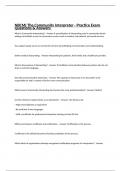
NBCMI The Community Interpreter - Practice Exam Questions & Answers
What is Community Interpreting? - Answer A specialization of interpreting used in community-based settings to facilitate access to community services such as medical, educational, and social services. You support equal access to community services by facilitating communication and understanding. Define medical interpreting: - Answer Interpreting for patients, their family and a healthcare provider. What is the purpose of interpreting? - Answer To facilitate communication between parties who do not share a common language. Describe Communicative Autonomy: - Answer The capacity of each party in an encounter to be responsible for and in control of his/her own communication. Which area of community interpreting has become the most professionalized? - Answer Medical List the minimum requirements as an interpreter: - Answer - Be 18 years old - High school diploma or equivalent - Be proficient in two languages - Hold a certificate for professional interpreter training (at least 40 hrs) Difference between certificate and certification: - Answer Certification is the process. Certificate is the official document showing completion of the process. Which kinds of organizations develop recognized certification programs for interpreters? - Answer Professional organizations or government entities. Name the organizations that provide national medical interpreter certification programs: - Answer CCHI- Certification Commission for Healthcare Interpreters NBCMI- National Board of Certification for Medical Interpreters What is a code of ethics? - Answer A set of principles or values that govern the conduct of members of a profession while they are engaged in the encounter of that profession. The "rules" that show us what we should do. What are standards of practice? - Answer A set of guidelines that show us "the how" to perform in a profession. (Guidelines to code of ethics) List some differences between ethics and standards of practice: - Answer Ethics are the rule, Standards of Practice are the guidelines. Ethics is more strict, Standards of Practice is more flexible. Ethics is what we should do, Standards of Practice are how we do it. What does NCIHC stand for and when did they publish the National Code of Ethics for Interpreters in Health Care? - Answer NCIHC - National Council on Interpreting in Health Care Published in 2004. Name the nine principles in the NCIHC code of ethics with one Standard of Practice each: - Answer 1. Confidentiality - The interpreter protects written patient information in his or her possession. 2. Respect - The interpreter promotes patient autonomy. 3. Accuracy - The interpreter maintains transparency. 4. Professionalism - The interpreter is prepared for all assignments. 5. Impartiality - The interpreter does not allow personal judgments or cultural values to influence objectivity. 6. Cultural Awareness - The interpreter alerts all parties to any significant cultural misunderstanding that arises.
Written for
- Institution
- NBCMI
- Course
- NBCMI
Document information
- Uploaded on
- October 21, 2023
- Number of pages
- 9
- Written in
- 2023/2024
- Type
- Exam (elaborations)
- Contains
- Questions & answers
Subjects
- nbcmi stuvia
-
nbcmi the community interpreter practice exam qu
-
what is community interpreting a specialization o
-
define medical interpreting interpreting for pati

Also available in package deal