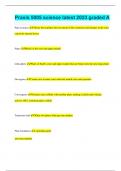
PRAXIS 5005: Science Latest 2023 Rated A
PRAXIS 5005: Science Latest 2023 Rated A Igneous Rock formed when hot magma cools beneath the ground or lava cools above the ground forms crystal like/ glassy rocks ex: granite, pumus, basalt Sedimentary Rock Changed by pressure does not involve heat Usually near water/ involves water sometimes contain fossils forms from previously weathered and erroted material which may have been igneous, sedimentary, rock metamorphic rock. ex: dolemite, limestone, sandstone Metamorphic Rock Has been changed by great heat and pressure altered, partially remelted ex: slate, marble Plate tectonic theory Lithosphere is made up of major and minor plates Sit on viscous (thick fluid) part and move with it Three types of plate boundaires 1. Transform boundaries: they slide past each other causing friction/ earthquakes 2. Divergent boundaries: two plates that pull away from each other/ creates new crust 3. Convergent boundaries: plates push into each other/ one goes under called subduction The atmosphere is composed of 78% nitrogen 21 % oxygen List earths atmosphere layers in order from lowest to highest. Troposphere Stratosphere Mesosphere Thermosphere Exosphere Moon phase: waxing Two weeks where the moon goes from a new moon to a full moon After a full moon the moon is Waning What type of cells are animal and plant cells Eukaryotic Eukaryotic cells have a Nucleus Mendels laws are the laws of Segregation (each parent contributes half) and the law of independent assortment (traits are passed randomly) Natural selection The theory developed by Darwin that traits help give a species a survival advantage are passed on to generations Heterotrophs feed off of a host can only consume food/ cannot produce their own the number of protons in the nucleus determines the atomic number of the element atoms with neutral charge have an atomic number that is equal to the number of electrons Atomic mass (A) total number of protons(Z) and neutrons(N) in the nucleus A= Z+N Boyle's law Gases contract when pressure is applied to them If temp remains the same so will pressure and and volume ratio Ideal gas law explains the properties of a gas under ideal pressure, volume, and temperature conditions. Conduction form of heat transfer that occurs at the molecular level ex: pan on burner, handle isn't hot at first but then heat transfers Convection heat transfer that occurs through the movement or circulation of fluids heat moves to cooler denser areas ex: boiling water, ocean currents Temperature the average kinetic energy of an objects particle when heat increases so does kinetic energy Heat capacity the amount of heat energy needed to raise the the temp of an object measured in joules Potential energy the amount of energy an object has stored within itself because of its position or orientation Kinetic energy the energy of an object in motion when an object is dropped it converts from potential energy to kinetic energy you can use potential and kinetic energy to calculate velocity of an object during a fall Friction a force that arises as a resistance to motion where two surfaces are in contact. Gravational force a universal force that causes every object to exert a force on every other object Bouyancy density determines if something will sink or float less dense than water = float 3 types of levers 1st: work is in the middle: ex seesaw 2nd: work is at one end: pry bar, wheelbarrow 3rd: work is at one end and the motion is reversed ex: fishing pole, hammer, tweezers Conductors vs Insulators Conductors allow the movement of electrical charge while insulator materials prevent the movement of electrical charge Blood is an example of a buffer Radiation Transfer of heat by electromagnetic waves What is the largest planet Jupiter- made up of hydrogen gas Half formed sun Lithosphere is made up of The crust and the upper mantle The kidneys Filter blood Dmitri Mendeleev Created the periodic table Bile Made in the liver and breaks down fats To separate salt from sand Boil mixture with water Primary Producers (Autotrophs) Organisms that make their own food sunlight EX: PLANTS Primary Consumers Herbivores Secondary Consumers Carnivores & Omnivores Tertiary Consumers Eat carnivores & omnivores Invertebrates Arthropods, Mollusks, Annelids, coelenterates, starfish & worms Arthropods Insects, spiders & crustacean Mollusks Snails, slugs, mussels & octopuses Annelids Earthworms & Leeches Animals with hollow bones Birds Animals with no teeth Birds, lizards, & frogs Primary succession Formation of a new community where no community has existed. EX: Newly formed volcanic islands Secondary succession Occurs when a community has been destroyed by natural occurrences or human activities. A new community then replaces it. Recovery & renewal When an ecosystem recovers from catastrophic events such as fires, floods, avalanches, landslides, or earthquakes. Succession will take place so long as the essential abiotic element remain to support living things. Succession Natural replacement of one community of living things by another. EX: An untended field of soil will first be inhabited by small plants and insects; when these plants and insects die, their nutrients will be added to the soil, creating rich enough soil to support the life of larger and different plants. Smallest plannet Mercury The ozone is deteriorating because of Bromine and chlorine in addition to chlorofluorocarbons. How to measure acidity Litmus Paper, Probe and Meter Qualities of inner plannets Also known as Terrestrial Planets. Smaller and rockier. Made up of mostly heavy metals such as iron and nickel. Qualities of outer plannets Also known as Jovian Planets or Gas Giants. Mainly composed of hydrogen and helium Pituitary Gland major endocrine gland responsible for growth Fossils are formed when organisms are buried by sediment. As more sediment is deposited, the sediment surrounding the organism is compacted, forming sedimentary rock that contains fossils. Metal attracted to magnets Nickel, iron, cobalt Troposphere Sphere where weather occurs Stratosphere Sphere where ozone is located within Sublimation The chane from a solid to a gas Condensation The change from a gas to a liquid Glands involved in homestasis Sweat glands, lungs, kidneys Examples of communicable diseases pneumonia, HIV/AIDS, tuberculosis (TB), malaria, measles, STD's Classification of life Domain > Kingdom > Phylum > Class > Order > Family > Genus > Species-(Dumb King Phillip Came Over From German Soil) Controlling the internal environment homeostasis Mutations Random errors in gene replication that lead to a change in the sequence of nucleotides. The source of all genetic diversity. (Changes in DNA) Adaptation An inherited behavior or physical characteristic that helps an organism survive and reproduce in its environment Main causes for extinction Climate change & Habitat destruction If earth began 12 midnight & it is currently 11:59, when did humans arrive? 11:59 Traits pass through proteins?
Written for
- Institution
- PRAXIS 5005: Science
- Course
- PRAXIS 5005: Science
Document information
- Uploaded on
- October 19, 2023
- Number of pages
- 12
- Written in
- 2023/2024
- Type
- Exam (elaborations)
- Contains
- Questions & answers
Subjects
-
praxis 5005 science latest 2023 rated a

Also available in package deal