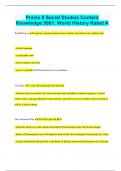
Praxis II Social Studies Content Know ledge 5081: World History Rated A World History ✔✔examines common patterns across nations and cultures on a global scale - written language - a geographic state - metal weapons and tools - use of a calendar ✔✔Characteristics of a civilization City-State ✔✔- were self -ruling and self -sufficient - different from one another, but some unifying traits included a common language, a shared belief system, and agriculturally based economy, and rule by several wealthy citizens instead of rule by a king or queen Greco -Persian Wars ✔✔499 BCE and 449 BCE - pitted the Greek city -states against the mighty Persian Empire after the Persian Empire - Battle of Thermoplylae were 300 Spartans held off the elite contingent Persian army for 2 days - Greeks defeated the Persian fleet at the Battle of Mycale and forced the Persians out of Europe Poloponnesian War ✔✔404 BCE Sparta crushed Athens King Philip II of Macedon ✔✔conquered the Greek city -states, ultimately achieved at the Battle of Chaeronea in 338 BCE, and establish the first centralized Greek state in ancient history Persian Empire ✔✔- Established: 550 BC by Cyrus the Great - stretched from Eastern Europe to Central and South Asia - consisted of multiple countries, religions, languages, and races governe d by a central government Myura Empire ✔✔- India - ruling from 322 to 185 BCE - the centralized government was made up of 4 provinces organized under one capital Mandate of Heaven ✔✔meaning a country's people believed the rulers of the land were put in place by a higher being that could not be disposed
Exam (elaborations)
Praxis II Social Studies Content Knowledge 5081: World History Rated A
Rating
Sold
-
Pages
8
Grade
A+
Uploaded on
19-10-2023
Written in
2023/2024
Praxis II Social Studies Content Knowledge 5081: World History Rated A World History examines common patterns across nations and cultures on a global scale - written language - a geographic state - metal weapons and tools - use of a calendar Characteristics of a civilization City-State - were self-ruling and self-sufficient - different from one another, but some unifying traits included a common language, a shared belief system, and agriculturally based economy, and rule by several wealthy citizens instead of rule by a king or queen Greco-Persian Wars 499 BCE and 449 BCE - pitted the Greek city-states against the mighty Persian Empire after the Persian Empire - Battle of Thermoplylae were 300 Spartans held off the elite contingent Persian army for 2 days - Greeks defeated the Persian fleet at the Battle of Mycale and forced the Persians out of Europe Poloponnesian War 404 BCE Sparta crushed Athens King Philip II of Macedon conquered the Greek city-states, ultimately achieved at the Battle of Chaeronea in 338 BCE, and establish the first centralized Greek state in ancient history Persian Empire - Established: 550 BC by Cyrus the Great - stretched from Eastern Europe to Central and South Asia - consisted of multiple countries, religions, languages, and races governed by a central government Myura Empire - India - ruling from 322 to 185 BCE - the centralized government was made up of 4 provinces organized under one capital Mandate of Heaven meaning a country's people believed the rulers of the land were put in place by a higher being that could not be disposed Silk Road Opened up trade routes between China and the rest of the world that some technology, culture, and ideas began to influence the West Roman Empire - advancements in literature, technology, architecture, urban planning, and hygiene influenced the future of Western Civilization - One of the greatest empires to ever exist Middle Ages - a period from the 5th century to the 15th - beginning with the fall of Roman and ending with the Renaissance and Age of Exploration - There was sharp population decline, intensely localized governance, frequent invasions, famine, and disease defined this era Renaissance Man a person who achieved mastery in many forms of subjects - Leonardo da Vinci The Renaissance - meaning rebirth - began in the 14th century in Italy and spread throughout Europe during the 15th century - reason and knowledge were highly valued Johannes Gutenberg Who invented movable type in 1439? Martin Luther nailed his famous Ninety-Five Theses or Disputation on the Power of Indulgences to the door of the cathedral in Wittenberg, Germany Peace of Augsburg which allowed rulers to decide which religion their kingdom would follow Thirty Years' War - broke out in 1618 and became one of the most destructive wars in European history - a war of political and religious hostility that would involve Germany, Denmark, France, Austria, Spain, and Sweden - ended in 1648 with the Peace of Westphalia The Enlightenment - known as the Age of Reason - the men were capable of improving the world, including themselves, through rational thinking - placed a heavy emphasis on individualism and rationalism Mayflower Compact - detailed the plan for a colony founded in fair and just laws, offering citizenship to adult males - is unique in that it provided one of the first forms of self-government in the colonies Pilgrims an English religious group of Anglican and Separatists, settled in the Cape Cod Bay are of Massachusetts and drew up their own plans for governing their colony - New England - Middle Colonies - Southern Colonies The three sections of colonies in America The Stamp Act Congress - sent their grievances to King George III of England - the Stamp Act was repealed, Parliament issued a law making it clear that the colonies were under the British government's rule Coercive Act - known as "Intolerable Acts" in America - these acts only served to unify the colonies and as a result the First Continental Congress in 1774 issued a formal complaint First Continental Congress - 1774 issued a formal complaint - response from King George III and Parliament was to increase troops in the colonies Second Continental Congress colonies (again) petitioned the king, sending the Olive Branch Petition to King George July 4, 1776 When was the Declaration of Independence adopted? Declaration of the Right of Man and of the Citizen which defined the natural right of men to be free and equal under the law Girondists liberal republics during the French Rev Jacobins radical revolutionaries during the French Rev Reign of Terror a period of mass executions after the French Rev Napoleon Bonaparte - consolidated power after becoming famous for his heroism during the revolutionary wars - 1804 declared himself emperor and remilitarized France Napoleonic Wars - A French leader conquered most of Europe in a series of global conflicts - War started in 1803 ending with the defeat of the French in the Battle of Waterloo in 1815 Congress of Vienna - November 1814 to June 1815 - carved out new territories, changing the map of Europe Haitian Revolution - 1791 - was the largest slave uprising since the Roman Empire - only slave uprising to establish a slave-free nation ruled by nonwhites and former slaves Monroe Doctrine - US President James Monroe wrote this document - it states that the Americas could no longer be colonized World War I This event trigged which war? - 1914 - Gavrilo Princip, a Serb Patriot, assassinated Archduke Franz Ferdinand, heir presumptive to the throne of Austria-Hungary - Emperor Franz Joseph I of Austria-Hungry declared war on the kingdom of Serbia The Great War or WWI - 1914 to 1918 - the deadliest war in European history until WWII Marshal Plan a grant of American subsidies to help Europe and Japan recover economically The Great Awakening a religious revival in colonial America during the 1730s and 1740s, contributed to the American Revolution by encouraging people to challenge authority in their pursuit of salvation
Show more
Read less
Institution
Praxis II Social Studies Content Knowledge 5081
Course
Praxis II Social Studies Content Knowledge 5081
Whoops! We can’t load your doc right now. Try again or contact support.
Written for
- Institution
- Praxis II Social Studies Content Knowledge 5081
- Course
- Praxis II Social Studies Content Knowledge 5081
Document information
- Uploaded on
- October 19, 2023
- Number of pages
- 8
- Written in
- 2023/2024
- Type
- Exam (elaborations)
- Contains
- Questions & answers
Subjects
-
praxis ii social studies content knowledge 5081 w
Content preview
$9.99
Get access to the full document:
100% satisfaction guarantee
Immediately available after payment
Both online and in PDF
No strings attached

Also available in package deal
Package deal
Praxis 5081 Bundled Exams Questions and Answers (2023/2024) (Complete and Accurate)
20
2023
$ 212.80
More info