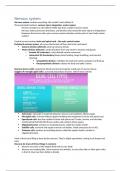
Nervous system
Nervous system controls everything. We couldn’t exist without it.
Three principal functions: sensory input, integration, motor output.
Sensory receptors on skin detect 8 little legs from a spider (sensory input)
Nervous system processes that input, and decides what should be done about it (integration)
Response that occurs when your nervous system activates certain parts of your body (motor
output).
Central nervous system: brain and spinal cord – the main control center
Peripheral nervous system: all nerves that branch off from the brain (and spine).
Sensory division (afferent): picks up sensory stimuli.
Motor division (efferent): sends directions from your brain to muscles and glands.
o Somatic NS (voluntary): rules skeletal muscle movement.
o Autonomic NS (involuntary):keeps heart beating, longs breathing, and stomach
churning.
Sympathetic division: mobilizes the body into action and gets it all fired up
Parasympathetic division: relaxes the body and talks it down.
Neurons (nerve cells): respond to stimuli and transmit signals. Small part of nervous tissue.
Gaggles of neuroglia (glial cells): surround and protect neurons. Half of mass of brain.
Astrocytes: exchange of materials between neurons and capillaries. Blood supply
Microglial cells: immune defense against invading microorganisms in brain and spinal cord.
Ependymal cells: they line cavities in brain and spinal cord. Create, secrete, and circulate
cerebrospinal fluid that fills those cavities and cushions those organs.
Oligodendrocytes: produce an insulating barrier called the myelin sheath.
Satellite cells: surround and support neuron cell bodies. (what astrocytes do in CNS).
Schwann cells: produce an insulating barrier called the myelin sheath. (similar to
oligodendrocytes).
Most of the heavy lifting is done by the neurons. They’re highly specialized, coming in all shapes and
sizes.
Neurons do share all three things in common:
Neurons are some of the longest-lived cells in your body.
Neurons are irreplaceable. (most neurons are amitotic, so once they take on their given roles
in the NS, they lose their ability to divide).
, Neurons have huge appetites. (they have a crazy-high metabolic rate. About 25% of the
calories that you take in every day are consumed by your brain’s activity)
Neurons also share the same basic structure.
Soma (cell body): the neuron’s life support. It’s got all the normal cell goodies like a nucleus,
and DNA, mitochondria, ribosomes, cytoplasm.
Dendrites: the bushy, branch-like things projecting out from the soma. They’re the listeners –
they pick up messages, news, gossip from other cells and convey that information to the cell
body.
Axon: like the talker. This long extension, or fiber, can super short, or run a full meter from
your spine down to your ankle. Transmit electrical impulses away from the cell body to other
cells. Not all the same. To classify them we look at how many processes extend out from the
cell body.
Multipolar neurons: 99% is. Three or more processes (projecting part of an organic structure) sticking
out from the soma – including one axon, and a bunch of dendrites.
Bipolar neurons: two processes – an axon and a single dendrite – extending from opposite.
Unipolar neurons: one process. Found mostly in your sensory receptors.
Function: which way an impulse travels through a neuron in relation to the brain and spine.
Sensory neurons: pick up messages and transmit impulses from sensory receptors and send
them toward the CNS. Most are unipolar
Motor neurons: the opposite of sensory neurons. They’re mostly multipolar, and transmit
impulses away from the CNS and out to your body’s muscles and glands.
Interneurons (association neurons): live in the CNS. Transmit impulses between those
sensory and motor neurons. Mostly multipolar.
Neurons
Neurons send all the impulses responsible for every actions, thoughts, and emotions
When a neuron is stimulated enough, it fires an electrical impulse that zips down its axon to its
neighboring neurons.
They only got one signal they can send, and it only transmits at one uniform strength and
speed.
They can vary the frequency or number of pulses.
Action potential: the nerve impulse.
Electricity: body is electrically neutral, but certain areas are more positively or negatively charged
than others. We need barriers or membranes to keep positive and negative charges separate until
we’re ready to use the energy that their attraction creates.
We keep positive and negative separated to build potential.
Neuron needs an event to trigger the action that brings those negative and positive charges
together. (neuron is like a battery)
Nervous system controls everything. We couldn’t exist without it.
Three principal functions: sensory input, integration, motor output.
Sensory receptors on skin detect 8 little legs from a spider (sensory input)
Nervous system processes that input, and decides what should be done about it (integration)
Response that occurs when your nervous system activates certain parts of your body (motor
output).
Central nervous system: brain and spinal cord – the main control center
Peripheral nervous system: all nerves that branch off from the brain (and spine).
Sensory division (afferent): picks up sensory stimuli.
Motor division (efferent): sends directions from your brain to muscles and glands.
o Somatic NS (voluntary): rules skeletal muscle movement.
o Autonomic NS (involuntary):keeps heart beating, longs breathing, and stomach
churning.
Sympathetic division: mobilizes the body into action and gets it all fired up
Parasympathetic division: relaxes the body and talks it down.
Neurons (nerve cells): respond to stimuli and transmit signals. Small part of nervous tissue.
Gaggles of neuroglia (glial cells): surround and protect neurons. Half of mass of brain.
Astrocytes: exchange of materials between neurons and capillaries. Blood supply
Microglial cells: immune defense against invading microorganisms in brain and spinal cord.
Ependymal cells: they line cavities in brain and spinal cord. Create, secrete, and circulate
cerebrospinal fluid that fills those cavities and cushions those organs.
Oligodendrocytes: produce an insulating barrier called the myelin sheath.
Satellite cells: surround and support neuron cell bodies. (what astrocytes do in CNS).
Schwann cells: produce an insulating barrier called the myelin sheath. (similar to
oligodendrocytes).
Most of the heavy lifting is done by the neurons. They’re highly specialized, coming in all shapes and
sizes.
Neurons do share all three things in common:
Neurons are some of the longest-lived cells in your body.
Neurons are irreplaceable. (most neurons are amitotic, so once they take on their given roles
in the NS, they lose their ability to divide).
, Neurons have huge appetites. (they have a crazy-high metabolic rate. About 25% of the
calories that you take in every day are consumed by your brain’s activity)
Neurons also share the same basic structure.
Soma (cell body): the neuron’s life support. It’s got all the normal cell goodies like a nucleus,
and DNA, mitochondria, ribosomes, cytoplasm.
Dendrites: the bushy, branch-like things projecting out from the soma. They’re the listeners –
they pick up messages, news, gossip from other cells and convey that information to the cell
body.
Axon: like the talker. This long extension, or fiber, can super short, or run a full meter from
your spine down to your ankle. Transmit electrical impulses away from the cell body to other
cells. Not all the same. To classify them we look at how many processes extend out from the
cell body.
Multipolar neurons: 99% is. Three or more processes (projecting part of an organic structure) sticking
out from the soma – including one axon, and a bunch of dendrites.
Bipolar neurons: two processes – an axon and a single dendrite – extending from opposite.
Unipolar neurons: one process. Found mostly in your sensory receptors.
Function: which way an impulse travels through a neuron in relation to the brain and spine.
Sensory neurons: pick up messages and transmit impulses from sensory receptors and send
them toward the CNS. Most are unipolar
Motor neurons: the opposite of sensory neurons. They’re mostly multipolar, and transmit
impulses away from the CNS and out to your body’s muscles and glands.
Interneurons (association neurons): live in the CNS. Transmit impulses between those
sensory and motor neurons. Mostly multipolar.
Neurons
Neurons send all the impulses responsible for every actions, thoughts, and emotions
When a neuron is stimulated enough, it fires an electrical impulse that zips down its axon to its
neighboring neurons.
They only got one signal they can send, and it only transmits at one uniform strength and
speed.
They can vary the frequency or number of pulses.
Action potential: the nerve impulse.
Electricity: body is electrically neutral, but certain areas are more positively or negatively charged
than others. We need barriers or membranes to keep positive and negative charges separate until
we’re ready to use the energy that their attraction creates.
We keep positive and negative separated to build potential.
Neuron needs an event to trigger the action that brings those negative and positive charges
together. (neuron is like a battery)