What is schizophrenia:
AO1:
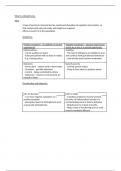
- A type of psychosis characterised by a profound disruption of cognition and emotion, so
that contact with external reality and insight are impaired
- Affects around 1% of the population
Symptoms:
Positive symptoms - (in addition to normal Negative symptoms – (atypical experiences
experiences) which are a loss of a normal experience)
Hallucinations: Avolition:
- Can be auditory or visual - The lack of willingness or inability to start
- False perceptions with no basis in reality and continue with goal-directed behaviour
- E.g., hearing voices - Low activity levels and low motivation
Delusions: Speech poverty:
- Persecution – others want to harm them - Limited speech output
- Grandeur – god-like individual - Delay in time taken to produce words
- Control – Being controlled by others
- Reference – Events in environment are
related to them
Classification and diagnosis:
ICD-10: (Europe) DSM-5: (USA)
- 2 or more negative symptoms or 1 - 2 positive symptoms must be present,
positive symptom but only 1 if hallucinations consist of a
- Recognises types of Schizophrenia such commentating voice or bizarre delusions
as paranoid schizophrenia - Disturbance for at least 6 months
- Major areas of functioning such as work
must be markedly different
, Evaluate issues associated with the classification and / or diagnosis of schizophrenia:
AO1:
DSM-5: (USA)
Issues – Reliability and validity of diagnosis and - 2 positive symptoms must be
classification present, but only 1 if hallucinations
consist of a commentating voice or
bizarre delusions
- Disturbance for at least 6 months
- Major areas of functioning such as
work must be markedly different
Key Idea Explanation
Reliability Level of consistent agreement between
researchers, inter-rater reliability (80%)
Test-retest reliability – across time periods
Validity The extent to which schizophrenia is a unique
syndrome with characteristics, signs and
symptoms specific to it
Culture Bias - Reliability In the WI and Africa Sz rates are low, however
those of African American decent in the West
are more likely to be diagnosed
Imposed etic – imposing Western viewpoints
and expectations onto other cultures
Gender Bias - Reliability Gender-biased diagnosing criteria,
androcentric, women may be better at
functioning with a syndrome than men
Co-morbidity – Validity The extent to which two diseases can occur
together
AO3:
Culture bias – Copeland (1971) gave the same patient description to both US and UK psychiatrists,
2% of UK diagnosed Sz, whereas 69% of US diagnosed Sz, low inter-rater reliability, no consistent
decisions, could lead to incorrect diagnosis which Ketter (2005) found can lead to suicide,
disproportionate effect on some cultures – trying to solve it using more categories in DSM-5
Co-morbidity – Support: Buckley et al. (2009) found that around half of patients with Sz had
depression (47% had drug abuse), less likely to tell the difference due to co-morbidity with OCD and
PTSD – supports the fact that co-morbidity can cause misdiagnosis - Contradiction: Serper et al.
(1999) found that patients with Sz and cocaine abuse were able to be accurately diagnosed with Sz
Gender bias – Androcentric diagnostic criteria – Longenecker et al. (2010) found that since the
1980’s men have been diagnosed more than women despite no prior difference – Loring and Powell
(1988) studied 290 psychiatrists and found that when given a description of a man 56% gave a Sz
diagnosis, compared to 20% for the description of a woman
AO1:
- A type of psychosis characterised by a profound disruption of cognition and emotion, so
that contact with external reality and insight are impaired
- Affects around 1% of the population
Symptoms:
Positive symptoms - (in addition to normal Negative symptoms – (atypical experiences
experiences) which are a loss of a normal experience)
Hallucinations: Avolition:
- Can be auditory or visual - The lack of willingness or inability to start
- False perceptions with no basis in reality and continue with goal-directed behaviour
- E.g., hearing voices - Low activity levels and low motivation
Delusions: Speech poverty:
- Persecution – others want to harm them - Limited speech output
- Grandeur – god-like individual - Delay in time taken to produce words
- Control – Being controlled by others
- Reference – Events in environment are
related to them
Classification and diagnosis:
ICD-10: (Europe) DSM-5: (USA)
- 2 or more negative symptoms or 1 - 2 positive symptoms must be present,
positive symptom but only 1 if hallucinations consist of a
- Recognises types of Schizophrenia such commentating voice or bizarre delusions
as paranoid schizophrenia - Disturbance for at least 6 months
- Major areas of functioning such as work
must be markedly different
, Evaluate issues associated with the classification and / or diagnosis of schizophrenia:
AO1:
DSM-5: (USA)
Issues – Reliability and validity of diagnosis and - 2 positive symptoms must be
classification present, but only 1 if hallucinations
consist of a commentating voice or
bizarre delusions
- Disturbance for at least 6 months
- Major areas of functioning such as
work must be markedly different
Key Idea Explanation
Reliability Level of consistent agreement between
researchers, inter-rater reliability (80%)
Test-retest reliability – across time periods
Validity The extent to which schizophrenia is a unique
syndrome with characteristics, signs and
symptoms specific to it
Culture Bias - Reliability In the WI and Africa Sz rates are low, however
those of African American decent in the West
are more likely to be diagnosed
Imposed etic – imposing Western viewpoints
and expectations onto other cultures
Gender Bias - Reliability Gender-biased diagnosing criteria,
androcentric, women may be better at
functioning with a syndrome than men
Co-morbidity – Validity The extent to which two diseases can occur
together
AO3:
Culture bias – Copeland (1971) gave the same patient description to both US and UK psychiatrists,
2% of UK diagnosed Sz, whereas 69% of US diagnosed Sz, low inter-rater reliability, no consistent
decisions, could lead to incorrect diagnosis which Ketter (2005) found can lead to suicide,
disproportionate effect on some cultures – trying to solve it using more categories in DSM-5
Co-morbidity – Support: Buckley et al. (2009) found that around half of patients with Sz had
depression (47% had drug abuse), less likely to tell the difference due to co-morbidity with OCD and
PTSD – supports the fact that co-morbidity can cause misdiagnosis - Contradiction: Serper et al.
(1999) found that patients with Sz and cocaine abuse were able to be accurately diagnosed with Sz
Gender bias – Androcentric diagnostic criteria – Longenecker et al. (2010) found that since the
1980’s men have been diagnosed more than women despite no prior difference – Loring and Powell
(1988) studied 290 psychiatrists and found that when given a description of a man 56% gave a Sz
diagnosis, compared to 20% for the description of a woman