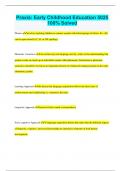
Praxis: Early Childhood Education 5025 100% Solved
Praxis: Early Childhood Education 5025 100% Solved Phonics involves teaching children to connect sounds with letters/groups of letters. Ex.: (K) can be represented by C, K, or CH spellings. Phonemic Awareness An exclusively oral language activity; refers to the understanding that spoken words are made up of individual sounds called phonemes. Instruction in phonemic awareness should be viewed as an important element of a balanced reading program in the early elementary grades. Learning Approach the theory that language acquisition follows the basic laws of reinforcement and conditioning i.e. memorize the rules Linguistic Approach based on letter-sound correspondence Socio-cognitive Approach A language acquisition theory that states that the different aspects of linguistic, cognitive, and social knowledge are interactive elements of total human development. 5 Basic Types of Phonemic Awareness 1. Ability to hear rhymes and alliteration. (ex: kids listens to poem, identifies rhyme words, teacher records words on chart.) 2. Ability to do oddity tasks (ex: recognize number of a set that is different.) 3. Ability to orally blend words and split syllables. 4. Ability to orally segment words (ex: ability to count sounds in a word - "hamburger = ham-bur-ger = 3 sounds) 5. Ability to do phonics manipulation tasks (ex: replace the "r" sound in rose with a "p" sound = pose.) Morphology Refers to its rules for word formation. Are the smallest combination of sounds that have a meaning. Prepositions, prefixes, suffixes, and whole words. Semantics Meaning of words and sentences Syntax Language rules that govern how words can be combined to form meaningful phrases and sentences Pragmatics Describes how context can affect the interpretation of communication. SOCIAL USE OF LANGUAGE ( EX: SAYING WRONG THINGS AT THE WRONG TIME.) 5 Stages of Language Acquisition 1. Acquisition learning hypothesis- difference between learning and acquiring language 2. Monitor hypothesis - Learned language "monitors" acquired language (ex: GRAMMAR CHECKIN) 3. Natural order hypothesis - Learning of grammar - normal "natural order" 4. Input hypothesis - When conversation is on par with language ability. Able to talk in convos and understand convos. 5. Affective filler hypothesis - be able to learn language if more relaxed and not all like, "OMG." Independent Reading Reading level at which students can accurately recognize and comprehend words well enough that no teacher guidance is needed. (95-100% accuracy). Guided Reading A teacher provides support for small, flexible groups of beginning readers. As students read a text or book that is unfamiliar to them, the teacher works with them to teach them how to use a variety of reading strategies. (92%-97% accuracy) Whole Group Reading Entire class will read the same text - teacher incorporates activities for phonics, comprehension, fluency, and vocabulary 5 Critical Areas of Reading Instruction 1. Phonemic awareness : is commonly defined as the understanding that spoken words are made up of separate units of sound that are blended together when words are pronounced. For example, hearing and saying that the word cat has three sounds, or phonemes /k/ /a/ /t/ is an example of phonemic awareness skill. 2.
Written for
- Institution
- Praxis: Early Childhood Education 5025
- Course
- Praxis: Early Childhood Education 5025
Document information
- Uploaded on
- October 19, 2023
- Number of pages
- 54
- Written in
- 2023/2024
- Type
- Exam (elaborations)
- Contains
- Questions & answers
Subjects
-
praxis early childhood education 5025 100 solved

Also available in package deal