Praxis 5038 Literary Devices and Terms 100% Correct
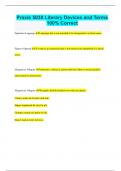
Praxis 5038 Literary Devices and Terms 100% Correct Figurative Language Language that is not intended to be interpreted in a literal sense. Figure of Speech A word or an expression that is not meant to be interpreted in a literal sense. Allegorical, Allegory characters, setting or actions that have ideas or moral qualities represented by abstractions. Allegorical, Allegory Example: Bashful looked over with red cheeks. Clumsy made the kitchen sink leak. Happy brightened the day for all, Grumpy caused our spirits to fall. Sneezy had an itchy red nose. ALLUSION Refer to literary or historical figures to impart symbolism to a thing or person, and or create reader resonance. Is a reference to people places, works or events, in which the author expects and emotional reaction from his audience. ALLUSION Example: It went down like the "Titanic" ANALOGY A comparison made between two things to show the similarities between them. ANALOGY Example: Your Education is the key to a life time of success ANAPHORA Repetition of a word, phrase, or clause at the beginning of word groups occurring one after the other. Concisesly state common beliefs and they may rhyme. ANAPHORA Example: "For everything there is a season . . . a time to be born, and a time to die; a time to plant, and a time to pluck up what is planted.-Ecclesiastes 3:1-18 ANAPHORA Example: Early to bed, early to rise, makes a man healthy, wealthy, and wise. ANECDOTE A little story, often amusing, inserted in an essay or a speech to help reinforce the thesis. A brief story authors may relate, which illustrate their points in a more real way. ANTITHESIS Placement of contrasting or opposing words, phrases, clauses, or sentences side by side. ANTITHESIS Example: The world will little note nor long remember what we say here, but it can never forget what they did here.-Abraham Lincoln, "Gettysburg Address." ASIDE In drama, a short speech spoken by a character in an undertone, to another character or directly to the audience. CHIASMUS Uses parallel clauses, the second reversing the order of the first. CHIASMUS Example: Has the Church failed mankind, or has mankind failed the Church CHIASMUS Ask not what your country can do for you, but what you can do for your country. CONNOTATION The ___________________ of a word is its emotional content. CONNOTATION Example: "Rat" No one likes a snitch you dirty Rat. Using words like home, or hale to illicit an emotional connection to the word. DENOTATION The __________________ of a word is its dictionary "literal" meaning. DENOTATION Example: "Rat" A rat is a rodent. Using words like house, without any emotional attachments or meanings. Diction Author's word choice establishing tone and effects. SIMILE A comparison in which two UNLIKE things are said to be "like" or "as" one another. METAPHOR A comparison in which two UNLIKE things are said to be THE OTHER. Without using "like" or "as." EUPHEMISM A mild word or phrase which substitutes for another harsher word or phrase which is undesirable because it is too direct, unpleasant, or offensive. EUPHEMISM Example: The word "joint" is a _______________ for the word "prison." Deductive Reasoning Moves from general to specific to reach a conclusion Inductive Reasoning Moves from specific to general to reach a conclusion DICTION An author's choice of words; a vital component of the author's style. Colloquialism is a dialect spoken by a specific region or time period. FARCE A type of comedy based on a humorous situation. FARCE Example: A bank robber who robs 1k and was arrested when he returns $600 to the police station because he only needed $400. Hyperbole Is overstatement using exaggerated language. An Exaggeration For a special effect. IDIOM Language peculiar to a region of people. A common shared understanding of words and relationships of those words. IDIOM Example: Don't let the cat out of the bag; IMAGERY Uses one or more of the five senses to paint mental images in the reader's mind. IMAGERY Example: lists of words strung together like: squeaky, lumpy, bed. INFERENCE A conclusion drawn based on something the author implied. INFERENCE Example: I can _________________ he's tall without you saying it at all when you say, "My man was built to play basketball." IRONY Is something that has a surprising twist like turning into an ogre after Fiona and shriek kissed. METONYMY A figure of speech in which one word or phrase is substituted for another with which it is closely associated. A symbol is used to represent an idea. METONYMY Example: The pen is mightier than the sword "Pen" replaces "writing" and "Sword" replaces "fighting." MYTH A legendary or traditional story, usually one concerning a superhuman being. It usually attempts to explain a phenomenon or strange occurrence without regard to fact or common sense and appeals to the emotions rather than reason. MYTH A _____________ is less historical than a legend and usually persists through oral transmission, as do legends and fables. OXYMORON Combines seeming contradictions. Two contradictory words that come together for a special effect. OXYMORON Example: jumbo shrimp, military intelligence, same difference. ONOMATOPOEIA The use of words that sound like the noises that they represent. ONOMATOPOEIA Example: sounds out words like this: boom, bang, screech, rattle, pop, and hiss PARALLEL CONSTRUCTION Grammatically identical or similar construction. PARALLEL CONSTRUCTION Some cried, some wept, some remained hushed, but all felt the loss. PARADOX Is a statement that is true despite appearing contradictory. A statement or proposition that seems self-contradictory or absurd but in reality expresses a possible truth. PARADOX Pinocchio says, "My nose will grow now." PARODY Is a form of Satire that imitates another work to ridicule its topic and or style. PERSONIFICATION Giving Human Qualities to Animals or Inanimate objects. PERSONIFICATION Example: Opportunity knocks, time creeps up on us. PUN A play on words wherein a word is used to convey its different meaning. PUN Noticing the bunch of bananas the hungry gorilla went ape. SARCASM Uses humor to mock a person action or thing. Like saying, "You're brilliant when you messed up everything." Usually done person to person. SATIRE Is a wrting style that ridicules or pokes fun at human foibles or ideas. Usually witty, and often very funny, the purpose of is not primarily HUMOR but criticism of an event, an individual or a group in a clever manner. SATIRE The use of mockery, irony, or wit to attack or ridicule something, such as a habit, idea, or custom that is, or is considered to be, foolish or wrong. SATIRE Example: Your son is undisciplined and abusive-I'm afraid I can only suggest a career in politics. SYLLOGISM refers either to deductive reasoning or deceptive, very sophisticated, or subtle argument. SYMBOL SOMETHING WITH A MEANING GREATER THAN IT'S SUM. SYMBOL Examples: the United States flag, the eagle, and the constitution each are_____________ for peace, liberty, and freedom Technical Language Vocabulary related to a specific discipline, activity or process. Technical Language In fire building using the word "kindling" Understatement Achieves effects like contrast or irony by downplaying or describing something more subtly than warranted. Explicit tells the reader exactly what is meant Implicit Not stated exactly but it is a drawn conclusion based on what the author said.
Written for
- Institution
- Praxis 5038 Literary Devices
- Course
- Praxis 5038 Literary Devices
Document information
- Uploaded on
- October 18, 2023
- Number of pages
- 11
- Written in
- 2023/2024
- Type
- Exam (elaborations)
- Contains
- Questions & answers
Subjects
-
praxis 5038 literary devices and terms 100 correc

Also available in package deal